He claimed she promised the company would repay everything after a property sale.
I did not tell him I believed him.
I asked whether he was willing to repeat the facts to the people reviewing my conviction and the estate.
His eyes moved toward the front window, where Vanessa was watching us.
For a moment, I expected him to retreat.
Then Vanessa opened the door and shouted that Damien had acted alone.
He removed my father’s watch.
He placed it on the porch railing and said, “I’ll tell them what happened.”
His decision did not erase his responsibility.
It did change who still controlled the lie.
The months that followed were slower than any revenge story would admit.
The estate review examined both wills, the lawyer’s file, witness statements, and the history of my father’s decisions during the same period.
The company records were compared with the exhibits from my trial.
The original access ledger showed changes missing from the prosecution’s copy.
The physical approval token records showed that the transactions required access I did not have.
Damien’s statement connected the altered login to the people who had actually used it.
Former employees were interviewed again, and several acknowledged that Vanessa had framed their questions before investigators ever arrived.
One worker had been asked whether I sometimes stayed late.
By the time his answer reached the jury, it sounded as though he had seen me authorizing payments after hours.
Another had testified that I knew the vendor names, which was true because I had flagged two of them as suspicious weeks before my arrest.
The warning email I sent my father had been removed from the company file produced at trial.
A printed copy remained in the workshop drawer beneath the ledger.
That email became the fact that changed the meaning of everything else.
I had not discovered the fraud because I was participating in it.
I had been framed because I was close to exposing it.
At first, I believed my father’s later will was an attempt to compensate me for believing the wrong people.
The final section of his letter showed that his purpose was harder and more honest than that.
He had not changed the will merely to punish Vanessa or reward me.
He had separated ownership from control because he knew the company employed families who had nothing to do with what happened to me.
The voting interest passed to me, but he asked me to keep the company operating long enough for employees and customers to survive the transition.
He did not command me to remain.
He gave me the option to sell after the records were corrected and the workers were protected.
For the first time since my release, I understood why the workshop key had been left with someone outside the family.
My father was not giving me a weapon to use against Vanessa.
He was giving me a choice she could not make for me.
The court reviewing my conviction eventually vacated it after the prosecutor agreed that the original case had relied on altered business records and incomplete access evidence.
The charge was dismissed after the remaining records were authenticated and the people responsible for the accounts were identified.
No speech could return the three years I lost.
Still, hearing the judge state that the conviction could no longer stand loosened something in my chest that I had carried through every locked door inside.
The estate decision came later.
The later will was accepted, Vanessa lost control of the company shares, and her claim that the house belonged entirely to her failed.
She was permitted the temporary occupancy my father had written into the document, nothing more.
I could have demanded that she leave as soon as the process allowed.
Instead, I gave her the full period my father had provided and required a documented inventory of every item removed from the house.
It was not forgiveness.
It was a boundary clear enough that neither of us could rewrite it later.
Vanessa left before the deadline without saying goodbye.
The silk robe remained hanging in my father’s closet.
Damien cooperated with the investigations into the company transactions, but cooperation did not turn us back into brothers.
When he asked whether we could start over, I told him the truth.
“Not yet.”
He nodded and left my father’s watch on the study desk.
I did not put it on.
Some things could be returned without being reclaimed.
I kept Hale Manufacturing open.
The first change I made was not putting my name on the building or moving into my father’s office.
I invited the employees into the break room, showed them what records had been altered, and explained which parts of the company were stable and which were not.
No one applauded.
They asked about payroll, health coverage, customer orders, and whether their jobs would still exist by winter.
Those were the questions my father had expected me to answer.
We sold unused equipment, ended the false vendor accounts, and created a two-person approval rule for every large payment.
I moved my desk into the old workshop while the company recovered.
The room was quieter than the main office, and the framed fishing photograph fit on the shelf above the workbench.
I eventually found my father’s grave using the information the lawyer recovered from the burial records.
The stone was plain.
Vanessa had chosen an inscription about devotion, but there was nothing on it about the son he had spent his final months trying to defend.
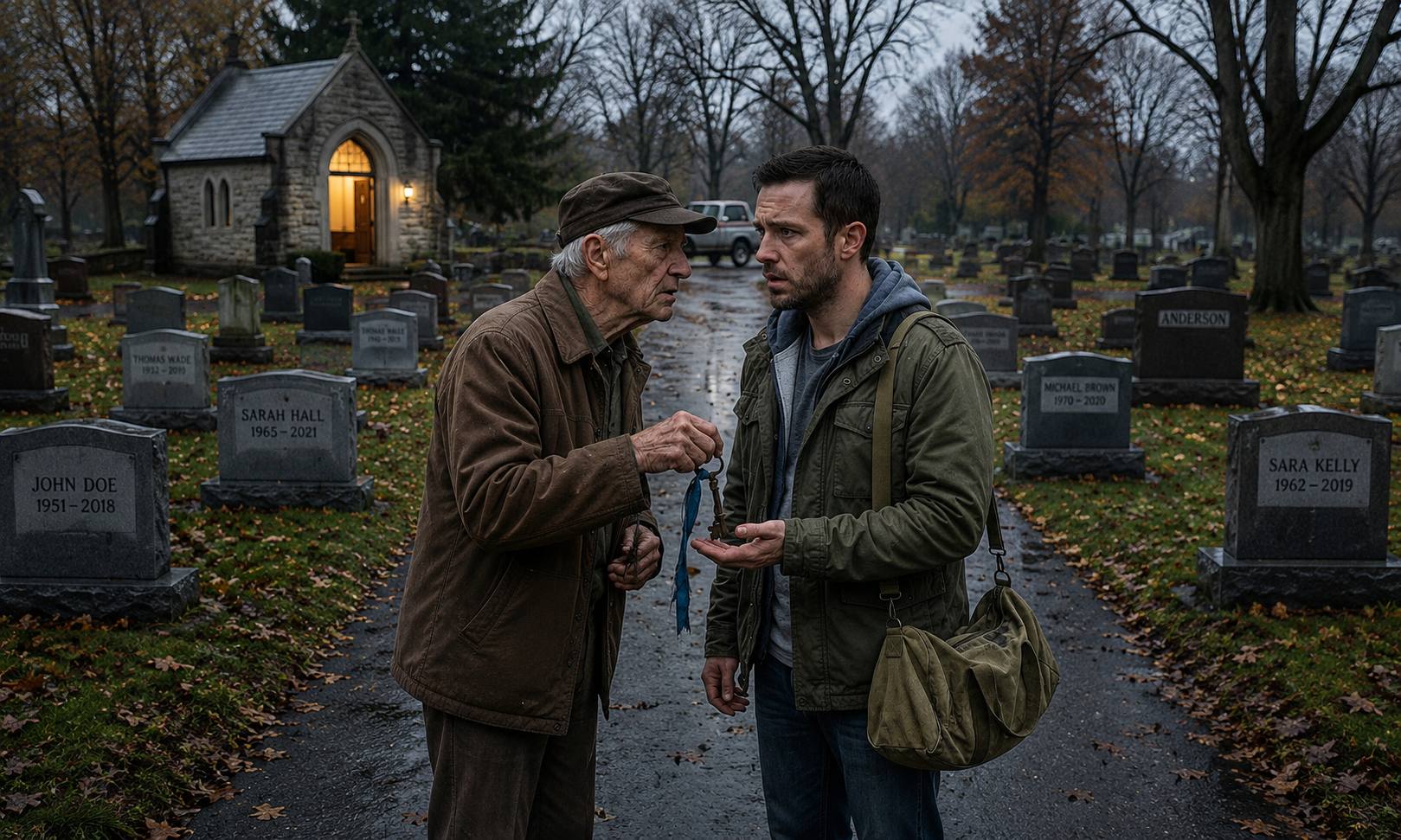
I stood there with the caretaker beside me and read the last page of Dad’s letter again.
The caretaker asked whether I had decided what the key meant.
I looked at the faded blue ribbon, now frayed from months in my pocket.
“At first, I thought it meant the house was mine,” I said.
“And now?”
“It means he trusted me to decide which doors should stay open.”
The following Monday, I arrived at the workshop before the morning shift.
I replaced the rusted lock, made two new copies, and gave one to the employee responsible for opening the floor each day.
Then I tied the original iron key to a fresh blue ribbon and hung it on the wooden hook beneath my father’s photograph.
It was no longer hidden in a coat, buried in a drawer, or carried like evidence.
Every morning, I used it to open the workshop door before the first employees arrived, and every evening, I returned it to the same hook where anyone I trusted could see exactly where it belonged.