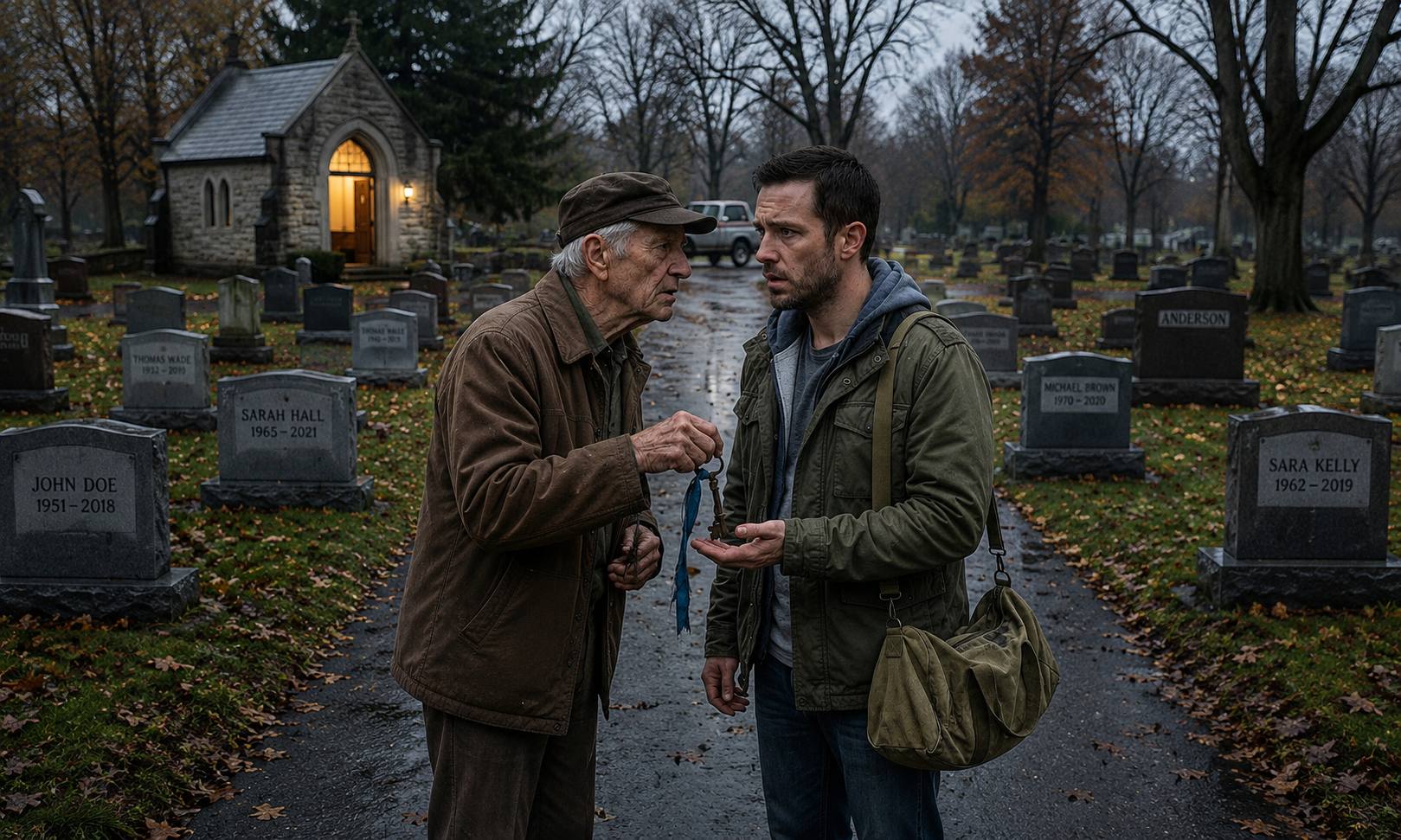
The caretaker did not release my wrist until he was certain I understood him.
“Your father knew they framed you,” he repeated, quieter this time.
The old iron key pressed into my palm, its teeth biting into skin that had grown rough from three years of prison work assignments.
I looked from the key to the rows of headstones behind him.
“If he knew, why didn’t he tell anyone?”
“He tried,” the caretaker said. “But first he had to find something people couldn’t dismiss as a grieving father protecting his son.”
Rain began tapping against the chapel roof as he led me beneath the narrow overhang.
He told me my father had started coming to Evergreen Cemetery eighteen months earlier, long before there was any reason for him to visit his own future grave.
He would sit on a bench near the stone chapel with a blue notebook on his knee, studying company records until the light disappeared.
At first, the caretaker assumed he was working.
Then one evening my father asked whether a person could survive learning that his certainty had destroyed someone he loved.
The caretaker had not known what he meant.
Six months later, my father returned with the iron key tied to the faded blue ribbon and gave him a single instruction.
“If Daniel comes looking for my grave, give him this before anyone tells him where I’m buried.”
My throat tightened.
“Where is he buried?”
The caretaker looked toward the darkening road beyond the cemetery gates.
“Not here.”
Vanessa had arranged a private burial outside the county and told almost no one where it was.
She had not simply kept me from the funeral.
She had made sure I could not find him afterward.
The caretaker reached into his coat again and handed me a folded piece of paper protected inside a clear plastic sleeve.
It contained directions in my father’s handwriting to the old workshop behind Hale Manufacturing, the company he had built before I was born.
I knew the place immediately.
It was where he taught me how to rebuild a carburetor, balance an account ledger, and tell when someone was lying by watching what their hands did after they finished speaking.
The workshop had been locked for years, even before my arrest.
According to the caretaker, my father reopened it during the final months of his life and went there nearly every night.
By the time we reached the industrial road, the rain had become steady enough to blur the security lights along the company fence.
The main building was dark, but a weak yellow bulb still burned above the workshop door.
The iron key turned on the first try.
The room smelled of sawdust, cold metal, and the citrus hand cleaner my father kept beside the utility sink.
Nothing had been arranged for drama.
There was no wall of photographs, no hidden vault, and no final message waiting beneath a spotlight.
There was only his workbench, his cracked coffee mug, and a gray steel tool cabinet with a strip of faded blue tape across the top drawer.
The same shade of blue as the ribbon around the key.
Inside the drawer sat three ordinary objects: a bound ledger, a thick envelope, and the framed photograph of Dad and me fishing at Lake Mercer.
Unlike the copy in Vanessa’s hallway, this one was standing upright.
My hands began shaking before I opened the envelope.
The first page was a letter.
Daniel,
If you are reading this, then I failed to finish what I started.
I believed the evidence against you because it came from inside my own company, and I trusted the people who placed it in front of me.
That was my first failure.
My second was waiting until I could prove everything before asking you to forgive me.
I sat down on the shop stool because my knees would no longer hold me.
The letter continued for six pages.
My father explained that he had discovered the first contradiction while reviewing an insurance audit after my conviction.
One of the transfers I had supposedly authorized used an approval code generated from the physical security token kept inside his locked desk.
At the time of that transfer, I had been working at the loading dock with six employees who later testified only that they had seen me earlier that afternoon.
The prosecution had shown the jury my username, my password history, and a printed approval bearing my initials.
They had never shown that the security token required for the final authorization had remained in my father’s office.
The bound ledger contained the original maintenance entries for the office alarm and door system.
On the night of the transfer, someone had entered my father’s office using the family override code assigned to Vanessa.
A second transfer was approved two days later, after my company access had supposedly been disabled.
The printed access report introduced at trial showed that my login had remained active.
The original handwritten shutdown record in the ledger showed something else: Damien had asked the systems contractor to reactivate it less than an hour after it was suspended.
The contractor’s initials appeared beside the change.
So did Damien’s signature.
The pages did not rely on one miracle document.
Purchase orders carried carbon impressions that did not match the copies used at trial.
Delivery receipts listed truck numbers belonging to vehicles the company had sold months earlier.
Several invoices were approved on weekends when I was visiting a customer site more than a hundred miles away, a trip confirmed by fuel receipts, handwritten gate logs, and the date stamped on the customer’s receiving form.
Someone had assembled the fraud carefully enough to survive a quick investigation.
My father had taken it apart slowly enough to expose the seams.
At the bottom of the envelope was a later will, signed two months after the will Vanessa had quoted to me at the front door.
It did not leave everything to her.
It gave Vanessa a fixed financial bequest and temporary use of the house, but the house itself and my father’s controlling interest in Hale Manufacturing passed to me.
The document had been witnessed outside the family and prepared by the same lawyer who had handled the company’s earliest contracts.
Attached to it was proof that a copy had been placed with the lawyer for safekeeping.
Vanessa had either never known that copy existed or had been unable to reach it.
For a few minutes, I thought the story was simple.
Vanessa and Damien had framed me, my father had uncovered the truth, and the key had led me to everything I needed to take back my name, the house, and the company.