That morning, I made a decision.
I would enjoy my trip without apologizing for it.
The days that followed became some of the most beautiful of my life.
I explored old neighborhoods with Bonnie. I tasted pastries I couldn’t pronounce. I walked along the waterfront and visited places Martin had once circled in travel magazines.
Every evening, I sent photographs to the family group chat.
Daisy loved the trams.
Ben wanted to know whether the ocean was bigger than the one he had seen on television.
Lucy asked about the buildings.
And Owen sent me a private message.
Grandma, I hope you’re having fun. You deserve it.
I read that sentence several times.
Then I saved it.
Not because I needed permission to enjoy myself, but because it reminded me that the next generation was watching how we treated one another.
Perhaps Owen would grow up understanding something his father had forgotten: loving family members did not mean owning their time.
Meanwhile, Adam’s messages gradually changed.
At first, they were complaints about the arrangements.
Then came questions about the children’s schedules.
Finally, on my eighth day in Portugal, he sent me a message that made me stop walking.
Mom, can we talk when you get home? Not about childcare. About us.
I replied:
Yes. I’m willing to talk.
For the rest of the day, I wondered what he wanted to say.
But I refused to let uncertainty steal another moment from my vacation.
On my last evening in Lisbon, I stood at the viewpoint where I had taken my first photograph.
The sky turned gold, then pink, then a deep shade of purple.
I held Martin’s photograph in my hand.
“We finally made it,” I whispered.
And for the first time, the words didn’t feel like a farewell.
They felt like a beginning.
The Ending: The Mother Who Finally Learned to Say No
When I returned home, Adam was waiting on my porch.
He stood when my shuttle pulled into the driveway.
For a moment, I saw the little boy who used to run toward me after school, his backpack bouncing against his shoulders.
Then I saw the grown man who had left four children in my kitchen and expected me to cancel a dream.
“Hi, Mom,” he said.
“Hello, Adam.”
He picked up my suitcase and carried it inside.
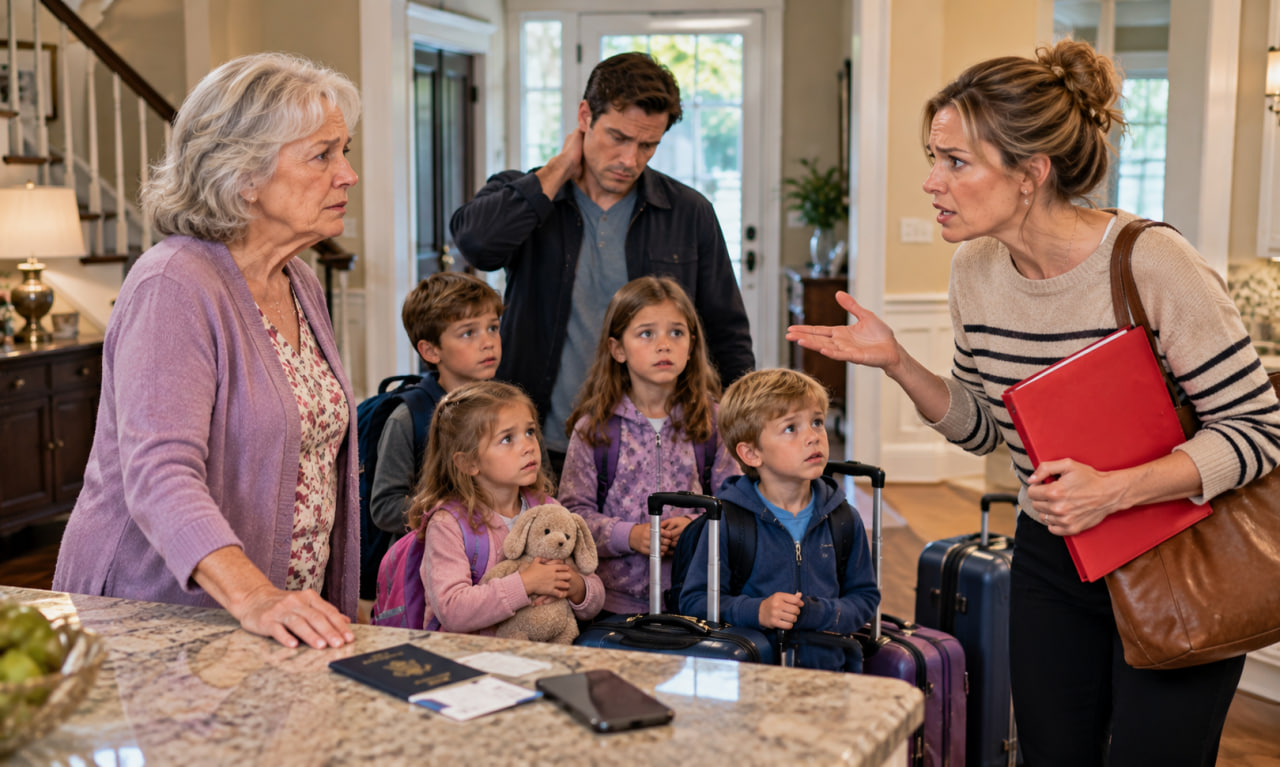
The house looked exactly as I had left it. The blue flowers in the kitchen vase had begun to wilt, and the red folder was still on the counter.
Adam stared at it.
“I should have asked you,” he said quietly.
I put my purse down.
“Yes, you should have.”
He swallowed.
“Kelsey and I argued about it after we got home. She thought you’d eventually agree because you always do.”
I waited.
“I thought so, too.”
That confession hurt more than I expected.
“Why?”
He rubbed his forehead.
“Because you’ve always been there. Whenever we needed help, you came. I never stopped to think about what it cost you.”
I sat down.
“Do you know what hurt the most?”
He shook his head.
“It wasn’t the childcare. It wasn’t even the way Kelsey spoke to me. It was realizing that you had both made plans for my life without considering that I might have plans of my own.”
Adam’s eyes filled with tears.
“I am sorry, Mom.”
This time, he didn’t add an excuse.
He didn’t tell me that I was overreacting.
He didn’t remind me that I was his mother.
He simply sat across from me and let the apology stand on its own.
After a while, he said, “The kids had a good time with Joan and Marissa. Everything worked out. But I kept thinking about what you said on the phone.”
“What did I say?”
“That loving us doesn’t mean you have to surrender your life.”
I nodded.
“I meant it.”
“I know.”
He looked down at his hands.
“I don’t want my children growing up believing that people who love them aren’t allowed to say no.”
For the first time since that terrible morning, I felt my anger begin to loosen.
Not disappear.
Loosen.
Because forgiveness was not pretending nothing had happened. It was allowing someone the opportunity to become better while still remembering what needed to change.
“Then show them,” I said. “Don’t just tell them you’re sorry. Ask before making plans for other people. Respect the answer, even when you don’t like it. And don’t teach your children that Grandma’s love means Grandma must always be available.”
He nodded.
“I will.”
Then he reached into his jacket and handed me a small envelope.
Inside was a photograph of my four grandchildren sitting together on Joan’s sofa. Daisy was holding a drawing of a yellow tram.
On the back, in uneven handwriting, she had written:
Dear Grandma, I’m happy you went to Portugal. Next time, can I come with you? Love, Daisy.
I laughed, and Adam laughed with me.
“Maybe when she’s older,” I said.
“Maybe,” he agreed.
He stood to leave, then hesitated at the door.
“Mom?”
“Yes?”
“Would you like to come to dinner on Sunday? The kids miss you.”
I smiled.
“I’d love to.”
His face brightened.
Then I added, “But I’m leaving at seven. I have my book club.”
He blinked.
For one second, I worried he might make a joke about it.
Instead, he smiled.
“Okay, Mom. Seven.”
And just like that, a small but important thing changed.
I had said yes to dinner without saying yes to everything.
Over the following months, our relationship slowly improved. Adam began asking before requesting help. Kelsey and I had our own conversation, and while we didn’t become best friends overnight, we agreed that future childcare arrangements would be discussed in advance and confirmed by everyone involved.
The children continued visiting me.
We baked cookies, planted flowers, watched movies, and made the kind of memories I had always treasured.
But I also kept my own life.
I returned to my book club. I signed up for a painting class. I planned another trip with Bonnie, this time to Italy.
And every now and then, when Daisy visited, she would ask me to show her the photographs from Portugal.
I always started with the yellow tram.
Then I showed her the sea, the old streets, the little restaurant, and the viewpoint where I had stood at sunset.
“Was it beautiful, Grandma?” she asked one afternoon.
I looked at the photographs.
Then I looked at my granddaughter.
“Yes, sweetheart,” I told her. “It was beautiful.”
She leaned against me.
“I’m glad you went.”
I kissed the top of her head.
“So am I.”
That evening, after everyone had gone home, I took Martin’s photograph from my bedside table.
For years, I had thought honoring his memory meant holding on to everything we had lost.
Now I understood that perhaps he had wanted something else for me.
He had wanted me to keep living.
To keep discovering.
To keep laughing.
To keep becoming someone beyond the roles I had spent a lifetime fulfilling.
I placed the photograph beside my passport and smiled.
At sixty-eight, I had finally learned that being a loving mother did not mean being an endlessly available one.
Being a good grandmother did not mean abandoning every dream.
And saying no to someone I loved did not mean I loved them any less.
Sometimes, the most loving thing we can do is teach the people around us how to respect us.
And sometimes, the life we have been waiting to begin starts with one small, terrifying word.
No.
I was sixty-eight years old when I finally learned to say it without guilt.
And the beautiful thing was that my family didn’t disappear.
Instead, we began learning how to love one another better.
I still miss Martin every day. But now, when I think of him, I don’t only remember the years we spent together.
I think about the places we never visited, the dreams we postponed, and the promise I finally kept.
I think about Lisbon’s golden sunsets.
I think about the woman I became when I stopped waiting for permission to live.
And whenever someone asks me whether I regret leaving for Portugal that morning, I give them the same answer.
Not for a single second.
Because I didn’t choose a vacation over my grandchildren.
I chose to show them that the people they love are human beings with dreams of their own—and that love should never require someone to disappear.