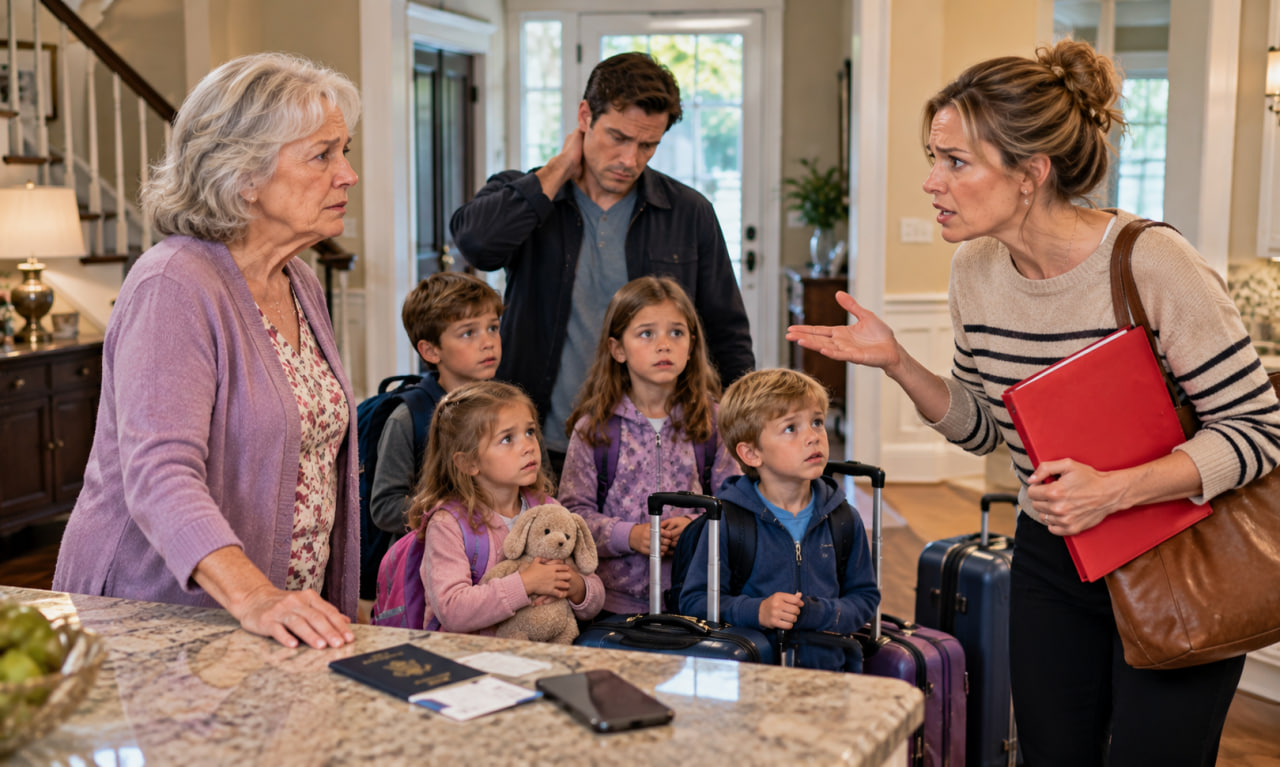
“Mom, I didn’t mean it that way.”
“Maybe you didn’t mean to hurt me. But you did.”
His voice changed.
“I thought you’d be happy to have the kids.”
“I am happy to see them. I am not happy that you made them believe I had agreed to something I never agreed to.”
In the background, I heard an airport announcement.
Then Adam sighed.
“Okay. What do you want us to do?”
It was the first sensible question he had asked all morning.
“We need to arrange childcare together. Marissa may be available, and Joan has offered to help with some of the transportation. But you and Kelsey need to contact the people involved, confirm the arrangements, and make sure the children are properly cared for.”
“And your flight?”
“I am taking it.”
He didn’t respond immediately.
Then he asked, almost in a whisper, “You really aren’t going to change your mind?”
“No, sweetheart.”
I used the word deliberately.
He was still my son.
I still loved him.
But loving him did not require me to surrender.
“I love you, Adam. I love those children. And I hope you have a wonderful trip to Japan. But you need to understand that my life belongs to me.”
For a long moment, I heard only the noise of the airport.
Then he said, “I understand.”
I wanted to believe him.
But understanding something in the middle of a crisis and truly accepting it were two different things.
We spent the next hour coordinating the arrangements. Adam and Kelsey agreed to pay Marissa for the days she could cover, and another trusted caregiver was contacted to help fill the remaining gaps. Joan offered to assist with transportation until the schedule was fully established.
Nothing was left vague.
Every pickup, medication instruction, emergency contact, and overnight arrangement had to be confirmed by the children’s parents and the adults actually providing care.
By eleven o’clock, the plan was taking shape.
At eleven-fifteen, Joan looked at her watch.
“Ruth, your shuttle is coming soon.”
I went upstairs and stood in front of my blue suitcase.
For a moment, I couldn’t move.
The thought of leaving the children made me uneasy. Daisy was so little. Ben sometimes woke from nightmares. Lucy liked someone to sit beside her while she read before bed. And Owen, despite being fourteen, was still a child who had been placed in the middle of an adult problem.
I wanted to make everything comfortable for them.
I wanted to stay until everyone was happy.
I wanted to guarantee that nobody would be upset with me.
Then I remembered Martin’s voice.
Don’t spend the rest of your life waiting for the next person to need you.
I zipped my suitcase.
Downstairs, Daisy ran toward me.
“Grandma, are you going somewhere?”
I knelt and hugged her.
“Yes, sweetheart. I’m going on my trip.”
Her little face fell.
“But I thought we were having the longest sleepover ever.”
My heart ached.
“We’re going to have wonderful sleepovers in the future. But this time, Grandma has something important to do.”
“What’s important?”
I smiled through the tears in my eyes.
“I’m going to see a place Grandpa always wanted to visit.”
Daisy thought about that.
“Can you take a picture for him?”
That was all it took.
I held her tightly and kissed her forehead.
“I’ll take a thousand pictures.”
Owen came over and wrapped his arms around both of us.
“You should go, Grandma,” he said. “Really.”
I looked at him.
“Thank you, sweetheart.”
Then Lucy and Ben joined the hug, and for a few precious moments, the kitchen was filled with the warmth I had always associated with family.
When I finally stepped outside, my shuttle was waiting.
Joan accompanied me to the door.
“Go live your life,” she whispered.
I looked back at my house.
For years, I had believed that being a good mother meant always opening the door, no matter what it cost me.
Now I was beginning to understand that a door could remain open without requiring me to stand in the doorway forever.
I climbed into the shuttle.
At 11:38 a.m., we pulled away from the curb.
And for the first time in a very long time, I did not turn around to see whether someone needed me to come back.
I was going to Portugal.
I was going to ride the yellow trams Martin had dreamed about.
I was going to walk through streets he had only seen in photographs.
And I was going to discover whether a sixty-eight-year-old widow could still begin a new chapter of her life.
I had no idea that the most important conversation of my life was waiting for me when I returned.
Because before my plane even reached Newark, my phone would light up with a message from my son.
And it would force me to confront a truth about our family that I had spent years refusing to see.
PART 4
The message arrived while my plane was crossing the Atlantic.
I had finally settled into my seat, tucked a blanket over my knees, and opened the small photograph of Martin that I always carried in my purse.
Then my phone connected to the aircraft’s Wi-Fi.
There were seven missed calls from Adam.
And one message.
Mom, Kelsey is furious. She says you embarrassed us by involving Joan and Marissa. She thinks you should have handled this privately. Please call me when you land.
I stared at the screen for a long time.
Not once had he asked whether I was all right.
Not once had he asked whether I had made my flight.
Not once had he asked whether I was enjoying the trip I had spent months planning.
Instead, he was worried that his wife was embarrassed.
I put my phone away.
For the first time, I understood that I could not keep explaining my boundaries to people who only wanted me to abandon them.
When I arrived in Lisbon, the air smelled of the sea, warm stone, and something sweet drifting from a nearby bakery.
Bonnie was waiting near the airport exit, waving both arms.
“Ruth Callahan!” she shouted. “You made it!”
I laughed as she pulled me into a hug.
“I made it.”
That afternoon, we rode the famous yellow tram through the narrow streets. I watched colorful buildings pass by, listened to strangers speaking Portuguese, and stood at a viewpoint overlooking the red rooftops and the shining water.
I took a photograph.
Then another.
And another.
That evening, I sat at a small outdoor restaurant with Bonnie, eating fresh seafood while the sun disappeared behind the buildings.
For the first time in five years, I felt something other than grief or responsibility.
I felt alive.
I whispered Martin’s name and lifted my glass.
“To Lisbon,” I said softly.
And, for the first time, I didn’t feel guilty for being happy without him.
But the real test came the following morning.
I woke to a message from Adam.
Mom, the kids are asking why you left. Daisy cried last night. I hope you understand what this is doing to them.
My stomach tightened.
There it was.
The guilt I had spent years trying to escape.
I called Joan immediately.
“How are the children?”
“They’re fine,” she assured me. “Marissa stayed with them last night, and the arrangements are working. Daisy missed you, of course, but she settled down after they read a story together.”
“Are you sure?”
“Ruth, I’m looking at them right now. They’re eating breakfast. Owen is helping Ben find his school shoes, Lucy is complaining about her cereal, and Daisy is trying to convince everyone that chocolate belongs in every meal.”
I laughed through my tears.
“Thank you for being there.”
“Don’t thank me for helping with my own family. But I want you to do something for me.”
“What?”
“Stop letting Adam use the children’s feelings to make you feel responsible for his decisions.”
I went quiet.
Joan continued gently.
“Children can miss their grandmother and still be perfectly safe. Those two things can exist together. You didn’t abandon them, Ruth. Their parents made a plan, and other adults are helping carry it out.”
After we hung up, I sat beside the window and watched Lisbon wake up.
I realized that I had spent years confusing being needed with being loved.
They were not the same thing.
Someone could love me and still be disappointed when I said no.
Someone could miss me and still respect my right to leave.
And someone could be upset with me without that meaning I had done something wrong.