Audrey nodded, tears running down her cheeks.
“Yes.”
There was no defense left.
No explanation that could turn abandonment into love.
No financial document that could make eighteen years disappear.
“I was selfish,” she whispered. “I was frightened, and I made a choice that hurt all of you. I can’t ask you to forgive me because I’m sorry now.”
For the first time, I believed she understood at least part of what she had done.
But understanding was not the same as repairing it.
I stood and walked to the window.
I remembered the nights when Mara woke from nightmares and reached for my hand. I remembered June learning to navigate the kitchen independently, insisting that I let her pour her own cereal even when she spilled half of it. I remembered Callie singing to herself while I braided her hair, her small fingers moving across the raised dots of her Braille books.
I remembered every difficult morning.
Every unpaid bill.
Every moment when I had been so tired that I wondered whether I was doing enough.
And I remembered how often I had told myself that I could endure anything as long as my daughters knew they were loved.
I turned around.
“Audrey, I don’t hate you.”
She looked up at me.
“But I can’t give you what you came here expecting. I can’t stand in front of our daughters and tell them that your return makes everything right. It doesn’t.”
“I know.”
“You will have to earn whatever place you have in their lives. Slowly. Honestly. Without money being used to pressure them. And you will have to accept that they may never want the relationship you imagine.”
She nodded.
“I understand.”
I wasn’t sure she did.
Perhaps she would understand only after she learned to accept a boundary she could not buy her way past.
Mara spoke next.
“We have decided what we want to do about college.”
Audrey straightened immediately.
“I can pay for it. All three of you. Tuition, accommodation, books, everything. You won’t have to worry about money.”
Mara shook her head.
“We appreciate the offer. But we won’t accept money from you as a condition of reconciliation.”
“There’s no condition,” Audrey protested.
“Then you won’t mind if we take time to decide.”
Audrey went silent.
June added, “If you genuinely want to help, put your offer in writing through an independent financial adviser. We’ll review it when we’re ready. There will be no private arrangements, no secret accounts, and no promises we have to make in return.”
Callie reached for her sisters’ hands.
“And we want the original foundation records examined independently. If money was intended for us and was improperly transferred, we want the people responsible held accountable. Not because we need revenge, but because nobody should be able to use vulnerable children to hide financial misconduct.”
Richard, who had been waiting in the hallway, entered when Mrs. Brooks invited him back.
He listened carefully.
Then he nodded.
“I will provide the records I have, cooperate with an independent investigation, and cover the reasonable costs of tracing the funds without demanding anything from the girls in return.”
Mara looked directly at him.
“That is a beginning. It isn’t proof that we trust you.”
“I understand.”
The following weeks were difficult.
With the help of an independent attorney and financial investigators, we began reconstructing what had happened to the foundation’s money.
The records showed that the original account had been established to support long-term needs for several families, including ours. Some payments had gone toward legitimate services. Other funds had been transferred through a series of accounts controlled by people who had managed the foundation.
The investigation uncovered serious accounting irregularities.
However, the evidence did not establish that Audrey had personally taken the missing funds, nor did it prove that Richard had knowingly directed every questionable transfer. Some records were incomplete, and several former administrators had died or could no longer be located.
For the first time, I understood how a secret could survive for so long.
It did not require every person involved to know the entire truth.
Sometimes it required only a few people to know enough to look away.
Richard cooperated with the investigation. His company funded an independent review and provided financial records, though the process took months and did not recover every missing dollar.
Audrey, meanwhile, did something I had never expected.
She stopped sending expensive gifts.
She stopped making grand promises.
Instead, she sent letters.
Her first letter to the girls was only two pages long.
She wrote about the fear she had felt when the doctors explained their condition. She admitted that she had been ashamed of her own inability to cope. She described how she had convinced herself that leaving would somehow spare everyone from her resentment.
At the end, she wrote:
None of those reasons excuses what I did. You deserved a mother who stayed. I did not stay. I cannot ask you to rewrite that truth just because I finally have the courage to face it.
Mara read the letter aloud to her sisters.
They did not reply immediately.
Several weeks later, June sent a short response.
We have received your letter. We need time. Please respect that.
Audrey did.
She began attending counseling and stopped treating reconciliation as something she could achieve by making the right offer.
Months passed.
My daughters started university.
Mara enrolled in a program focused on public policy and accessibility. June chose psychology, determined to understand how families and communities could better support children who faced challenges like those she and her sisters had experienced. Callie pursued computer science, with a particular interest in designing technology that would make education more accessible to people with visual impairments.
They were busy, independent, and happier than I had ever seen them.
I missed them terribly when they moved into student accommodation, but I was also proud.
For eighteen years, I had worried about whether I could prepare them for a world that did not always make room for them.
Now I watched them make their own room in it.
One evening, almost a year after graduation, Mara called me.
“Dad, are you sitting down?”
I laughed.
“That depends. Should I be?”
She laughed, too.
“Mom wrote again.”
I was quiet for a moment.
“What did she say?”
“She asked whether we’d be willing to meet her for coffee. No gifts, no money, no speeches. Just coffee.”
“And what do you think?”
Mara was silent.
“Honestly? I’m curious. But I’m not ready to pretend we’re a family the way we might have been if she’d stayed.”
“You don’t have to pretend anything.”
“I know. That’s why I think I might go.”
I felt a mixture of worry and relief.
“Whatever you decide, I’ll support you.”
She paused.
“Dad, would you come with us?”
I hadn’t expected that.
“Are you sure?”
“Yes. We’re not going because she deserves another chance. We’re going because we want to decide for ourselves what happens next. And we’d feel safer if you were there.”
“Then I’ll be there.”
The meeting took place in a small café on a rainy Saturday afternoon.
Audrey arrived early.
She wore a simple coat, no diamonds, and carried no designer handbag. Her hands trembled around a cup of tea.
When my daughters entered, she stood.
For a few seconds, nobody knew what to say.
Then Audrey spoke.
“Thank you for coming.”
June nodded.
“We agreed to meet. That’s all.”
“I understand.”
They sat down.
At first, the conversation was awkward. Audrey asked about their studies, their roommates, and the subjects they enjoyed. She listened more than she spoke. When she made a mistake, she apologized instead of defending herself.
She didn’t offer money.
She didn’t ask them to call her Mom.
And she didn’t pretend that one afternoon could repair eighteen years.
Near the end of the meeting, Callie asked a question.
“Do you ever regret leaving us?”
Audrey’s eyes filled with tears.
“Every day.”
Callie tilted her head.
“Then why didn’t you come back?”
Audrey looked down at her hands.
“Because regret was easier than admitting what I had done. Every year I stayed away, I became more ashamed. I told myself you would hate me. I told myself you didn’t need me. Eventually, I began using those excuses to protect myself from the truth.”
She lifted her face.
“You deserved better. I don’t expect you to make me feel better about what I did.”
Callie was quiet for a long time.
Then she said, “I don’t know whether I can ever love you the way I love Dad.”
Audrey nodded.
“I understand.”
“But I might be willing to know you.”
Audrey covered her mouth.
It wasn’t forgiveness.
Not yet.
It wasn’t the beginning of a perfect relationship.
It was simply a door left slightly open.
And for that day, it was enough.
As we left the café, Audrey approached me.
“Samuel,” she said, “I know I have no right to ask you for anything. But I want to thank you.”
I looked at her.
“For what?”
“For staying.”
I felt the old pain rise, but it no longer controlled me.
“I didn’t stay to prove anything to you, Audrey. I stayed because three little girls needed their father.”
“I know.”
She hesitated.
“I hope one day you can forgive me.”
I considered her words.
“Maybe one day I will. But forgiveness doesn’t mean pretending the past didn’t happen. And it doesn’t mean you automatically get back what you gave up.”
She nodded slowly.
“I understand.”
This time, I believed she was beginning to.
Then I walked away.
Not because I wanted her to suffer.
Not because I wanted revenge.
But because my life no longer revolved around the person who had left it.
It revolved around the family that had stayed together.
Eighteen years later, I finally understood what wealth meant
The following spring, my daughters invited me to a small celebration at their university.
Mara had received an award for her work on accessibility policy. June had been selected for a research placement. Callie had helped develop a digital learning tool that made several university resources easier to navigate using screen readers.
I sat among the audience, listening to them speak about their work.
At one point, Callie stepped up to the microphone.
“Dad,” she said, turning toward me, “when we were little, you used to tell us that being independent didn’t mean never needing anyone. It meant knowing that we deserved support and having the confidence to ask for it.”
She smiled.
“We understand now that you were teaching us more than how to survive. You were teaching us how to live.”
I wiped my eyes.
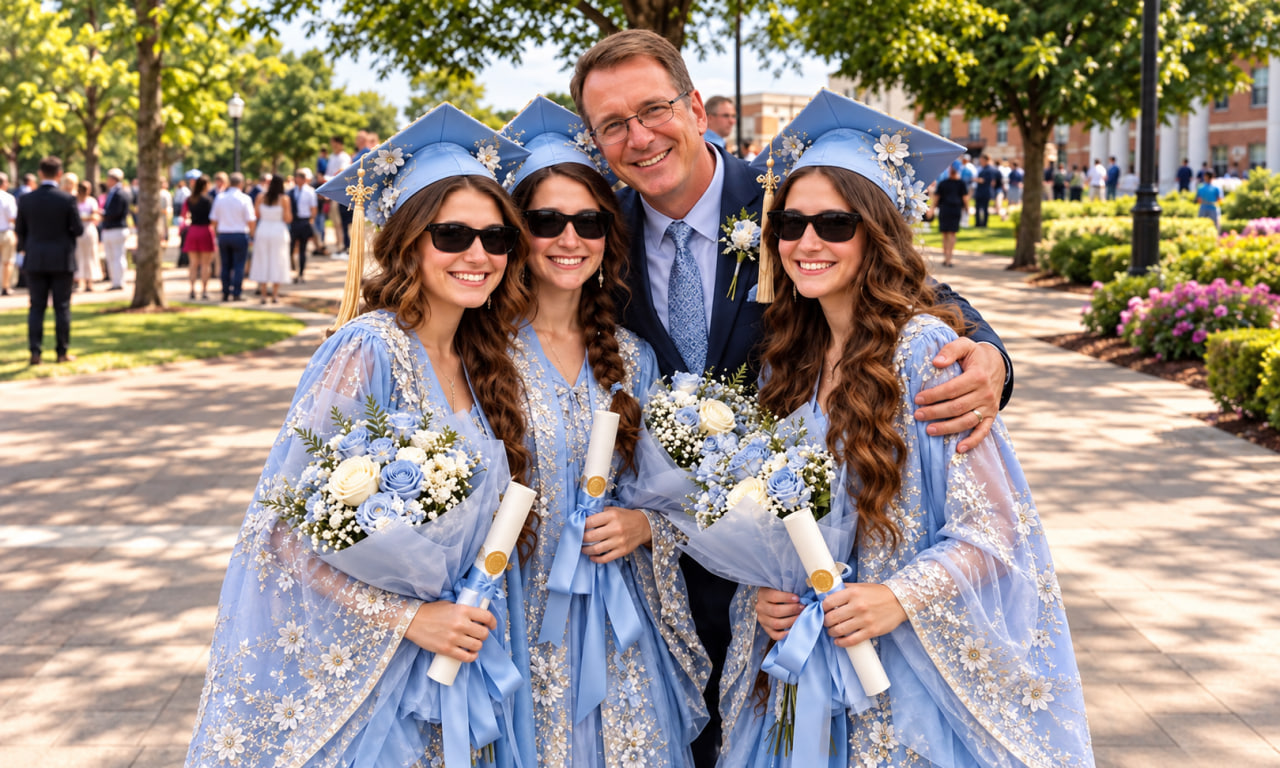
After the ceremony, the three girls gathered around me.
Mara hugged my left arm. June leaned against my shoulder. Callie rested her head against my chest.
For a moment, I was back in our tiny house, with three little girls pressed against me after a difficult day.
Only now they were grown women.
They were strong.
They were educated.
They were making their own choices.
And they knew, without a doubt, that they had always been loved.
Audrey attended the celebration, too.
She sat quietly near the back and applauded when each of her daughters received recognition. Afterward, she asked whether she could join us for a photograph.
Mara considered the request.
Then she said, “One photograph. But please don’t post it online without asking us.”
Audrey agreed immediately.
We stood together.
I was on one side, my daughters in the middle, and Audrey at the other end.
The photograph wasn’t a picture of a perfect family.
It was a picture of a complicated one.
A family marked by abandonment, pain, unanswered questions, and decisions that could never be undone.
But it was also a family in which three young women had found the freedom to choose what came next.
As we prepared to leave, Richard approached me.
The investigation had forced him to reconsider the foundation’s management, and he had since established stricter independent oversight for its remaining charitable programs. He had also funded accessibility initiatives without attaching his name to them or requiring public recognition.
“I owe your daughters an apology,” he said.
“Yes,” I replied. “You do.”
He accepted that without argument.
Then he asked, “Do you think people can change?”
I looked across the courtyard at my daughters, who were laughing together beneath a tree.
“I think people can change,” I said. “But change doesn’t erase what happened. It just gives you a chance to make different choices from now on.”
Richard nodded.
“And what about forgiveness?”
I thought about the years I had spent angry at Audrey. The sleepless nights. The bills. The loneliness. The fear that I would somehow fail the children who depended on me.
“I think forgiveness is something people have to decide for themselves,” I said. “It isn’t a reward you earn by buying the right gift or telling the right story. And it isn’t something anyone else gets to demand.”
He thanked me and walked away.
I stood alone for a moment, listening to the sound of my daughters’ voices.
For eighteen years, I had believed that my greatest achievement was raising three blind girls without their mother.
But I had been wrong.
My greatest achievement wasn’t that I had done everything alone.
It was that I had helped my daughters grow into women who understood that their worth had never depended on their mother’s presence, their father’s sacrifices, or anyone else’s money.
Audrey had returned wearing diamonds, believing that wealth could open doors she had closed.
She discovered that love was not a debt my daughters owed her.
And I discovered something, too.
For years, I had measured my success by what I could provide: food on the table, clothes on their backs, books they could read, and a home where they felt safe.
Those things mattered.
But the greatest gift I had given my daughters was something no foundation, businessman, or inheritance could ever purchase.
It was the certainty that they were never a burden.
That their blindness did not diminish their worth.
That they deserved to be loved without conditions.
And that when someone walked away, their departure did not mean the people left behind were unworthy of staying for.
I took my daughters’ hands as we walked toward the parking lot.
“Dad,” June said, “what are you thinking about?”
I smiled.
“How lucky I am.”
Mara laughed.
“You always say that.”
“Because it’s true.”
Callie squeezed my hand.
“Well, we’re lucky, too.”
I stopped walking.
For eighteen years, I had carried the responsibility of being their father as though it were a weight I had to bear alone.
In that moment, I understood that love had never been a one-way journey.
I had raised them.
But they had raised me, too.
They had taught me patience, courage, humility, and the difference between being abandoned and being alone.
Audrey had left our home believing that her life would become richer without the responsibility of three blind children.
She had gained money, possessions, and opportunities.
But she had lost years she could never recover.
I had begun with almost nothing.
Yet I had watched my daughters grow into compassionate, capable women who knew their own worth.
And I would not trade those years—not the difficult ones, not the frightening ones, not even the nights I spent crying when I thought nobody could hear me—for all the diamonds in the world.
Because in the end, the richest person in our family wasn’t the woman who returned wearing diamonds.
It was the father who had stayed when there was nothing to gain.
And the three daughters who grew up knowing that love was never measured by what someone could buy.
It was measured by who stayed, who showed up, and who kept choosing you—even when life became harder than anyone had imagined.