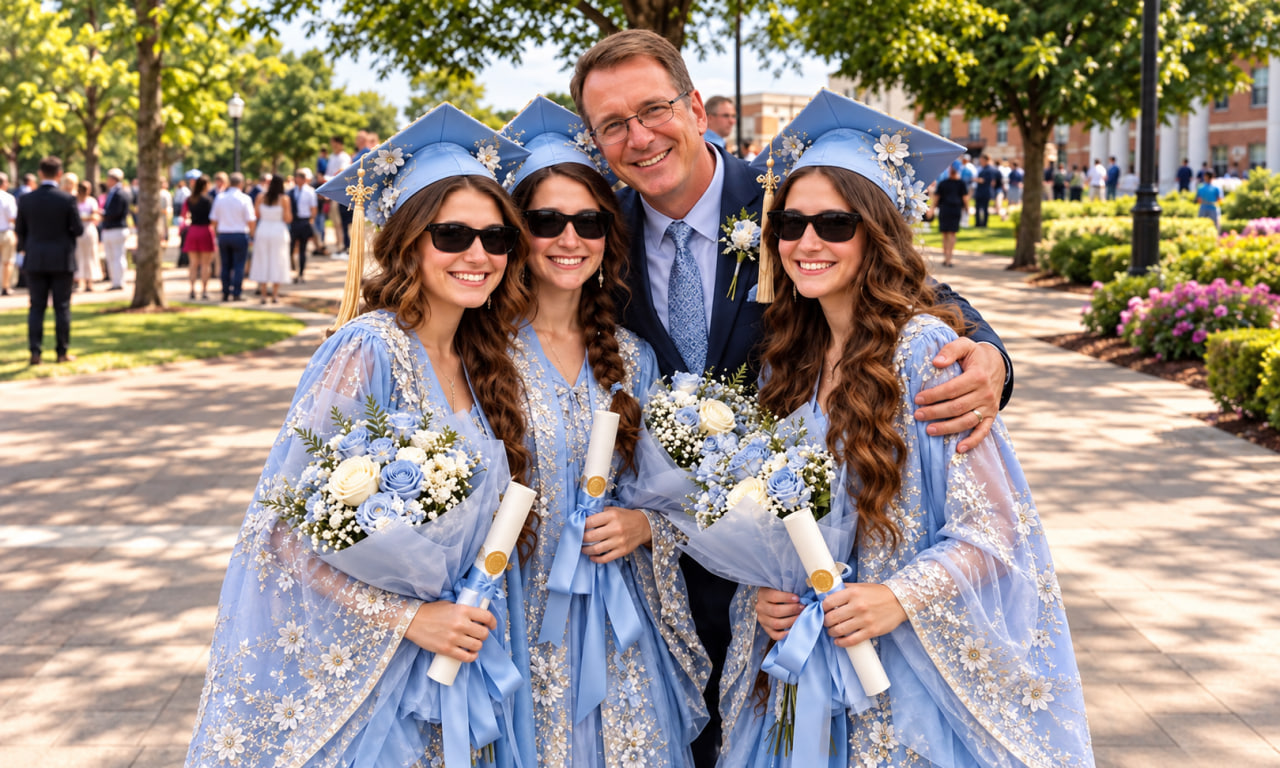
“I received a message from Mara yesterday,” he said. “She told me that the truth was going to come out whether I attended or not. I decided I had spent enough years hiding behind lawyers and other people’s silence.”
Mara stood still at the microphone.
“Then tell us the truth.”
Richard looked at the three young women.
For a long moment, his expression softened.
“You deserve that much.”
He turned toward me.
“Samuel, I know you have every reason to hate me. But before you decide what happened, you need to understand that the money wasn’t simply a payment to make Audrey disappear.”
“Then what was it?”
Richard drew a deep breath.
“Eighteen years ago, I was involved in a business partnership with a private medical organization. The organization had been funding a research program focused on premature infants and long-term developmental outcomes. I had invested heavily in it.”
He paused.
“When your daughters were born, the hospital was participating in a related study. Because they were born so prematurely and experienced serious complications, their case attracted attention.”
My hands curled into fists.
“What are you saying? That my daughters were a business opportunity?”
“No,” Richard said quickly. “Not intentionally. But their medical circumstances became entangled with decisions made by people who were more concerned with protecting their institution than with explaining everything to their families.”
Mrs. Brooks stepped forward.
“Be careful, Richard. You can explain what you know, but don’t imply wrongdoing you cannot substantiate.”
He nodded.
“You’re right.”
He turned back toward us.
“I was informed that the girls’ treatment might involve additional monitoring and specialized support. I was also told that the family could receive financial assistance. I agreed to provide some of that money through a foundation associated with my company.”
“Then why did Samuel never receive it?” Mara asked.
Richard lowered his head.
“Because the arrangements were changed.”
The words hung in the air.
“Changed by whom?” June demanded.
Richard looked at Audrey.
She began to cry.
“I didn’t know everything,” she said. “I swear I didn’t.”
I felt a terrible anger rising in me.
“Tell us what you did know.”
Audrey took a shaky breath.
“Richard had offered to pay for a place for me to stay and help me start over. I was frightened, and I wanted to leave. But he also told me there was money available to help the babies. I thought some of it would go toward their care.”
“Did it?”
“Some did,” she whispered. “But not all of it.”
Richard’s jaw tightened.
Audrey continued.
“When I left, I signed papers. I was told they were financial documents. I was told that if I stayed away, everything would be handled quietly and the girls would have access to resources if they needed them.”
“Resources?” I asked. “I worked two jobs. I applied for assistance. I borrowed money from people who barely knew me. I sold my car when the bills became too much. Where were these resources?”
Audrey looked at me through her tears.
“I don’t know.”
Richard answered for her.
“Some funds were transferred to accounts associated with a charitable trust. Others were used to settle disputes involving the research program. I believed the arrangements had been properly administered. Years later, I discovered that the paperwork did not match what I had originally authorized.”
“So you did nothing?” June asked.
“I asked questions. I was given explanations. Then the people involved left the organization, and the records became difficult to trace.”
Mara’s voice trembled with anger.
“That’s convenient.”
“Yes,” Richard admitted. “It is. And I should have pushed harder.”
For the first time, the wealthy man looked less like a powerful businessman and more like someone who had spent years avoiding an uncomfortable truth.
But one question still remained.
Why had Audrey returned now?
I looked at the diamonds on her ears, the expensive handbag resting against her side, and the immaculate dress that seemed so out of place beside the ordinary clothes of the parents around us.
“Why today?” I asked. “Why did you wait eighteen years to come back?”
Audrey wiped her face.
“I saw an article about the girls.”
“What article?”
“Your town’s newspaper published a story about their graduation. It mentioned that all three of them had earned places in university programs. It talked about their achievements and how you had raised them alone.”
She swallowed.
“I read it over and over. Then I saw a photograph of the three of them standing together, smiling. They looked so happy. I realized that they had become extraordinary young women without me.”
“That still doesn’t explain the money.”
“No.”
Her shoulders slumped.
“It doesn’t.”
She finally admitted what I had suspected.
“I wanted them to know I could provide for them. I wanted to arrive with something impressive, something that would make them willing to listen. I thought if I offered to pay for their education, they might give me a chance.”
“You thought you could buy eighteen years?” I asked.
“No,” she whispered. “I thought I could buy the opportunity to explain.”
Mara shook her head.
“You could have written a letter. You could have called. You could have come back when we were children. You could have come back when Dad was struggling.”
“I was ashamed.”
“And you let your shame become our childhood.”
Audrey covered her face.
For a moment, I felt no satisfaction at seeing her cry.
Only exhaustion.
I had imagined this woman returning many times over the years. In some versions of those imaginary encounters, I shouted at her. In others, I slammed the door in her face. Sometimes I imagined she would beg forgiveness, and I would finally feel that the years of suffering had been acknowledged.
But standing there, surrounded by my grown daughters, I realized that no confession could return the years we had lost.
Then Callie spoke.
“There’s something else.”
Everyone turned toward her.
She was the quietest of my daughters, the one who preferred to listen before speaking. When she was a little girl, she would sit beside me while I cooked and ask questions about everything from the stars to the sounds of birds outside our window.
Now her voice was steady.
“Richard sent us a second letter after we asked about the payments. It contained the name of the organization that managed the trust.”
Richard nodded slowly.
“Yes.”
Callie continued.
“We contacted them. Their records show that a portion of the original money was never used for medical expenses or research.”
Richard’s face tightened.
“That is correct.”
“Where did it go?” I asked.
Callie unfolded another page.
“It was placed in an investment account under the name of a private foundation. The account was eventually closed, but the records show that it generated substantial returns.”
I looked at Richard.
“Whose foundation?”
He didn’t answer immediately.
Then he said, “A foundation associated with my family.”
Audrey began shaking her head.
“No. No, that’s not possible.”
Richard looked at her.
“You knew about the account.”
“I knew there was money set aside,” she whispered. “I didn’t know how much it became.”
“And you never asked?” June said.
“I was told the money would be available when the girls reached adulthood.”
Mara gripped the podium.
“Available to whom?”
Richard reached inside his jacket and removed a folded document.
“The account was established to support the children’s future education and accessibility needs. It was supposed to be held in trust for them.”
He paused.
“But there is a problem.”
I felt my stomach tighten again.
“What problem?”
“The account was closed several years ago. The funds were transferred after a dispute involving the foundation’s management.”
“Transferred where?” Mara asked.
Richard looked toward Audrey.
“That’s what we need to establish.”
For the first time that afternoon, Audrey seemed genuinely horrified.
“I never received that money,” she said. “I swear to you.”
Richard studied her face.
“Then someone else did.”
The auditorium erupted in whispers.
I stood motionless, trying to absorb the possibility that money intended to help my daughters had vanished into the hands of someone we didn’t even know.
But Mara was not finished.
“That’s why we invited you both here,” she said. “We weren’t just trying to embarrass our mother. We needed everyone involved to hear the same questions at the same time.”
She turned toward the audience.
“Our father has spent eighteen years being told that he was alone in this struggle. He believed that no one had been willing to help us. Now we have documents suggesting that people knew about our situation, money may have been set aside for us, and somebody may have taken control of it.”
She faced Richard.
“We don’t want revenge. We want a complete accounting of what happened. We want the records. We want independent investigators to examine them. And we want our father to stop carrying the financial burden of decisions other people made without his knowledge.”
Richard nodded.
“I will cooperate fully.”
Then Mara turned toward Audrey.
“And as for you, Mom, we aren’t asking you to pay for our love. If you want to be part of our lives, you will have to begin by telling the truth, even when it makes you look terrible.”
Audrey was crying openly now.
“I will.”
June’s voice was quiet but firm.
“That is a promise. Not forgiveness.”
Audrey nodded.
“I understand.”
Then something unexpected happened.
Richard stepped toward the microphone again.
“There is one final document I need to give Samuel.”
He approached me and held out a sealed envelope.
“This was recovered during an internal review of the foundation’s old records. It contains a letter that was written shortly after the girls were born. I believe it may explain why some of the arrangements were made in secret.”
I stared at the envelope.
My name was written across the front.
Samuel.
The handwriting was unfamiliar.
“Who wrote this?” I asked.
Richard looked toward Mrs. Brooks.
“We believe it was written by someone who worked at the hospital at the time. Someone who became concerned about the decisions being made.”
I took the envelope with trembling fingers.
For eighteen years, I had believed the worst thing that had happened to my family was that Audrey had left us.
Now I was beginning to understand that the abandonment might only have been the most visible part of something much larger.
I broke the seal.
Inside was a single page.
The first sentence read:
Dear Samuel, if you are reading this, it means the girls have grown old enough for someone to finally tell you what happened during their first weeks of life.
I stopped breathing.
Below that sentence was a name.
A name I had not heard in eighteen years.
And beneath it were the words:
Your daughters were never supposed to become part of this agreement.
I looked up at Richard.
“What agreement?”
He said nothing.
For the first time, even Audrey seemed unable to hide her fear.
Because whatever the letter contained, it was clear that neither the diamonds nor the money had been the real secret.
The real secret had been buried long before my wife walked out the door.
And the person who had written that letter had known it all along.
THE END: The Truth That Money Could Never Erase
I asked everyone to leave the auditorium.
Not because I wanted to protect Audrey or Richard, but because I needed a moment to think.
The graduation ceremony had ended. Families were taking photographs in the hallway, children were laughing, and the staff were stacking chairs. Outside, the afternoon sun shone through the windows as though the world had not just been turned upside down.
My daughters and I went into a quiet conference room near the main entrance.
Mrs. Brooks joined us. Richard waited outside with his lawyer, agreeing to remain available while we decided what to do next.
Audrey sat near the door.
For the first time since she had arrived, she looked small.
The diamonds were still there. The designer handbag was still beside her feet. But the confidence she had worn when she entered the auditorium had disappeared.
I unfolded the letter again.
The writer identified herself as Dr. Helen Carter, a physician who had worked with the neonatal team during the girls’ first weeks.
I remembered her vaguely. She had been one of the doctors who explained the complications of prematurity to me when I was too exhausted to understand half of what she said.
According to the letter, the hospital had received funding from a private foundation to support families whose babies required prolonged intensive care.
The funding was intended to help with treatment-related expenses, accessible services, and long-term developmental support.
When Mara, June, and Callie were born, their circumstances were brought to the attention of the foundation.
But the money was never supposed to come with conditions requiring a parent to leave.
Dr. Carter wrote that she had become concerned when she learned that a separate arrangement was being discussed with Audrey and Richard.
She had objected to the idea that financial assistance could be linked to keeping a family situation quiet.
She had also insisted that I should receive accurate information about any support available to my daughters.
The letter ended abruptly.
I have been told not to interfere further. I am leaving this position, but I cannot leave without making one thing clear: Samuel must not be made to believe that his children were unworthy of help. If the money disappears, someone must answer for it.
I read the final sentence three times.
Then I put the letter down.
“So my daughters could have received help,” I said quietly, “and I spent years believing I had to manage everything alone.”
Mrs. Brooks nodded sadly.
“That appears to be part of what happened. But we need to be careful. The letter raises serious questions; it does not establish who ultimately took the funds or why every decision was made.”
June reached across the table and touched my hand.
“Dad, you did what you had to do with what you knew.”
I shook my head.
“I should have asked more questions.”
Mara’s expression softened.
“You were raising three premature babies. You were working, learning Braille, taking us to appointments, and trying to keep a roof over our heads. You weren’t responsible for investigating a foundation or understanding a complicated financial arrangement nobody explained to you.”
Callie nodded.
“Not knowing about a secret isn’t the same as failing to uncover it.”
I looked at my daughters.
They had grown into women who understood compassion more deeply than many people who had never suffered.
For eighteen years, I had tried to protect them from the world’s cruelty.
Now they were protecting me from the cruelty of my own guilt.
I turned toward Audrey.
“Did you know about Dr. Carter’s concerns?”
Audrey lowered her head.
“No. I never saw that letter.”
“Did you know the money was supposed to belong to the girls?”
“I knew Richard had arranged financial support. I thought it was connected to the hospital and that the money would be available if the girls needed it. I didn’t know about the foundation’s internal problems.”
“Then why didn’t you come back to check on them?”
She began crying again.
“Because every year I stayed away made it harder to return.”
I waited.
She wiped her face.
“At first, I told myself I needed time. I told myself you would be better off without me. I told myself that when I became financially secure, I would come back and make things right.”
Her voice shook.
“But then the years passed. I heard that you were managing. I heard the girls were doing well in school. And I became ashamed of what I had done. I convinced myself that if I appeared in their lives, I would only cause pain.”
June spoke without raising her voice.
“You were worried about causing pain, so you let us grow up wondering why our mother didn’t want us.”