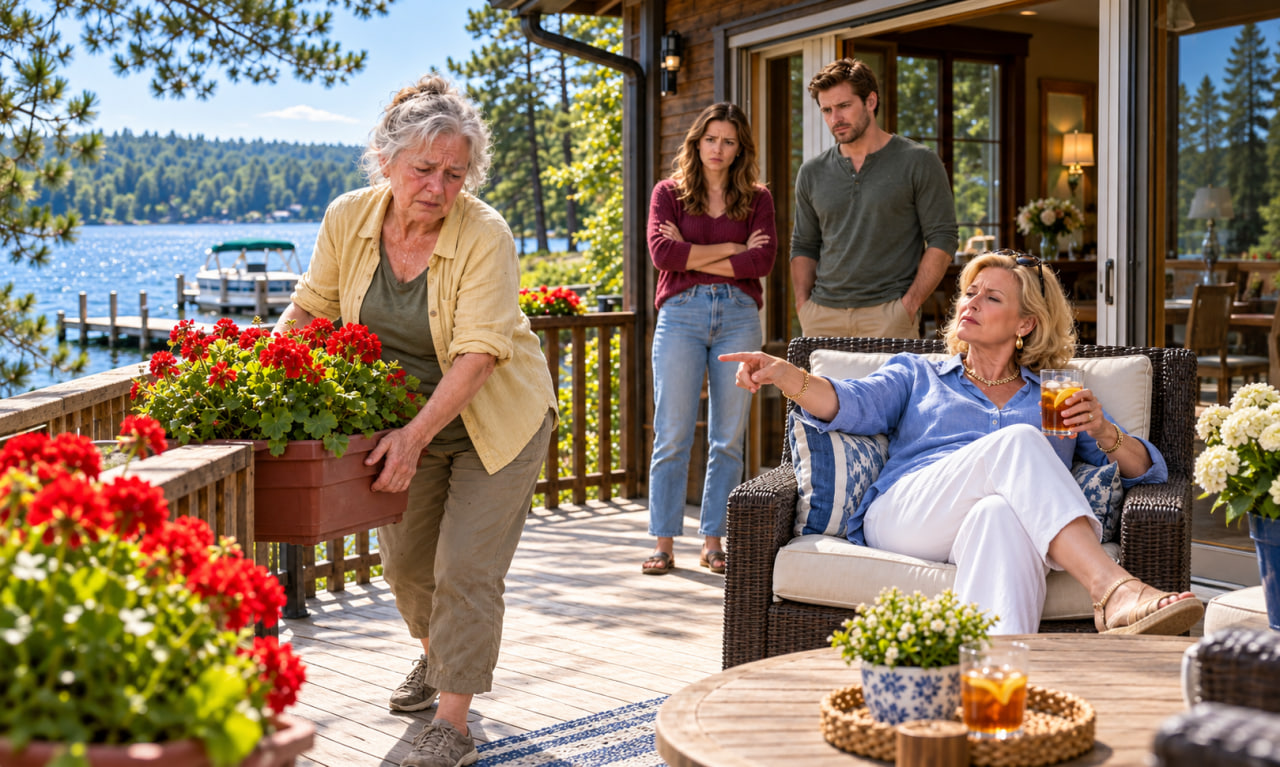
“So everyone has decided I’m the villain?” Susan snapped.
“No,” Richard replied. “We’re all admitting we’ve behaved badly. You just don’t want to hear your part.”
Maggie suggested a simple arrangement: guests would clean their own dishes, handle their own towels, and share the cooking. Anyone who wanted special groceries would bring them. Her flowers would stay exactly where she preferred, and nobody would invite additional visitors without asking her first.
Susan asked what would happen if she refused. Daniel looked at his mother, visibly struggling, then said she could choose not to stay. He spoke without cruelty, but the meaning was unmistakable: being his mother didn’t give her authority over somebody else’s home.
Susan went upstairs and packed. Forty minutes later, she returned carrying a suitcase, announcing that she wouldn’t remain where she was unwelcome. Richard told her he’d promised to help repair the dock railing and intended to honor that promise before leaving the following day.
“You’re staying here instead of coming home with me?” Susan asked.
“I’m finishing something I should have helped with weeks ago.”
At the door, Daniel told Susan he loved her and hoped they could talk when she’d had time to think. She accused him of choosing his wife over his mother, and he answered that respecting Maggie wasn’t a contest between the women in his life.
After Susan drove away, the cabin became unusually quiet. Maggie sat on the sofa, looking more distressed than relieved. I wrapped an arm around her, certain she was blaming herself, and told her nobody had forced Susan to reject reasonable house rules.
“There’s something I haven’t told you,” she whispered.
She disappeared into her bedroom and returned with a manila envelope. Inside was a property appraisal from a local real estate agent, dated three weeks earlier. At first I couldn’t understand what I was holding; then I realized Mom had been considering selling the cabin.
My mother had almost sold the house she shared with Dad for decades, simply because she’d begun dreading the arrival of her own guests.
“I started hating Fridays,” she confessed. “Thursday was cleaning. Friday was shopping. Saturday was serving everyone, and Sunday was washing sheets. By Monday I was exhausted.”
My father had loved that lake. Before he passed away, he’d planted the lilacs near the dock and taught me to swim beside the shallow rocks. Maggie had kept the cabin because those memories were precious. The thought of her selling it to escape her own visitors was unbearable.
“Why didn’t you tell me?” I asked.
“Because you were happy, Emily. You’d just gotten married, and I didn’t want our families fighting.”
Daniel looked sick. He said he’d never expected his family’s visits to make Maggie consider leaving her own home. Mom explained that she also needed to learn to speak honestly instead of agreeing to everything and hoping somebody would notice her unhappiness.
She studied the appraisal, then tucked it back into its envelope. We promised that visits would happen only when she invited us, and that she was free to refuse without explaining herself. After a long pause, she finally smiled.
“Then I suppose I can keep my house.”
The rest of Saturday felt wonderfully ordinary. Daniel and Richard repaired the railing while I made lunch and washed up afterward. Mom read a book on the deck and eventually stretched out in Susan’s favorite lounger, her feet resting on the cushion.
“How’s the view?” I asked.
“Beautiful,” she replied, looking straight through the red flowers. “Absolutely beautiful.”
On Sunday morning, I helped Maggie change the sheets in Susan’s room. She opened the bedside drawer and discovered a small brass tag she’d always kept attached to the cabin’s spare key. The tag was there, but the key itself had disappeared.
Daniel checked the kitchen drawer and the hooks beside the back door. Richard searched his belongings. Nobody had borrowed it, but Daniel remembered Susan asking where the spare was earlier that summer, explaining that she wanted to arrive before the rest of us sometimes.
He sent his mother a message. Her reply appeared within a minute: she’d taken the key several weeks earlier so she wouldn’t have to bother anybody if she arrived first. She seemed genuinely puzzled when Daniel demanded that she return it.
“I was allowed to use the cabin all summer,” she protested when she called.
“You were invited to visit,” Daniel replied. “You weren’t given permission to take Maggie’s key.”
Susan insisted that he’d become a different person since getting married and once again blamed me. Daniel told her he was speaking for himself, and that his wife wasn’t responsible for the decisions he was making about basic respect.
Susan hadn’t just claimed the best chair and the best view; she’d quietly helped herself to a key that let her enter my mother’s home without asking.
Maggie asked Richard whether changing the locks would be unreasonable. He shook his head and offered to do it that afternoon. We installed a keypad on the side door, and Maggie chose the code without sharing it, even with me.
Before we drove home, Daniel asked whether we could return the following weekend. Mom hesitated, looking almost apologetic, then told us she wanted the cabin to herself. I hugged her and said that sounded like the best weekend she’d had all summer.
The following Saturday, she sent me a photograph of her feet on the lounger, a cup of coffee, and the red geraniums against the lake. Nobody else appeared in the frame. She was alone, comfortable, and entirely content.
Susan mailed the spare key back on Tuesday. By then, stories about the confrontation had spread through Daniel’s relatives. In Susan’s account, I had humiliated her over an innocent complaint, and Daniel had abandoned his mother to please his new wife.
Daniel called his aunt and explained the situation without insulting Susan. He described Maggie’s exhausting summer and admitted he should have intervened sooner. His aunt sighed and revealed that Susan had rearranged her patio furniture during an earlier family vacation because the morning sun bothered her.
“We put everything back after she left,” the aunt said. “It was easier than starting an argument.”
Those words stayed with Daniel. He began recognizing how many family decisions had revolved around preventing his mother’s disappointment, from restaurant choices to holiday schedules. Richard admitted that he’d often surrendered simply because disagreeing seemed more exhausting than giving in.
Daniel didn’t stop speaking to Susan, although their calls were difficult. He told her that he loved her and would listen to her feelings, but he would no longer ask Maggie to sacrifice her comfort merely to keep Susan happy.
Three days before Labor Day, Maggie called with news that made me sit upright. A woman named Carol had messaged her about a planned holiday weekend at the cabin. Carol and five friends apparently believed Susan had invited them all to stay.