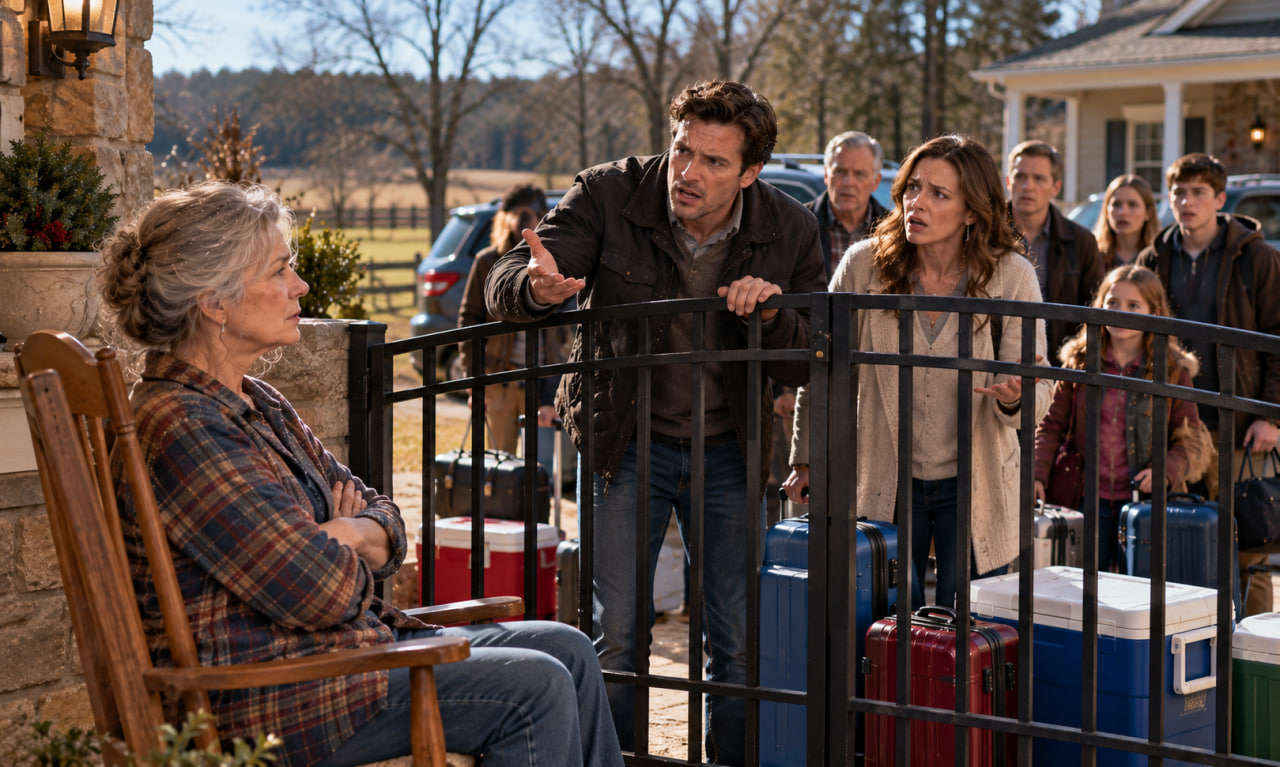
“Okay.”
“From now on, visits must be arranged with me. Nobody gets a key unless I decide otherwise. I won’t provide money simply because someone expects it, and I won’t accept being insulted because I choose to say no.”
Charlie swallowed.
“And the farm?”
“The farm is my home. I will decide what happens to it. When I’m ready to share those plans, I will.”
He looked disappointed, but he didn’t argue.
That was the first sign that something might truly change.
Before they left, I gave them each a piece of apple pie wrapped in foil.
Lauren hugged me at the door.
Charlie lingered on the porch.
“Dad would have been ashamed of me,” he whispered.
I looked at him carefully.
“Your father loved you. But love doesn’t mean he would have agreed with everything you did.”
He nodded, wiping his eyes.
Then he left.
For the first time, I felt that perhaps I had finally spoken to my son—not the boy I remembered, not the man who expected me to solve his problems, but the person standing before me.
And that person had begun to listen.
Six Months Later
The farm changed, but not in the way my children had expected.
John helped me repair the old fence, and we planted new apple trees along the eastern field. I hired a local woman to help with the heavier housework, and I began attending a weekly gathering for older residents in the nearby town.
I made friends.
I laughed more.
I even learned to use video calls so I could speak with my grandchildren without waiting for their parents to arrange a visit.
Emily called every Wednesday.
Sometimes she showed me her drawings. Sometimes she told me about school. Once, she spent twenty minutes explaining why her class hamster was the smartest animal in the world.
I listened to every word.
One afternoon, Charlie arrived alone.
He brought a toolbox and asked whether he could help repair the porch steps.
“You don’t have to do that,” I told him.
“I know,” he replied. “I want to.”
So we worked together.
He measured the boards while I held the nails. We talked about ordinary things—the weather, his job, the children, the apple trees.
After an hour, he put down the hammer.
“Mom, can I ask you something?”
“Of course.”
“Why didn’t you tell us about all the money you helped us with? Why did you keep writing everything down if you never expected us to repay you?”
I smiled sadly.
“Because I wanted to remember what we had built together. Not because I wanted to collect debts.”
He looked toward the orchard.
“I wish I’d understood that sooner.”
“So do I.”
He was quiet for a while.
Then he asked, “Do you think you’ll ever forgive me completely?”
I considered my answer.
“Charlie, forgiveness isn’t a switch. I don’t wake up one morning and suddenly forget everything that happened. But I can choose not to carry the hurt everywhere I go.”
He nodded.
“And trust?”
“Trust takes longer. You rebuild it through what you do, not just what you say.”
He accepted that answer without arguing.
That meant more to me than any promise he could have made.
The Day They Read Joe’s Letter
A year after the locked gate, I invited my children and grandchildren to the farmhouse for a family lunch.
This time, everyone waited for an invitation.
They arrived at noon. Charlie knocked before entering. Lauren brought a salad and asked where I wanted it placed. David helped John carry chairs onto the porch.
Nobody assumed anything.
After lunch, I brought out Joe’s leather notebook and the sealed letter I had kept in the metal box.
“I want you all to understand something about this farm,” I said.
They gathered around the table.
I opened the letter and read Joe’s words aloud.
He had written about the years we spent building our life together, about the sacrifices we made, and about his hope that our children would remember that a family was not held together by land or money.
One paragraph made my voice tremble.
If our children ever begin to believe that what we built belongs to them simply because they were born into this family, remind them of the truth. An inheritance is not a reward for being born. It is a responsibility entrusted to those who understand its meaning.
Nobody spoke.
I continued reading.
Barbara, you have spent your life making sure everyone has a place at the table. If the day comes when they forget that you deserve a place there too, do not confuse their forgetfulness with your worth.
My voice broke.
I lowered the letter.
For several seconds, the only sound was the wind moving through the orchard.
Then Charlie began to cry.
“I wish Dad were here,” he whispered.
“So do I,” I said.
He reached for my hand.
“I think I finally understand what you were trying to tell me at the gate.”
I squeezed his fingers.
“What was I trying to tell you?”
“That we were treating your love like something we were entitled to.”
I nodded.
“Yes.”
He looked around the table at his brothers, sisters, and the family members who had come with him that first terrible morning.
“We all did it,” he said. “We took advantage of her because she never said no.”
Lauren wiped her eyes.
“I’m sorry, Barbara.”
One by one, they apologized—not because they wanted the key, not because they wanted access to the farm, but because they had finally begun to understand what their behavior had cost me.
I accepted their apologies.
But I did not change my plans.
The farm would remain my home for as long as I wanted to live there. The conservation agreement would protect the land, and the education fund would help children whose families worked the soil just as Joe and I once had.
My children would inherit whatever I eventually chose to leave them, according to the plans I had made with my attorney.
They would not receive the farm simply because they had expected it.
And for the first time, nobody argued.
The Last Page of the Notebook
Two years later, on my seventy-eighth birthday, I sat beneath the old oak tree with Emily beside me.
She had grown taller, and her braids were neater now. She brought me a new drawing of the farmhouse.
This time, the picture showed a woman sitting on the porch with a book in her lap. Beside her were children, apple trees, and a little wooden sign that read:
EVERYONE IS WELCOME WHEN THEY REMEMBER TO ASK.
I laughed when I saw it.
“That’s a wonderful sign, sweetheart.”
She leaned against my shoulder.
“Grandma, are you happy now?”
I looked across the land Joe and I had spent our lives building.
The farmhouse needed paint. Some of the orchard trees were old. The porch still creaked when the wind blew hard enough.
But the kitchen was warm, the garden was blooming, and my phone rang because my family wanted to talk to me—not merely because they needed something.
“Yes,” I told her. “I’m happy.”
Later that evening, after everyone had gone home, I took out the brown leather notebook.
The pages were worn, and the edges had softened with age. I turned to the last blank page and picked up my pen.
For decades, Joe and I had recorded the cost of everything: seeds, repairs, groceries, tools, and the long list of expenses that had kept the farm alive.
Now I wrote something different.
Today, I finally understood that the value of a home cannot be measured by how many people have a key.
I paused, listening to the crickets beyond the window.
Then I added one final sentence.
It is measured by whether the people who enter remember to respect the person who lives there.
I closed the notebook and placed it beside Joe’s photograph.
For a long time, I sat quietly, thinking about the morning my son had removed me from the family group chat.
At the time, I believed that moment meant I had lost my place in my family.
Now I understood something else.
I had not lost my place.
I had simply stopped accepting the place they had assigned me.
The woman who once left the key beneath the flowerpot had finally learned that love did not require her to leave every door unlocked.
And the twelve people who had arrived at my farm expecting a free weekend had learned a lesson they would carry for the rest of their lives.
Family is not an entitlement to someone’s home, money, time, or forgiveness. Family is a relationship built on respect, gratitude, and love freely given.
That night, I turned off the lights, locked the front door, and went to bed without worrying about who might arrive unannounced.
For the first time in many years, I felt completely at home.
And if Joe was watching from somewhere beyond the stars, I hoped he knew that I had finally understood his letter.
The farm was safe.
My future was mine.
And my heart, though it had been hurt, had not become bitter.
It had simply learned where to place the key.