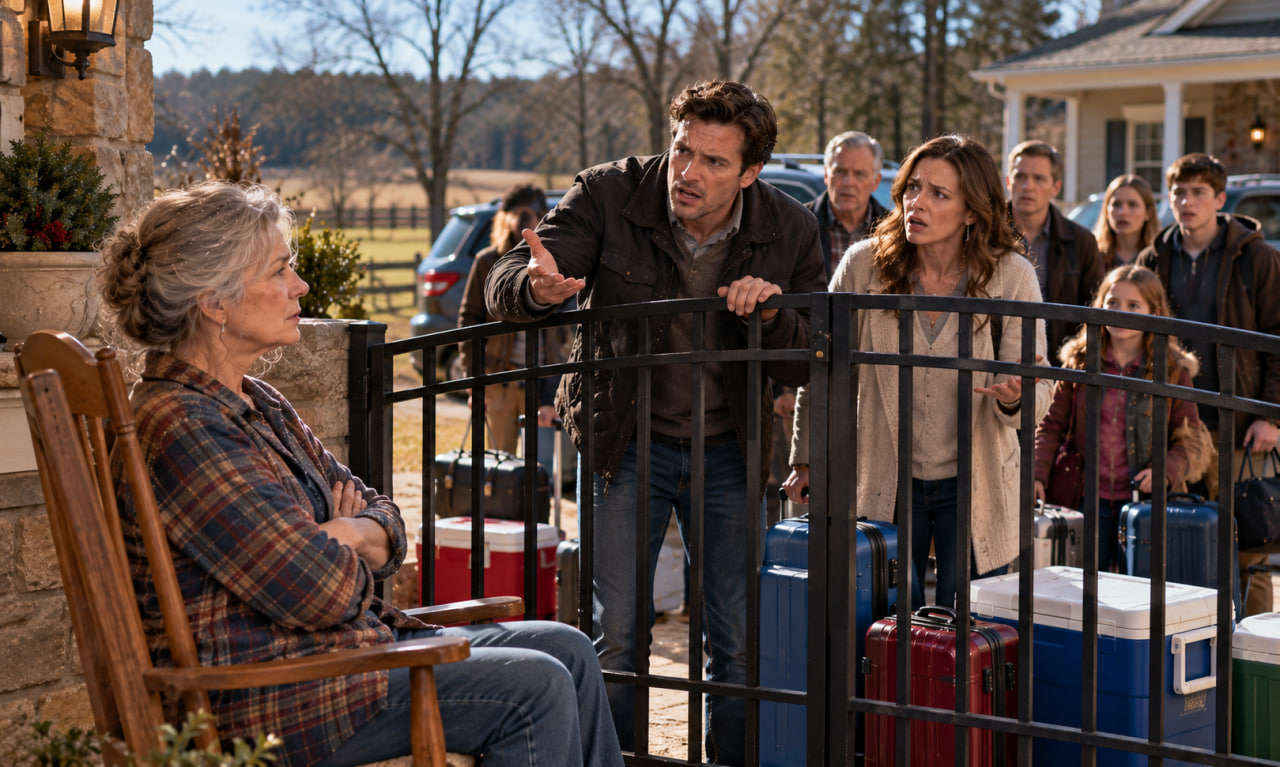
“Whenever you come to visit and we plan it together, I’ll make you the biggest apple pie you’ve ever seen.”
She smiled.
Charlie called her from the car.
Emily hesitated before running back to him.
I watched the vehicles disappear down the country road. When the last one passed the oak trees, the farm became quiet again.
For the first time in years, the silence didn’t feel like loneliness.
It felt like room to breathe.
But I knew the gate was only the beginning.
Because the thing hidden beneath the floorboards of my bedroom was not merely a collection of old papers or a forgotten keepsake.
It was the reason Joe had made me promise, on the night before he died, that I would never sign anything concerning the farm without reading every word.
And it was the reason I had called an attorney three days earlier.
I returned to the house, placed Emily’s drawing beside Joe’s photograph, and went into my bedroom.
Then I lifted the loose floorboard.
Beneath it lay a metal box.
Inside the box were three things: the original deed to the farm, a sealed envelope bearing Joe’s handwriting, and a thick folder of documents I had not looked at since his funeral.
I picked up the envelope first.
My name was written across the front.
For Barbara, when the time comes.
I sat on the edge of the bed.
For eleven years, I had been afraid to open it. Joe had asked me to wait until I felt that I could no longer protect the life we had built by simply being kind.
I had thought that day would never come.
I broke the seal.
And as I read the first paragraph, I understood why Joe had insisted that the truth be kept hidden until I was ready.
My children had been arguing over what they believed they would inherit. But they had never bothered to learn what their father and I had actually built—or what we had agreed to do with it.
I read the letter to the end.
Then I picked up the telephone and called my attorney.
“Mr. Harris,” I said when he answered, “I think it’s time we finished what my husband started.”
He was quiet for a moment.
“Are you certain, Barbara?”
I looked toward the window, where the twelve cars had vanished beyond the fields.
“Yes,” I said. “But before we do anything, I want to make sure everything is legal, everything is documented, and nobody can say I acted out of anger.”
“That’s wise,” he replied. “Bring the documents to my office tomorrow. We’ll review them together.”
After we hung up, I returned Joe’s letter to the metal box.
I wasn’t interested in revenge.
I wanted something much harder to achieve.
I wanted my family to understand that love was never supposed to mean unlimited access to another person’s life.
And I wanted to make certain that whatever happened next, the farm would remain a place of dignity, not entitlement.
That evening, I sat on the porch with a cup of tea and watched the sun sink behind the orchard.
For the first time in years, I didn’t prepare twelve beds.
I didn’t fill twelve plates.
I didn’t check my phone every five minutes to see whether someone needed something.
I simply sat there, listening to the crickets.
Then my phone vibrated.
A message from Charlie appeared.
Mom, we need to talk about the farm. Please don’t do anything stupid.
I read it twice.
Then I placed the phone face down on the table.
For once, I wasn’t going to rush to answer my son simply because he had decided his needs were urgent.
Tomorrow, I would meet with my attorney.
Tomorrow, I would learn exactly what Joe had left behind.
And tomorrow, I would begin making decisions about my future—not based on who might be disappointed, but on what was right.
I looked at the farmhouse, the orchard, and the old oak tree where Joe had taught Charlie to climb.
Then I whispered into the quiet evening.
“You were right, Joe. The things people don’t notice are often the things holding everything together.”
I touched the leather notebook beside me.
“But I won’t be the only thing holding this family together anymore.”
And when my children finally discovered what their father had written in that sealed letter, they would realize that the locked gate had never been the real surprise.
PART 4
The next morning, I sat across from Mr. Harris in his office, the metal box resting between us.
He read Joe’s letter carefully, examined the original deed, and reviewed the documents I had carried from the farmhouse.
Finally, he looked up.
“Barbara, your husband planned very carefully. The farm belongs to you, free of any claim by your children. And these additional documents show that he wanted you to have complete control over what happens to it.”
I nodded.
“I never wanted to fight my children over money.”
“Then don’t make this about money,” he said gently. “Make it about protecting your home and your future.”
Those words stayed with me.
Over the next two weeks, we reviewed everything. I updated my will, clarified the rules for visiting the property, and established a plan to preserve the farm. I also arranged for part of the land to be placed under a conservation agreement, ensuring that the orchard and the old farmhouse would not be sold or developed without the necessary legal process.
I made one more decision.
I created a small fund to help local children from struggling farming families pay for school supplies and books.
Joe would have loved that.
He had always believed that land was valuable not simply because of what it could earn, but because of what it could give to the next generation.
I didn’t tell my children about any of it.
For the first time in my life, I made a decision without asking whether they would approve.
Then, three weeks after the morning at the gate, Charlie called.
“Mom, can we come over this Sunday?”
“Why?”
He hesitated.
“Because we need to talk.”
“Are you asking to visit, or are you asking to use the farmhouse?”
There was a long silence.
“To visit,” he finally answered.
“Then you’re welcome to come for lunch. Just you and Lauren. Please leave the children out of any disagreements between us.”
He sounded offended, but he agreed.
On Sunday, they arrived carrying a small box of pastries.
Lauren looked uncomfortable. Charlie kept glancing toward the orchard as though he expected to find something different.
I invited them into the kitchen.
There was no elaborate meal waiting for them. No mountain of food prepared to prove my love. I had made soup, bread, and a simple apple pie.
We sat around the same table where Joe and I had once helped Charlie with his homework.
For several minutes, nobody spoke.
Then Charlie placed his hands on the table.
“Mom, I want to know what you’re planning to do with the farm.”
I set down my spoon.
“Why?”
“Because we’re your children. We should know.”
“You should know what I choose to tell you about my plans. But being my child doesn’t give you ownership of my decisions.”
His jaw tightened.
Lauren spoke softly.
“We’re worried you’ll make decisions you might regret later.”
I looked at her.
“I’m seventy-six, Lauren. I’ve spent most of my life making decisions for other people. I think I’m capable of making a few for myself.”
She lowered her eyes.
Then Charlie said the words I had been waiting to hear.
“I’m sorry about the group chat.”
I remained silent.
He continued.
“I thought you wouldn’t care. I thought you were happier doing your own thing here. And when you got upset, I figured you were making it bigger than it was.”
“Did you ever consider asking me how I felt?”
He stared at the table.
“No.”
“Why?”
He rubbed his forehead.
“Because I was selfish, Mom.”
It was the first honest thing he had said to me in a long time.
His voice grew quieter.
“I got used to you always being there. The house, the food, the beds, the money when we needed help. I stopped thinking about what it cost you.”
My eyes filled with tears, but I didn’t look away.
“That is what hurt me, Charlie. Not that you needed help. Not that you had your own life. It was that you stopped seeing me as a person.”
He began to cry.
“I didn’t know how much I’d hurt you.”
“You didn’t ask.”
He covered his face with his hands.
For a moment, I wanted to reach across the table and comfort him as I always had. But I stayed where I was. He needed to understand that an apology was not a magic key that opened every door.
After a while, Lauren spoke.
“I was wrong, too. I sent that message about leaving the key without even asking whether you wanted us there. I treated your home like it was ours.”
“Thank you for acknowledging that,” I said.
Charlie looked up.
“Can we start over?”
I thought about that question for a long time.
“Yes,” I answered. “But starting over doesn’t mean returning to the way things were.”
He nodded slowly.