He simply stood beside me.
After a while, I whispered, “I never thought it would come to this.”
“I know.”
“I kept thinking if I loved him enough, he would remember who he was.”
Richard was quiet for a moment.
“Maybe he still can,” he said. “But he has to choose it himself.”
I wiped my face with a dish towel.
“What if he never does?”
Richard looked toward the hallway where Tyler had disappeared.
“Then you still have to live.”
Those words hurt more than I expected.
Because they were true.
My life could not remain on hold while I waited for my son to become someone he had not yet decided to be.
Later that afternoon, Tyler came into the kitchen carrying a duffel bag.
He looked exhausted.
His eyes were red, and his anger seemed to have burned itself into something quieter.
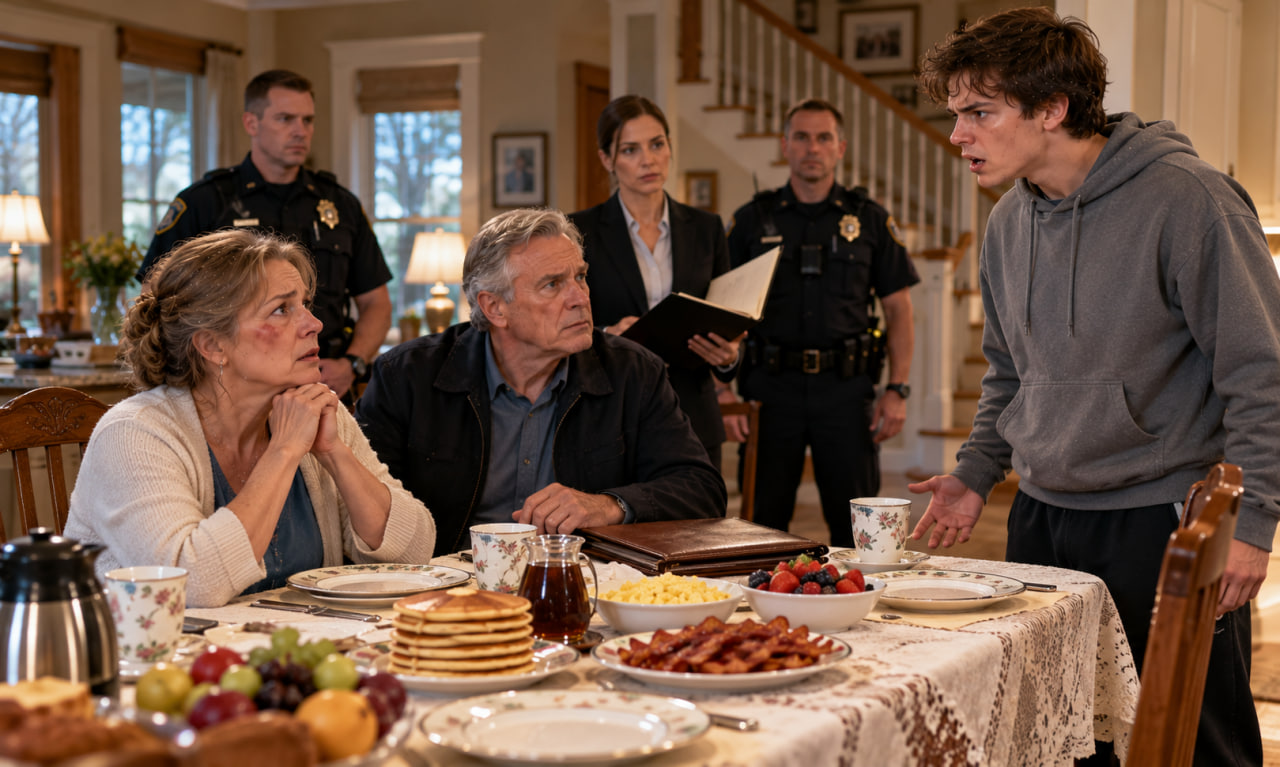
He stopped near the table, where the brown folder remained beside the embroidered tablecloth.
“Mom?”
I turned from the counter.
“What is it?”
He looked down at his bag.
“I don’t know what I’m supposed to do.”
For the first time that day, the question sounded honest.
I pulled out a chair but didn’t move closer to him.
“You can start by taking responsibility for your actions.
You can get help with your drinking and anger.
You can learn to support yourself. You can apologize without expecting forgiveness in return.”
He rubbed his forehead.
“I said I was sorry.”
“No, Tyler. You said you didn’t mean it.
You said I was destroying your life. You said everybody was against you.”
He swallowed.
“I don’t know how to fix this.”
“You don’t fix it in one afternoon.”
He finally looked at me.
There was something painfully familiar in his face.
I remembered the boy who used to cry after falling off his bicycle, embarrassed by his scraped knees and desperate for me to tell him everything would be all right.
I wanted to reach for him.
I wanted to tell him he could stay, that we could forget the folder and the officers and the terrible morning that had changed everything.
But I knew what would happen if I allowed my longing to make the decision.
He might feel relieved.
I might feel relieved.
And tomorrow, if nothing changed, we would be right back where we had started.
“I love you,” I said. “But you cannot live here under the same conditions anymore.
We need to follow the legal process, and you need to respect the boundaries being established.
I will not give you money for drinking. I will not lie for you. And I will not accept being hit again.”
He stared at the tablecloth.
Then he asked a question that nearly undid me.
“Do you hate me?”
“No.”
My answer came immediately.
“I hate what happened. I hate that I became afraid in my own home.
I hate that I waited so long to admit how serious things had become. But I do not hate you.”
He pressed his lips together.
A tear rolled down his cheek.
“I don’t know why I did it.”
I took a slow breath.
“Then you need to find out. And you need to do the work to make sure it never happens again.”
He nodded, though I couldn’t tell whether he understood.
He picked up his bag.
At the doorway, he stopped.
“I used to love your pancakes.”
I looked at the cold plate still sitting on the table.
“I know.”
He waited, perhaps expecting me to offer him one last plate, a hug, or a promise that he could come home whenever he wanted.
I didn’t offer any of those things.
Not because I wanted him to suffer.
Because the morning had taught me that affection without boundaries had become part of the problem.
Tyler walked out.
Richard followed to help him with the practical arrangements we had discussed. Ms. Harrison remained available for any further legal questions, and I stayed inside my house.
For the first time in years, I did not run after my son to make sure he wasn’t angry with me.
That evening, I took the embroidered tablecloth off the table.
I washed it carefully, smoothed the creases, and folded it into the linen cupboard beside the good napkins.
My mother’s tablecloth had survived decades of family dinners, birthdays, arguments, reconciliations, and holidays when everyone pretended not to remember what had happened the year before.
I had always believed that a family stayed together because someone was willing to forgive.
Now I understood that forgiveness was only one part of love.
Love also required honesty.
Accountability.
Respect.
And sometimes, the courage to say no to someone you would give anything to protect.
The next morning, I made myself one pancake.
Just one.
I sat at the kitchen table with a cup of coffee and watched the sunlight move slowly across the floor.
The house was quiet.
For years, I had thought silence meant peace.
But there was a difference between a house that was quiet because everyone was afraid to speak and a house that was quiet because nobody was threatening anyone.
This silence felt different.
It felt like room to breathe.
I didn’t know whether Tyler would seek help. I didn’t know whether he would take responsibility or spend months blaming me.
I didn’t know whether we would ever sit across from each other at this table again and speak honestly about what had happened.
I hoped he would change.
I hoped he would find his way back to the kind, curious boy I remembered.
But I finally understood that I could hope for his future without sacrificing my own.
At fifty-eight, I was learning something I should have learned decades earlier.
Being a mother did not mean accepting every wound her child inflicted.
Being forgiving did not mean pretending nothing had happened.
And loving someone did not require opening the door to the same harm over and over again.
Tyler had believed that the slap would break me.
He had believed I would cry, apologize, hand him the money, and return to the familiar role of a mother who cleaned up every mess he made.
Instead, I called for help.
I told the truth.
I protected myself.
And I began making decisions based on what was safe rather than what would keep my son happy.
I still loved him.
That was the hardest part.
I loved him enough to grieve the relationship we had lost, and I loved myself enough to stop pretending it was healthy.
Sometimes, the most difficult thing a mother can do is refuse to rescue her child from the consequences of his own behavior.
Not because she has stopped loving him.
But because she has finally understood that love cannot do the work he must do himself.
And sometimes, the first morning of a new life begins with cold pancakes, a folded tablecloth, and an empty chair.
Because a mother can forgive her son without surrendering her safety.
She can hope he changes without waiting for him to change.
And she can love him with her whole heart while finally choosing herself.