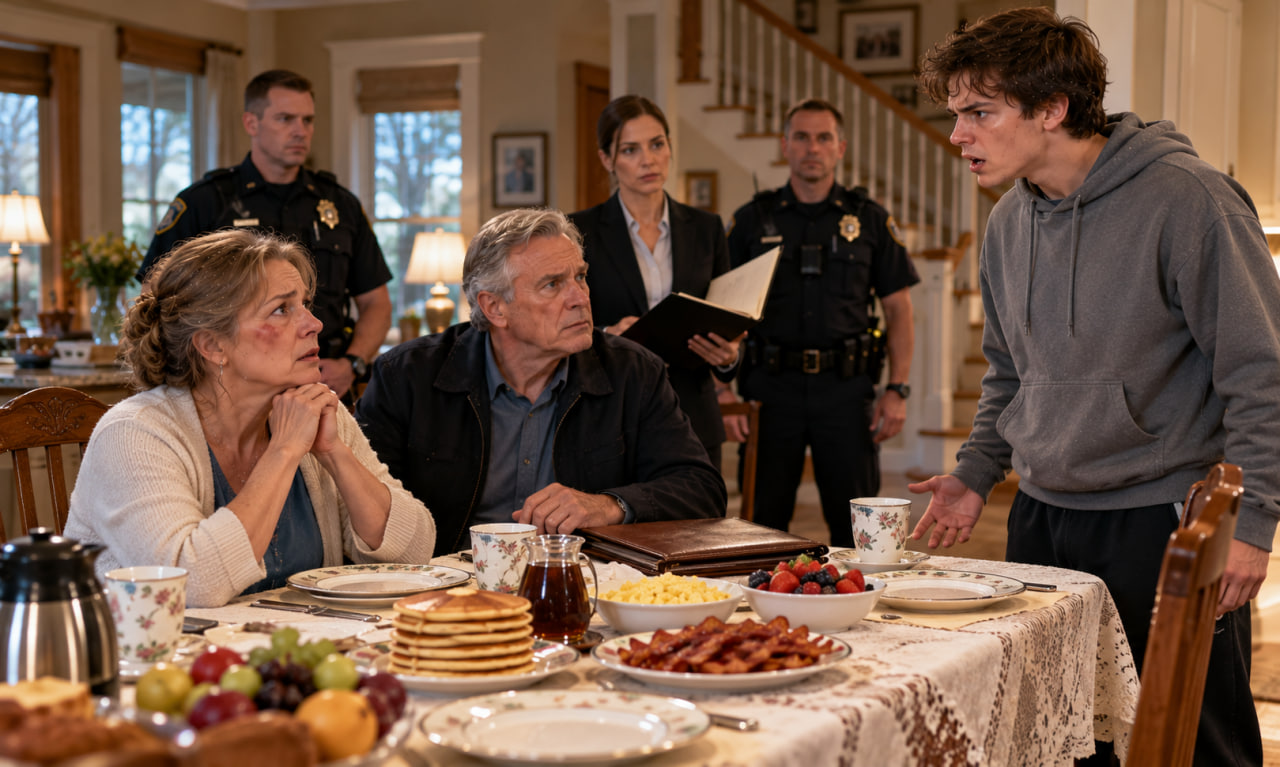
He shook his head.
“You’ve changed.”
“No, Tyler. I’ve finally stopped pretending.”
The officer closest to the door asked Tyler to remain calm while they discussed the reported incident.
Tyler began talking over him.
He said I was exaggerating. He said Richard had manipulated me.
He said the attorney was trying to frighten him.
He insisted that I had been threatening to cut him off for weeks and that anyone would eventually lose their temper under such pressure.
Ms. Harrison let him speak.
When he finished, she placed her pen on the table.
“Your mother saying no to giving you money does not justify physical violence,” she said. “Neither does an argument about household responsibilities.
You are responsible for your own actions.”
Tyler rubbed both hands over his face.
Then he pointed at me.
“She never tells you what she’s like when nobody else is around.”
I felt a familiar urge to defend myself, to explain every sacrifice and every night I had stayed awake worrying about him.
But I stopped.
I didn’t need to prove that I was a perfect mother to deserve safety.
I didn’t need to win an argument about my character before someone could acknowledge what had happened.
“I have made mistakes,” I said. “I have given you money when I shouldn’t have. I have allowed you to speak to me in ways I should never have accepted.
I have covered for you when I should have told the truth.”
Tyler’s eyes narrowed.
“So you admit it.”
“Yes. I admit that I made it too easy for you to avoid responsibility.”
He looked startled.
“But I did not make you hit me.”
The silence that followed was different from the silence after the slap.
This time, I wasn’t frozen.
I was waiting.
Waiting for him to understand that I wasn’t going to chase him around the room with explanations, begging him to agree that my pain was real.
He looked toward his father.
“Are you taking me to Cleveland?”
Richard glanced at me before answering.
“I can help you find somewhere safe to stay if your mother decides you cannot remain here.
But I’m not going to hide what happened, and I’m not going to pretend you did nothing wrong.”
Tyler laughed bitterly.
“Everybody’s against me.”
“No,” I said. “Everybody is tired of being afraid of you.”
For the first time, his eyes dropped to the floor.
After the officers had explained the immediate next steps, they continued handling the report according to their procedures.
Ms. Harrison stayed with me to discuss the legal arrangements and what would be needed to protect my home and my personal safety.
Tyler was furious.
He paced from the table to the living room, then back again.
He muttered about betrayal, humiliation, and how none of this would have happened if I had simply given him the money.
I listened without answering.
Finally, he stopped beside the kitchen doorway.
“Where am I supposed to go?”
There it was.
Not an apology.
Not concern about my cheek.
Not even a question about whether I was all right.
He wanted to know where he would sleep.
I took a breath.
“Your father can help you look at your options.
You can contact other relatives, too.
If you need assistance finding housing or support for your drinking and anger, we can give you information about services that may help.”
His face twisted.
“You’re sending me away like I’m some stranger.”
“No,” I said. “I’m setting a boundary because I love you and because I need to be safe.”
“If you loved me, you wouldn’t do this.”
That was the sentence I had feared for years.
It was the sentence that had kept me handing over money I couldn’t afford to lose, forgiving behavior that frightened me, and waking up every morning hoping that perhaps today would be different.
I looked directly at him.
“If loving you means allowing you to hurt me, then I have misunderstood love for a very long time.”
His eyes filled with tears.
For one brief moment, I thought he might finally come toward me and apologize.
Instead, he turned away.
“You’ll regret this.”
Richard stood up.
“Tyler, stop.”
“No! You all think you’re so righteous.
You think I’m the only person who’s ever made a mistake!”
Richard’s voice rose for the first time.
“Making a mistake is one thing. Hitting your mother and then blaming her is another.”
Tyler stared at his father, breathing hard.
Then he kicked the leg of a chair.
The sound made me flinch.
Richard noticed.
So did Tyler.
For a second, the room seemed to shrink around that tiny movement.
My son saw what his anger had done to me.
He saw my shoulders tighten and my hands pull instinctively toward my chest.
He had spent years claiming I overreacted.
But now he had seen the fear before I could hide it.
His expression changed.
Not into remorse, exactly.
More like the first uncomfortable awareness that the situation was no longer under his control.
He sat down heavily.
Nobody rushed to comfort him.
At around nine o’clock, the house finally became quiet.
Ms. Harrison had finished explaining the immediate legal steps to me.
Richard was helping Tyler gather a few essential belongings while we worked out the appropriate arrangements.
Nothing was being decided through shouting or threats anymore.
I stood in the kitchen, looking at the breakfast spread.
The pancakes had gone cold.
The bacon had lost its crispness.
The coffee tasted bitter.
I picked up a plate and carried it to the sink.
Then another.
Then another.
I had always cleaned up after Tyler.
After his parties.
After his arguments.
After his bad decisions.
After every situation in which I convinced myself that keeping the house peaceful was more important than acknowledging what was happening inside it.
I had even prepared a beautiful breakfast the morning after he hit me.
Part of me had hoped that the familiar smell of pancakes would bring the old Tyler back. Perhaps he would see the tablecloth and remember the mother who had loved him before life became complicated.
Perhaps he would apologize before anyone arrived.
Perhaps I could tell myself the slap had been an awful accident and that everything would return to normal.
But love cannot make an unsafe situation safe simply by setting a prettier table.
I turned off the coffee machine.
My hands began to shake.
Until then, I had been strong because there had been too much to do to fall apart.
Now there was nothing left to organize.
I gripped the edge of the sink and started crying.
I cried for the little boy who had once brought me pebbles from the park.
I cried for the young man who had lost his way and had begun hurting the people who loved him.
I cried for all the years I had mistaken rescuing him for helping him.
And I cried for myself.
For Margaret Collins, who was fifty-eight years old and had spent so much of her life being needed that she had forgotten she was also allowed to need protection.
Richard found me there a few minutes later.
He didn’t tell me to stop crying.
He didn’t say everything would be fine.