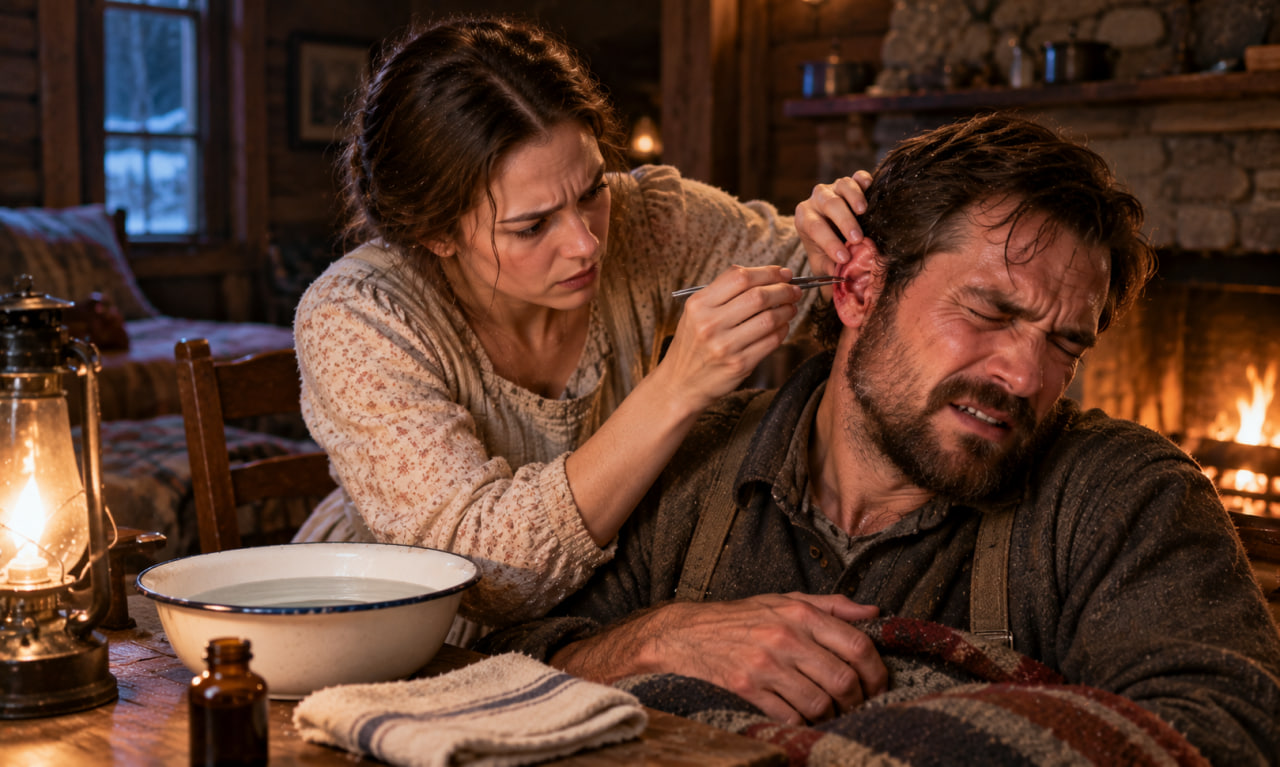
It was addressed directly to Elias.
My son,
If you are old enough to read this, then I pray you have escaped the people who destroyed our family.
There is one thing I never told you.
Your mother did not die from fever.
Clara stopped.
Elias seized the paper from her hand.
His eyes raced across the lines.
Then his entire body went still.
The letter continued.
They told you she became ill during the winter. They told you the doctor did everything he could.
That was a lie.
She found the first set of records. She was going to take them to Denver.
The night before she left, Samuel visited our house.
The following morning, your mother was dead.
I could not prove what he had done. I could not protect you. And when they came for me, I hid the evidence where no one would think to look.
I am sorry, my boy.
If you ever recover your hearing, do not waste your first words cursing the men who took it from you.
Use them to tell the truth.
Clara lowered the letter.
The room was silent except for the fire.
Elias looked as if the world had opened beneath his feet.
For thirty years, he had believed his mother had died from a fever.
For thirty years, he had believed his father had abandoned him when he was sent away to live with distant relatives.
For thirty years, he had believed that his deafness was a terrible accident.
Now every memory had become a question.
And every question led back to the same three men.
Thomas Thorne had died when Elias was still a child, officially after an accident on a mountain road.
His mother had died months earlier.
And the only man who could have explained what happened was the doctor who had repeatedly insisted that Elias’s condition was incurable.
Clara felt a surge of anger so fierce that it frightened her.
“They stole your family,” she whispered.
Elias couldn’t hear her.
But he saw her expression.
She took his notepad and wrote:
“WE WILL FIND THE TRUTH.”
He stared at the words.
Then he looked at her wedding ring.
For a moment, Clara wondered if he regretted marrying her.
Perhaps he believed that bringing her into his life had placed another person in danger.
But instead of pushing her away, Elias reached for her hand.
He held it carefully, as though he had never imagined anyone would voluntarily stand beside him.
Then he wrote two words.
“NOT WE.”
Clara frowned.
He took the pencil again.
“THEY WILL COME FOR YOU TOO.”
She looked at him.
“Let them.”
He shook his head.
His eyes were filled with a fear she had never seen before.
He wrote:
“YOU DON’T KNOW WHAT THEY DID TO MY FATHER.”
Clara leaned closer.
“Then tell me.”
Elias looked at the locked iron box.
Then he pointed to the map.
And for the first time that night, he did something Clara had never seen him do.
He smiled.
It wasn’t a happy smile.
It was the smile of a man who had finally found someone willing to walk into the darkness with him.
He wrote:
“TOMORROW, WE GO TO THE MINE.”
They left before sunrise.
The storm had weakened, but the mountains remained buried beneath a thick layer of snow. Clara wore two coats, a wool scarf, and her father’s old boots. Elias carried a lantern, a small shovel, a coil of rope, and the iron box wrapped in canvas.
Before they departed, Clara placed the parasite and copper fragment inside a sealed glass jar.
She had no idea what the creature was or how it had survived inside Elias’s ear for so many years. She only knew that the pain he had endured was real, and the town doctor had never given him an honest explanation.
They would need help from someone who wasn’t connected to Samuel Whitmore.
But first, they needed proof.
The old mining road twisted through the trees. In places, snow covered it completely, forcing them to follow the faint tracks left by animals.
Clara stumbled several times.
Each time, Elias stopped and offered his hand.
He never laughed.
He never grew impatient.
He simply waited until she was steady again.
It was such a small kindness, but Clara found herself thinking about all the men in Blackwood who had laughed when she walked down the aisle.
They had called her unwanted.
They had called her ugly.
They had treated her marriage as a joke.
Yet the man they had mocked was the only person who had treated her with dignity.
By midmorning, they reached the ravine.
The river below was nearly frozen, but beneath the ice, the water ran dark.
Clara understood the words from Thomas’s letter.
Where the river turns black.
Elias led her toward a narrow opening hidden behind a wall of pine branches.
The entrance to the mine was nearly invisible beneath the snow.
A weathered wooden beam lay across it.
The sign above the opening had almost rotted away.
Clara brushed snow from the lettering.
BLACKWOOD MINING COMPANY — EASTERN TUNNEL.
She turned to Elias.
“How did you know this place existed?”
He opened his notepad.
“MY FATHER BROUGHT ME HERE ONCE.”
He paused.
Then added:
“THE NIGHT BEFORE HE DIED.”
Clara felt a chill that had nothing to do with the weather.
Elias pushed aside the branches.
The darkness beyond the entrance seemed endless.
He lit the lantern.
Its glow revealed rough stone walls, rusted rails, and scattered pieces of timber. The air smelled of damp earth and old metal.
Clara stepped inside.
After only a few yards, she noticed something strange.
There were footprints in the snow near the entrance.
Fresh footprints.
Someone had been here recently.
Elias noticed them too.
He crouched beside the tracks, studying their depth.
Then he looked at Clara and held up three fingers.
Three people.
At least.
He pointed toward the darkness ahead.
They continued cautiously.
The tunnel narrowed, then opened into a large chamber supported by thick wooden beams. Old mining equipment lay scattered across the floor. A broken lantern rested beside a rusted cart.
Clara spotted something on the wall.
A series of names had been carved into the wood.
She moved closer.
There were seventeen names.
Beside each name was a date.
Some dates were separated by months.
Others by only days.
At the bottom, someone had carved a sentence.
WE DID NOT DIE IN AN ACCIDENT.
Clara touched the words.
“These were the miners.”
Elias nodded.
He pointed toward the far end of the chamber, where a wooden door stood half concealed behind a collapsed support beam.
They approached it slowly.
The door was locked.
Elias took the small key from his leather cord.
It fit.
Inside was a narrow room containing shelves, broken chairs, and several rusted filing cabinets.
Most of the papers had disintegrated.
But one cabinet remained intact.
Clara pulled open the top drawer.
Inside lay a leather ledger wrapped in oilcloth.
She unfolded the covering.
The pages were stained, but the handwriting was still readable.
Names.
Dates.
Payments.
And columns of numbers.
At first, Clara couldn’t understand what she was looking at.
Then she noticed that the same three names appeared repeatedly.
Samuel Whitmore.
Charles Whitmore.
And a third man whose name she recognized from the photograph.
Nathaniel Crowe, president of Blackwood Mining and Medical Company.
Beside their names were payments made to families of dead miners.
Except the amounts didn’t match.
Some families had received nothing.
Others had been paid only after signing statements claiming their husbands had died from natural causes.
And one name appeared more often than any other.
Thomas Thorne.
Clara turned the page.
There was a record of a payment made to Samuel Whitmore on the night Elias’s father died.
The description read:
Medical services and permanent silence.
Clara’s hand flew to her mouth.
Permanent silence.
The phrase seemed to stare back at her from the paper.
Then she found another entry.
Subject: Elias Thorne, age eight.
Procedure authorized.
Outcome: successful auditory suppression.
Payment released upon confirmation of long-term impairment.
Clara’s knees nearly gave way.
There it was.
Proof.
Not an accident.
Not a childhood illness.
A deliberate procedure.
The doctor had documented what he had done to a child as if he were repairing a broken wagon.
Clara turned toward Elias.
He was staring at the page.
His face had gone completely white.
He reached for the ledger.
His fingers traced the words.
Then he pressed the paper against his chest and closed his eyes.
For thirty years, he had wondered what was wrong with him.
Now he knew.
Someone had decided that a little boy should never hear the world again.
Clara put her arms around him.
This time, he didn’t pull away.
He held her so tightly that she could feel his heart beating against her shoulder.
And for a few moments, they stood together in the darkness, mourning the childhood he had lost.
Then Clara heard a sound.
A scrape.
From the other side of the door.
She lifted her head.
Elias felt her body stiffen and immediately turned toward the entrance.
Footsteps echoed through the chamber.
Slow.
Measured.
Unhurried.
Someone had followed them into the mine.
A man’s voice drifted through the darkness.
“Mr. Thorne.”
Clara recognized it immediately.
Dr. Samuel Whitmore.
“I was wondering how long it would take you to come back here.”
Elias seized Clara’s wrist and pulled her behind the filing cabinet.
The lantern flame flickered.
Whitmore continued speaking.
“You should have stayed on your farm, Elias. You were always much easier to manage when you didn’t ask questions.”
A second voice answered him.
Mayor Charles Whitmore.
“Have you found the ledger?”
“Not yet.”
“Then find it.”
Clara held her breath.
The doctor stepped into the room.
He carried a revolver.
Behind him stood two men wearing heavy coats.
One held a lantern.
The other carried a shovel.
Samuel Whitmore surveyed the room with mild irritation.
Then his gaze fell upon the open cabinet.
The ledger was missing.
His expression changed.
“He’s been here.”
Charles swore.
“Find them.”
The men began searching the chamber.
Clara looked at Elias.
There was no way to escape through the main entrance without being seen.
But she had noticed something earlier.