PART 3
Her mother had never explained why she kept it.
She had only said one thing when Clara was a little girl.
“If you ever see that mark again, Clara, remember that some men will bury the truth before they allow it to destroy them.”
At the time, Clara had thought it was merely another strange saying from a woman who spent too many nights staring into the fireplace.
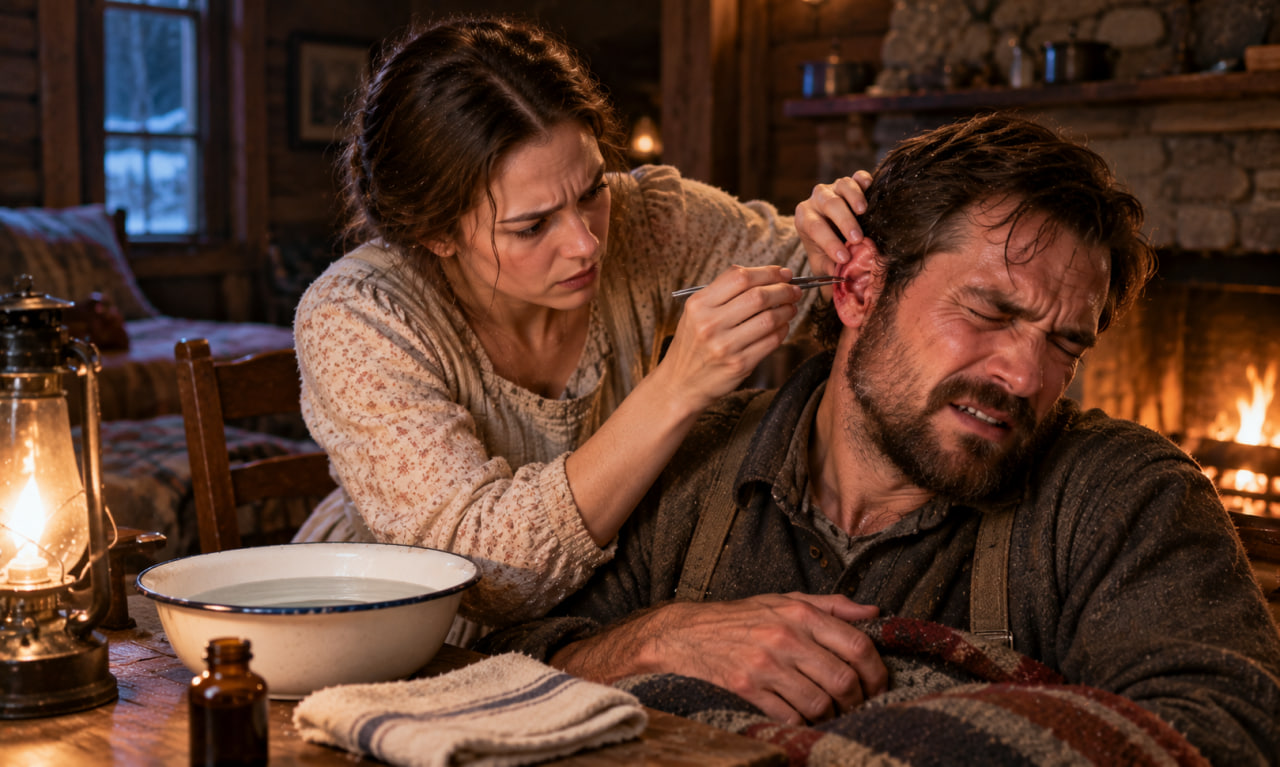
Now, standing over her husband’s trembling body, she felt those forgotten words crawl back into her mind.
“Elias?”
He couldn’t hear her.
His eyes were fixed on the copper fragment.
For the first time since Clara had met him, his expression was not merely frightened.
It was horrified.
She quickly wrapped the parasite in the cloth and set it aside. Then she pressed another clean cloth gently against his ear.
“Elias, look at me.”
He didn’t.
He reached for the notepad with shaking fingers.
The pencil slipped from his hand.
Clara picked it up and placed it between his fingers.
He struggled to write.
The first attempt produced only a crooked line.
He tried again.
Finally, he turned the notepad toward her.
“WHERE DID YOU FIND IT?”
Clara frowned.
“Inside your ear.”
He shook his head violently.
He pointed at the copper fragment.
Then he wrote again.
“THE MARK. WHERE HAVE YOU SEEN IT?”
Clara felt the blood drain from her face.
“On an old newspaper clipping that belonged to my mother.”
Elias stared at her.
For several seconds, neither moved.
Then he grabbed the pencil and wrote three words so forcefully that its tip snapped.
“YOUR MOTHER KNEW.”
Clara stepped backward.
“What do you mean?”
Elias looked toward the window.
Snow swept across the glass, hiding the mountains beyond it. The fire crackled, and somewhere in the barn, a horse stamped its hoof.
He turned back to Clara.
Then, slowly, he began writing.
“MY FATHER SAID THE SAME THING.”
Clara sat down.
Elias continued.
“My father?”
He nodded.
She had heard almost nothing about Elias’s family. The people of Blackwood spoke of him as though he had appeared from the mountains one winter, already deaf, already strange, already deserving of their suspicion.
No one talked about his parents.
No one mentioned his childhood.
And whenever Clara had tried to ask about his past, Elias had closed his notepad and walked away.
Now, for the first time, he seemed determined to tell her something.
He wrote one sentence.
“I WAS NOT BORN DEAF.”
Clara forgot how to breathe.
She read the words once.
Then again.
“You weren’t?”
He shook his head.
He placed a trembling finger against his right ear, where the skin was swollen and streaked with blood.
Then he pointed to the parasite.
“THEY PUT SOMETHING IN MY EAR WHEN I WAS EIGHT.”
Clara covered her mouth.
Eight years old.
A child.
Someone had deliberately put that thing inside a little boy’s ear.
“But who would do that?”
Elias’s eyes filled with tears.
He looked down at his hands.
For a long moment, he didn’t write anything.
Then he turned to a fresh page.
“THE MAN WHO DID IT WAS THE MOST RESPECTED DOCTOR IN BLACKWOOD.”
Clara felt the room tilt around her.
Doctor Samuel Whitmore.
The same doctor who had attended her wedding.
The same man who had shaken Elias’s hand in the churchyard and joked that Clara would finally have a husband who couldn’t hear her complain.
The same man who had examined Elias countless times and insisted there was nothing that could be done.
Clara remembered the doctor’s silver watch, his immaculate coat, and the way he had smiled whenever someone mentioned Elias’s deafness.
She had never questioned him.
Why would she?
In Blackwood, Samuel Whitmore was considered a saint.
He delivered babies, treated the sick, and occasionally provided medicine to families who couldn’t afford it.
People trusted him with their lives.
And apparently, he had spent twenty years allowing a man to suffer from something he himself had caused.
Clara looked at Elias.
“Why?”
He didn’t answer immediately.
Instead, he reached beneath his shirt and pulled out a thin leather cord.
Hanging from it was a small, tarnished key.
He placed it in Clara’s palm.
Then he wrote:
“MY FATHER LEFT ME SOMETHING. IF I DIED, I WAS SUPPOSED TO GIVE IT TO NO ONE.”
Clara stared at the key.
“Then why are you giving it to me?”
Elias looked directly into her eyes.
He wrote slowly, carefully, as if every word cost him something.
“BECAUSE YOU ARE THE FIRST PERSON WHO TRIED TO SAVE ME.”
Clara’s throat tightened.
For the first time since the wedding, she understood something about her husband.
His silence had never meant he had nothing to say.
It meant someone had taken away his ability to speak freely long before they took away his hearing.
And the world had mistaken his suffering for stupidity.
Clara closed her fingers around the key.
“Show me what your father left you.”
Elias hesitated.
Then he pointed toward the bedroom.
The box was hidden beneath a loose floorboard behind the bed.
It took Elias several minutes to lift the heavy plank. His hands were still trembling, and every movement seemed to send another wave of pain through his head.
Clara wanted him to rest.
He refused.
Whatever waited beneath that floor had haunted him for thirty years.
Neither of them could leave it there any longer.
Elias pulled out a small iron box, blackened with age. The lock was rusted, but the key fit perfectly.
When Clara turned it, something clicked.
Inside lay three objects.
A faded photograph.
A bundle of letters tied with twine.
And a folded map marked with the same symbol engraved on the copper fragment.
Clara picked up the photograph first.
It showed three men standing outside a wooden building. Two wore formal coats. The third wore a doctor’s apron.
The man in the center was young, perhaps thirty, with dark hair and a stern expression.
Elias touched the photograph.
Then he pointed at the man in the center.
“My father?”
He nodded.
Clara studied the faces.
The man standing on the left looked familiar.
She couldn’t place him immediately, but something about his narrow eyes and carefully trimmed beard stirred a memory.
Then she recognized him.
Mayor Charles Whitmore.
Samuel Whitmore’s older brother.
The man who had presided over town meetings for nearly twenty years.
The man who had publicly supported Clara’s father’s humiliating wager, laughing alongside the other men while she stood in her wedding dress.
Clara’s stomach twisted.
“And the doctor?”
Elias pointed to the man on the right.
Samuel Whitmore.
Younger, but unmistakable.
All three men stood beside a sign reading:
BLACKWOOD MINING AND MEDICAL COMPANY — 1896.
Clara stared at the date.
Something was wrong.
The copper fragment had been engraved with 1876, but the photograph was taken twenty years later.
She looked at the map.
It showed the surrounding mountains, the old mining roads, and a location marked with a red cross near a narrow ravine north of Elias’s property.
In the corner, someone had written:
Where the earth swallowed the evidence.
Clara unfolded the first letter.
The handwriting was hurried and uneven.
To whoever finds this,
If my son is still alive when you read these words, then I have failed to protect him.
They know what I discovered.
They know I kept copies.
And now they have decided that my family must pay for my refusal to remain silent.
Clara felt cold despite the fire burning behind her.
She continued reading.
The mine beneath Blackwood was never closed because it ran dry. It was closed because men were dying, and the company could no longer hide what was happening.
They blamed the mountain.
They blamed the weather.
They blamed the men who entered the tunnels.
But the truth lies in the records.
And the records are buried where the river turns black.
The letter ended with a name.
Thomas Thorne.
Elias’s father.
Clara looked at her husband.
“Your father discovered something about the mine?”
Elias nodded.
He turned the page of his notepad and wrote:
“HE WAS THE ACCOUNTANT.”
That surprised her.
She had assumed Elias’s father had been a miner, perhaps someone who worked with his hands and knew the mountains.
But an accountant would have seen the company’s records.
He would have known about its payments, its accidents, its hidden expenses.
He might have known exactly how many men had died.
Clara returned to the letters.
The next one was dated October 1896.
Samuel has agreed to help us.
He says the substance in the eastern tunnels is poisoning the men. He believes he can prepare a treatment to protect them while we bring the matter before the authorities.
For the first time in months, I feel hopeful.
Clara looked up.
Samuel had once been an ally.
Then she reached the next letter.
Its date was only twelve days later.
I was wrong about Samuel.
He is not trying to save the men.
He is trying to keep the company open.
He has told Charles that if the workers speak, the company will collapse, and the town will lose everything.
They have decided that a few lives are a reasonable price to pay.
Clara’s hands began to shake.
The next lines were smudged, as if the writer had been crying or writing in the rain.
I confronted Samuel tonight.
He told me that no one would believe an accountant over a doctor and a mayor.
He told me that if I continued, my son would suffer the consequences.
I laughed at him.
I thought he was bluffing.
God forgive me, I thought he was bluffing.
Clara stopped reading.
She looked at Elias.
He had turned his face toward the fireplace.
His shoulders were rigid.
A single tear ran down his cheek.
Clara gently touched his arm.
He flinched at first, then allowed her to hold it.
She understood now that the parasite was only part of the story.
Someone had wanted Elias to suffer.
Someone had wanted him unable to speak about what happened to his father.
Someone had ensured that the town would dismiss anything he tried to communicate.
But one question remained.
Why had Samuel Whitmore waited so many years to finish what he started?
Clara found the answer in the final letter.