PART 4
The first time Evan saw me after the fall, he didn’t come to the hospital.
He came to my father’s house.
I learned this from Rachel, my lawyer, who called me one afternoon while I sat beside Lily’s incubator.
“Mia, your husband has contacted us. He wants to return to the house and collect some belongings.”
I looked at my daughter sleeping beneath her little knitted cap.
“What did you tell him?”
“That all communication should go through the appropriate channels while we work through the legal arrangements. You don’t have to meet with him.”
I let out a breath I hadn’t realized I was holding.
“Thank you.”
After we hung up, I looked at the tiny hand resting against Lily’s blanket.
I had once believed that marriage meant standing beside someone through every difficulty. I had believed that if I loved Evan enough, he would eventually learn to love me with the same patience.
But lying in the snow had taught me something I could never forget.
When I had needed him most, he had chosen to leave.
And I couldn’t build a safe future for my daughter by pretending that choice had never happened.
Over the following days, Rachel helped me arrange temporary accommodations and begin the process of separating our affairs. The authorities continued reviewing the footage and the other evidence. I didn’t know how long everything would take, but I knew I didn’t have to face it alone.
Then, on a cold Thursday morning, Detective Harris called.
“Mia, I wanted to update you. We’ve spoken with your husband and mother-in-law, and we’ve recovered the crib. It’s being held while the ownership and circumstances are documented.”
I covered my mouth.
“My father’s crib?”
“Yes. We have photographs and a record of where it was found. We’ll explain the next steps for recovering your property.”
For the first time in weeks, I cried tears that weren’t entirely born of pain.
“Thank you,” I whispered.
After the call, I told Lily about her grandfather.
I described his warm hands, his terrible jokes, and the way he used to hum while working in his garage.
I told her how he had spent months making her crib, sanding every corner until it was smooth enough that no splinter could ever hurt her.
“He wanted you to have something made with love,” I whispered. “And I promise you, sweetheart, nobody gets to take that love away from you.”
Lily stirred in her sleep.
Her tiny fingers curled around mine.
And I knew I would keep that promise.
Three weeks after the fall, Lily was finally strong enough to leave the hospital.
The doctors gave us detailed instructions and arranged follow-up appointments. I listened to every word, asked questions, and wrote down everything I needed to remember.
When a nurse placed Lily in my arms for the journey home, I looked down at her little face and felt my heart fill with a kind of love I had never known before.
We weren’t going back to the house immediately.
Rachel had helped me arrange a temporary place to stay while the legal situation was addressed. It was a small, quiet apartment with wide windows and enough room for a bassinet beside my bed.
It wasn’t the home my father had left me.
It wasn’t the nursery I had prepared.
But it was safe.
And for now, safe was enough.
My best friend, Claire, came to help me settle in. She brought groceries, clean blankets, and a small vase of white flowers.
When she saw me standing in the living room with Lily in my arms, she began to cry.
“I was so scared when you called me from the hospital,” she whispered.
I hugged her carefully.
“So was I.”
Claire had been the person I called when I first learned my father was dying. She had sat with me through the funeral and helped me sort through his belongings when I couldn’t bear to do it alone.
She had also warned me, more than once, that Evan didn’t treat me the way I deserved.
I had defended him every time.
Now I wished I had listened.
But Claire never said, I told you so.
She simply helped me prepare Lily’s bottles and showed me where she had put the diapers.
That evening, after Claire left, I sat beside the bassinet and watched my daughter sleep.
For the first time in weeks, there were no shouting voices, no accusations, and no one telling me that my feelings were inconvenient.
There was only the quiet sound of Lily breathing.
And it was enough.
Evan’s first real attempt to reach me came through a letter.
Rachel forwarded it after confirming that I wanted to receive it.
The envelope contained three handwritten pages.
The first began with the words:
Mia, I know you’re angry, but you need to understand that everything happened very quickly.
I nearly stopped reading.
He wrote that Vanessa had been desperate for somewhere to put the twins. He wrote that Patricia had been under pressure. He wrote that he had believed I would eventually calm down and agree that helping family was the right thing to do.
He described the fall as an unfortunate accident.
He said he had been shocked.
He said he hadn’t known what to do.
But he never wrote that he was sorry for leaving me.
He never mentioned the blood on the snow.
And he didn’t ask how Lily was doing.
The final paragraph was the part that made my hands tremble.
I want us to move past this. My mother is devastated, and Vanessa is frightened about what the police might do. Please tell them you slipped. We can settle this privately, like a family.
I read that paragraph twice.
Then I placed the letter on the table.
For years, I had mistaken Evan’s ability to sound reasonable for proof that he was right.
He could turn cruelty into a misunderstanding and selfishness into a family obligation. He could make me feel guilty for being hurt by things he had chosen to do.
But the letter revealed something I could no longer ignore.
Even now, after everything, he was asking me to protect him.
I called Rachel.
“I don’t want to respond,” I said.
“You don’t have to.”
“And I don’t want to change my statement.”
“You should continue telling the truth. Let the authorities determine what the evidence establishes.”
I thanked her and ended the call.
Then I tore the envelope into pieces.
I kept the letter because Rachel advised me to preserve relevant communications, but I stopped rereading it.
I had spent enough time trying to understand a man who had never made a serious effort to understand me.
Now I had a daughter who needed me to look forward.
So that was what I did.
The next month brought more difficult news.
Vanessa’s husband, Daniel, contacted Rachel after learning that the crib had been recovered.
He said he hadn’t known how the crib had been obtained.
According to his statement, Vanessa had told him that Evan and I had agreed to lend it to them. He had believed her.
Rachel asked whether he was willing to provide information to clarify what had happened.
He agreed.
Daniel also sent a message to me through my lawyer.
He wrote that he was sorry for what had happened and that he had never intended for Lily to be harmed.
I appreciated that he had reached out, but I wasn’t ready to forgive anyone simply because they expressed regret.
There was a difference between accepting an apology and allowing someone back into your life.
I had learned that difference the hard way.
As the investigation continued, the security recordings became an important part of the evidence. The authorities reviewed the footage alongside the accounts given by those involved.
I learned that Evan and Patricia had initially described the incident as a fall.
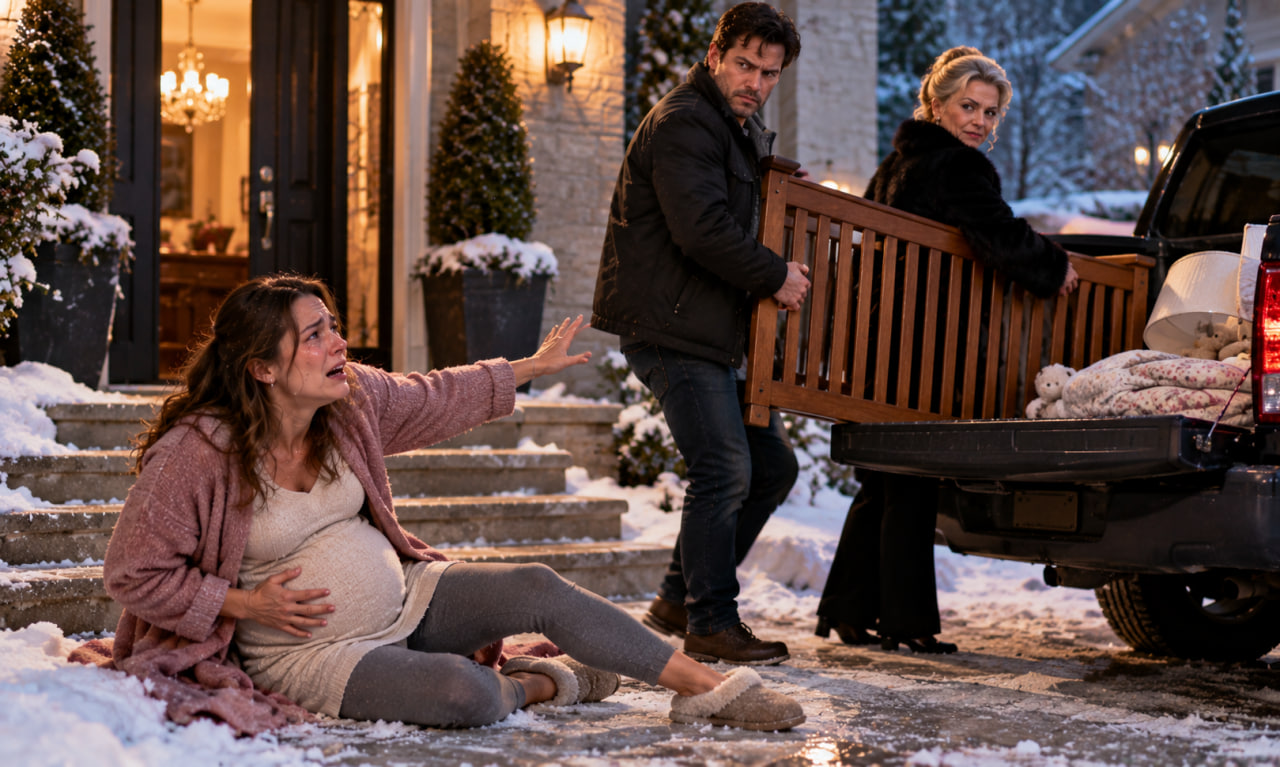
But the recordings showed Patricia pushing me.
They showed me losing my balance and striking the concrete.
And they showed the truck leaving while I remained on the ground.
The footage couldn’t tell anyone everything that had happened inside our home, but it could establish what occurred on the porch.
I didn’t need to embellish the truth.
I didn’t need to beg anyone to believe me.
The evidence could speak for itself.
Eventually, the authorities informed me that the case would proceed through the appropriate legal channels. I was advised to continue following my lawyer’s guidance and to avoid direct contact with Evan and Patricia.
There would be more waiting, more paperwork, and more difficult days.
But the fear that had once controlled me was beginning to lose its grip.
I was no longer sitting in the dark, wondering whether I had imagined the cruelty.
I knew what had happened.
And I knew I had done the right thing by telling the truth.
Two months after Lily came home, I returned to my father’s house with Rachel and a trusted friend to collect some personal belongings.
The legal arrangements allowed us to make the visit safely, and I had no intention of staying longer than necessary.
When I opened the front door, the familiar smell of the house washed over me.
For a moment, I couldn’t move.
The hallway still held the little framed photograph of my father standing beside his workbench. The kitchen clock still ticked above the doorway. My coat was still hanging on the hook where I had left it.
But the house felt different.
The nursery door was open.
I stepped inside.
The room was nearly empty.
The rocking chair was gone. The blankets had disappeared. The little shelf where I had arranged Lily’s books stood bare against the wall.
I placed my hand over my mouth.
For weeks, I had imagined that returning home would make everything feel right again.
Instead, I felt the full weight of what had been taken from me.
Rachel stood quietly in the doorway.
“Do you want to leave?”
I shook my head.
“Not yet.”
I walked to the window and looked out at the snow-covered garden.
My father had planted a small tree there when I was a child. Every spring, it produced white blossoms, and every autumn, its leaves turned gold.
He used to tell me that trees didn’t hurry to prove they were growing.
“They just keep reaching for the light,” he would say.
I had never understood why he repeated that sentence so often.
Now I did.
I had been trying so hard to save my marriage that I had forgotten I was allowed to save myself.
I had believed that being strong meant enduring more.
But perhaps strength meant recognizing when endurance was no longer the answer.
I turned away from the window.
“I want to take his photograph,” I said.
Rachel nodded.
I lifted the frame from the wall and held it against my chest.
Then I collected the documents I needed, checked the rooms, and left.
I didn’t look back until I reached the car.
The house was still mine.
The memories were still mine.
And one day, when Lily was older, I would bring her back there if it was safe and appropriate.
But I would never again confuse a building with a home.
A home was supposed to be a place where love could breathe.
I was going to build that kind of home for my daughter, even if I had to begin with four walls and a borrowed bassinet.
The legal proceedings took time.
There were interviews, records to review, and difficult conversations with people who had once been part of my everyday life.
I learned to stop measuring progress by how quickly everything ended.
Some days, progress meant answering a difficult email.
Other days, it meant taking Lily to an appointment, coming home, and allowing myself to sleep for two uninterrupted hours.
I also began reviewing the financial records I had gathered.
The statements showed several transfers from our joint account that Evan had never adequately explained. Rachel helped me separate the facts from my suspicions and determine what needed further examination.
Some of the money had gone toward ordinary household expenses.
Other transfers required clarification.
I refused to make assumptions before the records were fully reviewed.
For the first time, I was learning to protect myself without letting anger make my decisions.
Meanwhile, Evan continued trying to contact me.
Sometimes he sent long messages through relatives. Sometimes he asked whether I would consider counseling. Once, he sent a photograph of himself holding a baby blanket he had bought before Lily was born.
His message read:
I should have been there when she came into the world.
I stared at the photograph for a long time.
Perhaps he finally understood what he had lost.
Perhaps he was frightened by the consequences of his actions.
Perhaps he genuinely regretted what had happened.
But regret did not automatically restore trust.
I had no way to know whether he was becoming a different person, and I wasn’t willing to risk my daughter’s safety while waiting to find out.
I sent the message to Rachel and did not respond.
I had already spent too much of my life believing that someone’s potential mattered more than their behavior.
Now I judged people by what they actually did.
And Evan’s actions had already told me enough to make one decision.
I would not return to the marriage simply because he wanted me to.
Spring arrived slowly that year.
The snow melted from the sidewalks, the days grew longer, and the little tree in my father’s garden began to blossom.
Lily grew stronger, too.
At her follow-up appointments, her doctors were pleased with her progress. She still needed careful monitoring, but she was gaining weight and becoming more alert.
One morning, I found her staring at the sunlight falling across her blanket.
I sat beside her and smiled.
“What are you looking at, little one?”
She waved her arms and made a tiny sound that was almost a laugh.
I laughed with her.
Then I cried, because there had been a time when I feared I would never hear that sound.
Claire visited that afternoon and found me sitting on the floor beside Lily’s play mat.
“You look different,” she said.
I glanced up.
“Different how?”
“Like you’re finally breathing again.”
I considered that.
“I think I am.”
She sat beside me.
“Do you miss him?”
The question caught me off guard.
I looked at Lily, who was busy attempting to grab her own foot.
“I miss who I thought he was,” I admitted. “I miss the life I thought we were building. But I don’t miss being afraid to say no.”
Claire nodded.
“That’s a big difference.”
“It is.”
I had loved Evan.
That was true.
I had also been hurt by him.
That was true, too.
One truth did not erase the other.
I didn’t need to pretend I had never loved him to acknowledge that our marriage was no longer safe for me.
And I didn’t need to hate him forever to decide that I would not go back.
That evening, I opened the box containing my father’s belongings.
Inside were his old work gloves, a small notebook, a few photographs, and a wooden flower he had carved years before he began making Lily’s crib.
Beneath them lay an envelope with my name written across the front.
I recognized his handwriting immediately.
My hands began to shake.
I had read his will, sorted through his papers, and gone through his belongings after his death, but I had never seen this letter.
Perhaps I had overlooked it.
Perhaps he had placed it there for me to find when I needed it most.
I opened it carefully.
Mia,
If you’re reading this, I hope you’re happy. I hope you’re surrounded by people who remind you how wonderful you are, especially on the days when you forget.
I know you sometimes try too hard to keep everyone happy. You have always had a generous heart, and that is one of the things I love most about you.
But never confuse being generous with allowing someone to take everything from you.
You can love people without giving them permission to hurt you.
You can forgive someone without inviting them back into your life.
And you can walk away from a situation that is breaking your heart without being a failure.
When I made the crib, I wanted my granddaughter to have something beautiful. But the wood was never the most important part.
The most important part was the love I put into it.
Remember that love is not measured by what you sacrifice. It is measured by how you care for one another.
I won’t always be here to tell you these things, sweetheart. But I hope you carry them with you.
Always remember that you are worth protecting.
Love, Dad.
I pressed the letter against my chest.
For months, I had been trying to save the family I thought I was supposed to have.
My father had been reminding me, even after his death, that I was allowed to protect the family I actually had.
I looked at Lily.
She was watching me with wide, curious eyes.
I kissed her forehead.
“Your grandpa was a wise man,” I whispered.
And for the first time since his death, the ache of missing him was accompanied by something else.
Peace.
Several months later, the legal process reached a turning point.
The authorities completed their review of the available evidence, and the case proceeded through the relevant legal channels. I attended the necessary meetings with Rachel, answered questions truthfully, and allowed the process to move forward.
I won’t pretend it was easy.
Hearing people question my account hurt.
Learning that Evan and Patricia continued to minimize their actions hurt even more.
But I reminded myself that I wasn’t there to punish them through anger.
I was there to tell the truth and protect my daughter.
Eventually, the legal matters surrounding the incident were resolved through the appropriate process. The outcome included consequences for those responsible, although the exact terms were private.
The arrangements concerning the house and our separation were also finalized.
I retained my father’s home, and Evan was no longer living there.
The financial matters were addressed through the legal process as well. The records were examined, the accounts were separated where appropriate, and I began rebuilding my financial independence without relying on promises from someone who had repeatedly broken my trust.
I had expected to feel triumphant.
Instead, I felt tired.
Then relieved.
Then, finally, free.
There was no dramatic celebration.
No crowd applauding me.
No perfect speech that erased everything I had endured.
There was simply a morning when I woke up, looked at Lily sleeping beside me, and realized I was no longer afraid of the next message from Evan.
I could make plans without wondering whether his mother would interfere.
I could spend money on my daughter without having to justify every decision.
I could say no without preparing myself for an argument.
The quiet felt unfamiliar at first.
Then it began to feel like happiness.
The crib was returned to me after the necessary arrangements had been completed.
When it arrived, the delivery workers carefully carried the pieces into the nursery.
I stood in the doorway, holding Lily against my chest.
The walnut panels were wrapped in protective blankets. The rails were stacked neatly beside the headboard, and the little carved flower was still there.
I ran my fingers over it.
There were a few small scratches, but the wood was intact.
For a moment, I couldn’t speak.
I had thought about this day so often that I had almost convinced myself it would never happen.
I expected to feel anger when I saw the crib again.
Instead, I felt grief for my father, relief that his work had survived, and gratitude that I could finally bring the last piece of his gift back where it belonged.
I hired a professional to inspect and reassemble it, making sure it met current infant-safety standards before Lily would ever sleep in it.
I wasn’t willing to take shortcuts with her safety.
While the work was being completed, I sat in the rocking chair Claire had helped me recover and watched the afternoon light move across the nursery walls.
The room was different now.
I had repainted it a soft cream color and replaced the curtains with simple white ones. A small bookshelf stood beside the window, filled with children’s books.
On the wall above it hung my father’s photograph.
The room no longer looked exactly as it had before the fall.
But perhaps that was fitting.
Neither did I.
When the crib was finally ready, I stood beside it for a long time.
Then I placed my father’s letter in a protective frame and hung it beside the photograph.
Lily would be too young to understand the words for years.
But one day, I hoped she would read them.
One day, I would tell her how much her grandfather had loved her.
I would tell her that the crib had been made by hand, with patience and care.
And I would tell her that even when people tried to take something precious from us, we could choose what happened next.
We could grieve.
We could seek help.
We could rebuild.
And we could refuse to let cruelty define the rest of our lives.
Lily slept in the crib for the first time on a quiet Sunday evening.
I stood beside her, watching her tiny chest rise and fall beneath the blanket.
The little carved flower rested above her head.
I thought about the day Evan had dismantled the crib.
I remembered standing on the porch, begging him to stop.
I remembered Patricia’s sneer.
I remembered the cold concrete, the sharp pain, and the terror of seeing blood spread across the snow.
For months, those memories had returned without warning.
But now, standing in the nursery, I noticed something had changed.
The memory was still there.
It simply no longer controlled the room.
The room belonged to Lily.
It belonged to the future.
I bent down and kissed her forehead.
“Goodnight, sweetheart.”
She stirred but didn’t wake.
I switched off the lamp and left the nursery door slightly open.
Then I went downstairs and made myself a cup of tea.
My father’s house was quiet.
Not the lonely, frightening quiet I had felt after Evan left me in the snow, but the peaceful quiet of a place where nobody was waiting to tell me that I was selfish for wanting something of my own.
I sat by the window and watched the garden.
The little tree was covered in white blossoms.
For a moment, I could almost hear my father’s voice.
You are worth protecting.
I smiled through my tears.
“I know, Dad,” I whispered. “I finally know.”
Almost a year after the fall, I received one final letter from Evan.
He wrote that he had spent months thinking about what happened. He acknowledged that he had allowed his mother’s opinions to influence his decisions and that he had treated my objections as obstacles rather than concerns worth hearing.
He admitted that leaving me on the porch had been indefensible.
He said he was sorry.
For the first time, he didn’t ask me to change my statement, return to the marriage, or protect his reputation.
He asked whether I would ever consider letting him see Lily.
I read the letter carefully.
Then I passed it to Rachel so she could advise me about the appropriate next steps.
Any future contact involving Lily would have to be considered according to the relevant arrangements and her best interests. I would not make that decision out of anger, guilt, or pressure from his family.
Evan’s apology might have been sincere.
But an apology was only a beginning.
Trust would require consistent actions over time, and Lily’s safety would always come first.
I didn’t hate him.
I didn’t need to.
I had finally understood that moving forward didn’t require me to carry hatred in my heart.
It required me to stop carrying responsibility for his choices.
That evening, I sat beside Lily’s crib and watched her sleep.
She had grown so much since the night I first held her in the hospital.
Her cheeks were rounder now, her hands stronger, and her smile had become the brightest part of my day.
I wondered what she would be like when she was older.
Would she love books? Would she enjoy drawing? Would she grow up to be an artist, a teacher, a doctor, or something I couldn’t even imagine?
Whatever she chose, I wanted her to know one thing.
She would never have to earn her right to be treated with kindness.
She would never have to stay silent to keep a family together.
And she would never be responsible for making another person’s cruelty disappear.
I touched the wooden flower above her head.
Then I whispered the promise I had made on the day she was born.
“I will always protect you, Lily. And I will teach you that love should never require you to lose yourself.”
She slept peacefully.
Outside, the wind moved gently through the branches of my father’s tree.
And inside the nursery he had helped make possible, my daughter rested in the crib built with love.
The people who had tried to take it had not taken my future.
They had forced me to see the truth.
They had forced me to stop confusing endurance with love.
And, in the end, they had shown me something I would spend the rest of my life teaching my daughter.
Family is not defined by the people who demand your loyalty. It is defined by the people who treat your heart, your safety, and your dignity as things worth protecting.
My father had built a crib for his granddaughter.
But the greatest gift he left me wasn’t the house, the wood, or even the beautiful little flower carved into the headboard.
It was the reminder that I had always been worth protecting.
And finally, I believed him.