PART 3
I had spent nine months imagining the moment I would hold her. I had imagined Evan standing beside me in the hospital, crying as he placed his finger in her tiny hand. I had imagined bringing her home to the nursery my father had built with his own hands.
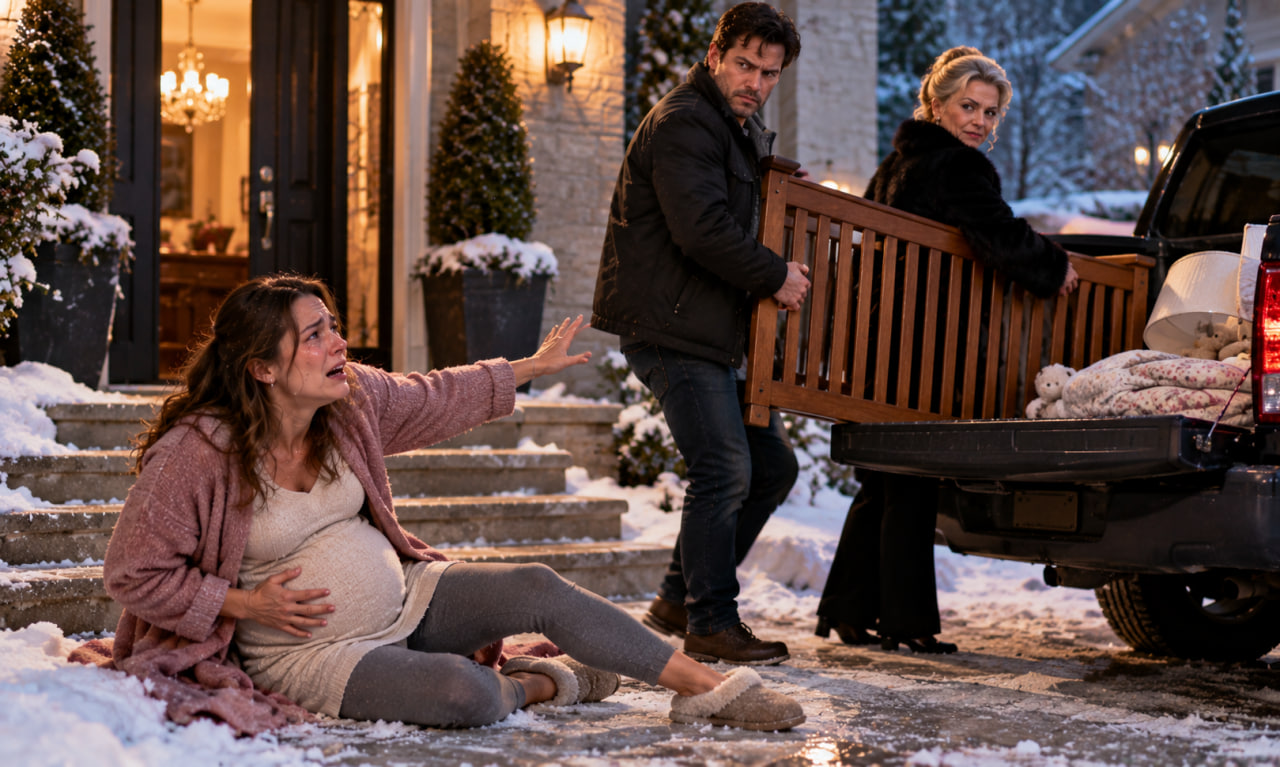
Now I was lying in the snow, watching my blood soak through my clothes while the two people who had caused this drove away with her crib.
But there was one thing Evan and Patricia had never bothered to learn about me.
I had never been as helpless as they believed.
The first sirens sounded in the distance.
I forced myself to keep my eyes open.
“Please,” I whispered to the dispatcher. “Tell the officers not to let my husband into the house. Everything is recorded. The front door, the porch, the driveway, and the garage.”
“Can you explain what happened?”
“My mother-in-law pushed me. My husband watched me fall, and then they drove away.”
My voice broke.
“And they took my baby’s crib.”
I knew that last detail sounded insignificant compared with what was happening to my body. But to me, it was more than a crib.
It was the last gift my father had ever made for me.
And I was determined that the people who had destroyed my family would never get the chance to rewrite what happened.
When the paramedics reached me, one of them knelt beside my head.
“Ma’am, look at me. We’re going to get you to the hospital.”
“Is my baby alive?”
He didn’t answer immediately.
That pause terrified me more than the pain.
“We’re going to do everything we can,” he said gently.
They lifted me onto a stretcher. The cold air disappeared beneath the warmth of the ambulance, but the pain in my abdomen seemed to grow sharper with every bump in the road.
I gripped the paramedic’s sleeve.
“Please save her.”
He squeezed my hand.
“We’re trying.”
Then the doors closed, and the world became a blur of flashing lights.
As the ambulance sped toward the hospital, I thought about my father.
He had died eight months earlier, just before I discovered I was having a girl. His final weeks had been difficult, but he had refused to stop working on the crib.
When I begged him to rest, he would smile and tell me he had one important job left.
“I want my granddaughter to sleep in something that will outlive us both,” he had said.
He had carved a tiny flower into the headboard, the same flower he used to draw on my birthday cards when I was little.
After he died, I couldn’t bring myself to move the crib out of the nursery.
Sometimes I would sit beside it and run my fingers over the smooth wood, imagining him standing there, watching me prepare for motherhood.
Evan had known all of that.
He had watched me cry when I finished arranging the blankets. He had listened when I told him the stories behind the little wooden details.
And he had dismantled it anyway.
Not because we couldn’t afford another crib.
Not because his sister had no other options.
But because he had decided that whatever belonged to me could be taken whenever his family wanted it.
The ambulance stopped.
Someone shouted for a medical team.
Then everything happened at once.
A nurse cut through my clothing. A doctor pressed his hands against my abdomen. Another nurse asked about my pregnancy, my medications, and when I had last felt Lily move.
I tried to answer, but my teeth were chattering.
“Her heart rate is dropping,” someone called.
My entire body went cold.
“No,” I whispered. “No, please.”
A doctor leaned over me.
“Mia, we’re going to move quickly. We may need to deliver your baby immediately.”
I reached for his hand.
“Save my daughter.”
“We’re going to do everything possible for both of you.”
They rushed me toward the operating room.
The ceiling lights passed overhead, one after another.
And just before the doors closed, I remembered the tiny flower my father had carved into the crib.
I imagined Lily sleeping beneath it.
I imagined her growing up and asking me about the grandfather she had never met.
I imagined telling her how much he had loved her before she was even born.
Then the lights blurred.
And I heard someone say my name.
“Mia? Stay with us.”
I tried.
I really did.
But the darkness pulled me under.
When I woke, my throat was dry, my body felt impossibly heavy, and the room smelled of antiseptic.
For several seconds, I couldn’t remember where I was.
Then I felt the bandages beneath my hospital gown.
I remembered the porch.
The snow.
The blood.
I sat up too quickly and cried out.
A nurse hurried to my bedside.
“Easy, Mia. You need to lie back.”
“My baby.”
She paused.
My heart began to race.
“Where is she? Please tell me where my baby is.”
The nurse took my hand.
“Your daughter is alive.”
I broke.
A sob escaped me so violently that I covered my mouth with both hands. Tears poured down my face, and I couldn’t stop them.
“She is?” I whispered.
“Yes. She was delivered by emergency C-section. She was struggling when you arrived, so the neonatal team took her to the NICU. She’s very small, and the doctors are watching her closely, but she’s receiving care.”
I pressed my hand against my chest.
“Can I see her?”
“Not quite yet. Your doctor wants to make sure you’re stable first. But I’ll ask the neonatal team to update you.”
I nodded, though every part of me wanted to run down the hallway and find my daughter.
For the first time since the fall, I could breathe without feeling that my entire world was ending.
Lily was alive.
My daughter was alive.
And I would do whatever it took to bring her home.
A little later, a doctor came in to explain what had happened.
I had suffered a serious placental injury from the fall and had lost a significant amount of blood. The emergency delivery had been necessary. I would need time to recover, and Lily would need specialized care.
I listened carefully, asking questions whenever I could.
Then I asked the one question that had been eating at me.
“Did the police come?”
The doctor glanced toward the door.
“Yes. An officer is waiting to speak with you, but you don’t have to do that immediately.”
“I want to speak with him.”
The officer entered a few minutes later. He introduced himself as Detective Harris and pulled a chair beside my bed.
“I understand you reported an assault involving your husband and mother-in-law.”
“Yes.”
“I’m sorry this happened to you. Before we discuss the details, I need to ask whether you feel safe returning home.”
I looked at him.
For the first time, I allowed myself to admit the truth.
“No. I don’t.”
He nodded and wrote something down.
“Your safety comes first. We’ll discuss where you can stay and how to handle contact with your husband.”
Then he asked me to explain what had happened.
I told him about the crib, the argument, Patricia pushing me, and Evan driving away.
I told him they had left me bleeding in the snow.
He listened without interrupting.
When I finished, I took a shaky breath.
“The house has security cameras. They’re connected to a system that saves recordings to an account they don’t have access to.”
Detective Harris looked up.
“Did you see the recordings yourself?”
“No. But I know they were running.”
“Do you know whether the footage includes the porch?”
“Yes. Two cameras cover it from different angles.”
He closed his notebook.
“We’ll need to preserve that footage. Don’t delete anything, and don’t try to confront either of them. We’ll handle the evidence through the appropriate process.”
I nodded.
Then I remembered something else.
“My father left me the house.”
The detective waited.
“It was transferred into my name before he died. Evan lives there with me, but the property belongs to me. The crib was also made by my father. It was never his to give away.”
“Do you have documentation showing ownership?”
“Yes. The property records and my father’s estate documents are in a locked cabinet in my home office.”
“Good. Let us know where those records are when it’s safe to retrieve them. Don’t put yourself at risk to get them.”
After he left, I lay back against the pillows.
I had spent months convincing myself that Evan’s behavior was just another part of marriage.
His demands.
His mother’s insults.
The way he treated my work as a hobby, despite the fact that my income had paid a large share of our household expenses.
Every time he crossed a line, he found a way to make me feel responsible for the argument that followed.
But there was no excuse for what had happened on that porch.
Not the cold.
Not the stress of the pregnancy.
Not his sister’s twins.
Nothing.
For the first time in our marriage, I wasn’t thinking about how to make Evan understand me.
I was thinking about how to protect my daughter from him.
The following morning, a nurse wheeled me into the neonatal intensive care unit.
I had imagined my first meeting with Lily so many times.
I had pictured holding her against my chest, kissing her forehead, and whispering all the things I had wanted to tell her before she arrived.
Instead, I stood beside a small hospital incubator, afraid to touch her.
She was so tiny.
A knitted cap covered her head. Wires and monitors surrounded her, and her chest rose and fell beneath a blanket decorated with little yellow stars.
I pressed my fingers against the side of the incubator.
“Hi, sweetheart.”
My voice broke.
“I’m your mommy.”
A nurse showed me how to place one finger against Lily’s hand through the opening in the incubator.
Her tiny fingers curled around mine.
That was all it took.
I began to cry.
“I’m here,” I whispered. “I’m not going anywhere.”
For several minutes, I stood there, talking to her about everything I could think of.
I told her about the snow outside.
I told her about the little yellow dress waiting in her nursery.
And I told her about my father.
“Your grandpa made you something beautiful,” I whispered. “And I’m going to make sure you get to see it someday.”
I didn’t tell her what had happened to the crib.
She didn’t need to know that yet.
She only needed to know that she was loved.
When I returned to my room, I found several missed calls from Evan.
There were also messages.
Evan: Where are you?
Evan: Why isn’t anyone answering the house phone?
Evan: Mia, stop ignoring me. I have things to explain.
Then, almost two hours later:
Evan: My mother says you told the police she pushed you. You need to correct that before this gets out of hand.
I stared at the screen.
He hadn’t asked whether I was alive.
He hadn’t asked whether our daughter had survived.
He was worried about what I had told the police.
My hands trembled, but not from fear this time.
I typed a reply.
Me: Our daughter was delivered by emergency C-section. She is in the NICU. You can communicate with me through my attorney or the appropriate authorities.
I read it twice before sending it.
Then I blocked his number.
It was the first boundary I had ever set with Evan that I didn’t immediately apologize for.
And I felt something inside me change.
By the afternoon, my phone was filled with messages from Evan’s family.
His sister, Vanessa, sent the first one.
Vanessa: I heard you had an accident. Mom says you slipped. I hope you’re okay, but please don’t turn this into a family war. The babies need that crib.
I read it three times.
An accident.
That’s what they were calling it.
Not the result of an argument over property. Not a fall after Patricia shoved me. Not a pregnant woman left bleeding in the snow.
An accident.
I didn’t reply.
Then another message arrived.
Vanessa: Evan told me you were being unreasonable about lending us the crib. I didn’t know you’d get this upset.
I closed my eyes.
Lending.
That was another lie.
Nobody had asked me for permission. Nobody had offered to return it. Nobody had even pretended to care about what it meant to me.
They had simply decided that Vanessa’s needs mattered more than mine.
I opened my laptop and logged into the security system.
My fingers shook as I navigated to the recordings from the previous afternoon.
The first camera showed Evan carrying pieces of the crib out of the nursery.
The second showed Patricia standing near the front door while I followed them outside.
I watched myself pleading.
I watched Evan ignore me.
I watched Patricia turn toward me.
Then I watched her shove me.
The footage was clear.
My slipper slid on the ice. My body struck the steps and tumbled onto the concrete.
For a moment, Patricia stood still.
Evan looked back.
I could see his face.
He knew something was wrong.
I watched myself try to move, then collapse again.
Patricia said something to him. The camera had no audio, but the movements were unmistakable.
Evan opened the driver’s door.
They left.
I covered my mouth.
Even though I had lived through it, watching it happen made me feel as if I were witnessing someone else’s nightmare.
I wanted to throw the laptop across the room.
Instead, I remembered Detective Harris’s instructions.
Preserve the evidence.
I downloaded the recordings, saved copies to a separate account, and sent the access information to the detective through the contact details he had provided.
Then I stopped watching.
I had seen enough.
I didn’t need to keep hurting myself to prove that I had been hurt.
Three days later, I was finally allowed to hold Lily.
A nurse settled her against my chest, carefully arranging the blanket around us.
Lily’s face was smaller than I had imagined, and her breathing was still delicate, but she was warm.
Real.
Alive.
I kissed her forehead.
“Your grandpa would have loved you so much,” I whispered.
For the first time since the fall, I felt something stronger than fear.
I felt determination.
I had spent too much of my life trying to earn kindness from people who treated it like a privilege they could withdraw whenever they wanted.
My father had never made me earn his love.
He had given it freely, even when he was dying.
And now I understood the difference between a family that loved you and a family that simply expected you to obey.
I would not teach Lily that love meant accepting cruelty.
I would not teach her that being a good wife meant being silent.
And I would never let her believe that she had to sacrifice her dignity to keep someone else comfortable.
That evening, Detective Harris called with an update.
The police had obtained the security recordings. They were reviewing the evidence and interviewing the people involved.
He also told me that Evan and Patricia had been contacted.
“Your husband says you lost your balance and that he didn’t realize how badly you were injured,” the detective explained. “His mother denies pushing you.”
I felt my stomach tighten.
“Can they just lie about it?”
“They can give their account of what happened. Our job is to evaluate the evidence, not simply accept one person’s version.”
“And the footage?”
“It’s being examined alongside the other evidence. We haven’t reached a final determination, but the recording is important.”
I thanked him.
Before hanging up, I asked whether the police had located the crib.
“Not yet. Do you know where they might have taken it?”
“Vanessa’s house. She lives about forty minutes away.”
“We’ll look into that.”
After the call ended, I stared out the hospital window.
The snow was beginning to melt along the edges of the parking lot.
I thought about the nursery waiting at home.
I wondered whether Evan had returned to the house. Whether he had taken anything else. Whether he believed he could walk back into my life once he had decided his anger was over.
But I wasn’t going to make decisions based on what Evan believed anymore.
I would make them based on what Lily needed.
And what I needed to be safe.
A week later, my lawyer visited me at the hospital.
Her name was Rachel Morgan, and she had handled the legal paperwork surrounding my father’s estate.
I had called her after Detective Harris explained that I would need help protecting my home and understanding my options.
Rachel listened while I explained what had happened.
When I finished, she folded her hands on the table.
“Mia, your father’s property records are clear. The house was transferred to you before his death. Your husband doesn’t become the owner simply because he lives there.”
I nodded.
“I want him out.”
“We’ll need to follow the appropriate legal process. Given what you’ve described, we can discuss protective measures and the options available under local law.”
“And the crib?”
“If your father left it to you, or if you own it as part of your personal property, we can document that. We can also ask the authorities to help locate it. Don’t attempt to retrieve it yourself.”
I looked down at my hands.
“There is something else.”
Rachel waited.
“For months, Evan has been taking money from our joint account. I thought he was using it for household expenses, but I recently discovered transfers I couldn’t explain.”
“How much?”
“I haven’t calculated everything yet. But it may be several thousand dollars.”
“Do you have statements?”
“Yes.”
“Keep copies of those, too. We’ll review the records and determine what they show.”
I felt embarrassed admitting how much I had overlooked.
Rachel seemed to notice.
“Don’t blame yourself for trusting your spouse,” she said. “Trust is not the same as permission for someone to mistreat you. We’ll work through the facts one step at a time.”
For the first time in days, I felt as though someone was speaking to me without trying to control me.
Before she left, Rachel helped me make a list of the documents we needed.
Property records.
Bank statements.
My father’s estate papers.
Copies of the messages from Evan’s family.
The security recordings.
It was a long list, but every item represented something I could do to protect myself and Lily.
I no longer had to convince anyone that I deserved to be safe.
I simply had to take the next step.
And then the next.
The biggest surprise came two days later.
Detective Harris called to tell me that the crib had been located.
Vanessa had posted a photograph online showing the assembled walnut crib in a spare bedroom.
The caption read:
Finally getting everything ready for our little miracles. So grateful for family who steps up when we need help.
The photograph had been posted the evening after my fall.
I stared at it in disbelief.
The crib stood beneath a window, its smooth wooden rails shining under the light. The little flower my father had carved was visible in the center of the headboard.
Vanessa had even placed two folded blankets inside it.
She had taken the one thing I had begged them to leave behind and turned it into a symbol of her family’s happiness.
My lawyer told me not to contact Vanessa.
Instead, she documented the photograph and forwarded it to the appropriate authorities.
Later that day, Vanessa sent me another message from a different number.
Vanessa: I heard the police are asking questions about the crib. You really need to stop this. The babies will be here soon, and we have nowhere else to put them.
I looked at Lily sleeping beside me in her hospital bassinet.
Then I typed one sentence.
Me: Your babies deserve a safe place to sleep. That does not give you the right to take something that belongs to my daughter.
I sent it.
For once, I didn’t explain myself.
I didn’t apologize.
And I didn’t allow her to turn her needs into my responsibility.
My lawyer later explained that the police were working to establish how the crib had been transferred and whether it could be recovered through the appropriate process.
Nothing happened instantly.
There were statements to collect, evidence to review, and legal procedures to follow.
But for the first time, the situation was no longer being decided by whoever shouted the loudest.
There were records.
There was evidence.
And there were people whose job it was to examine what had actually happened.
Evan had spent years making me doubt my own judgment.
Now the truth was finally being examined without his permission.
And that was only the beginning.