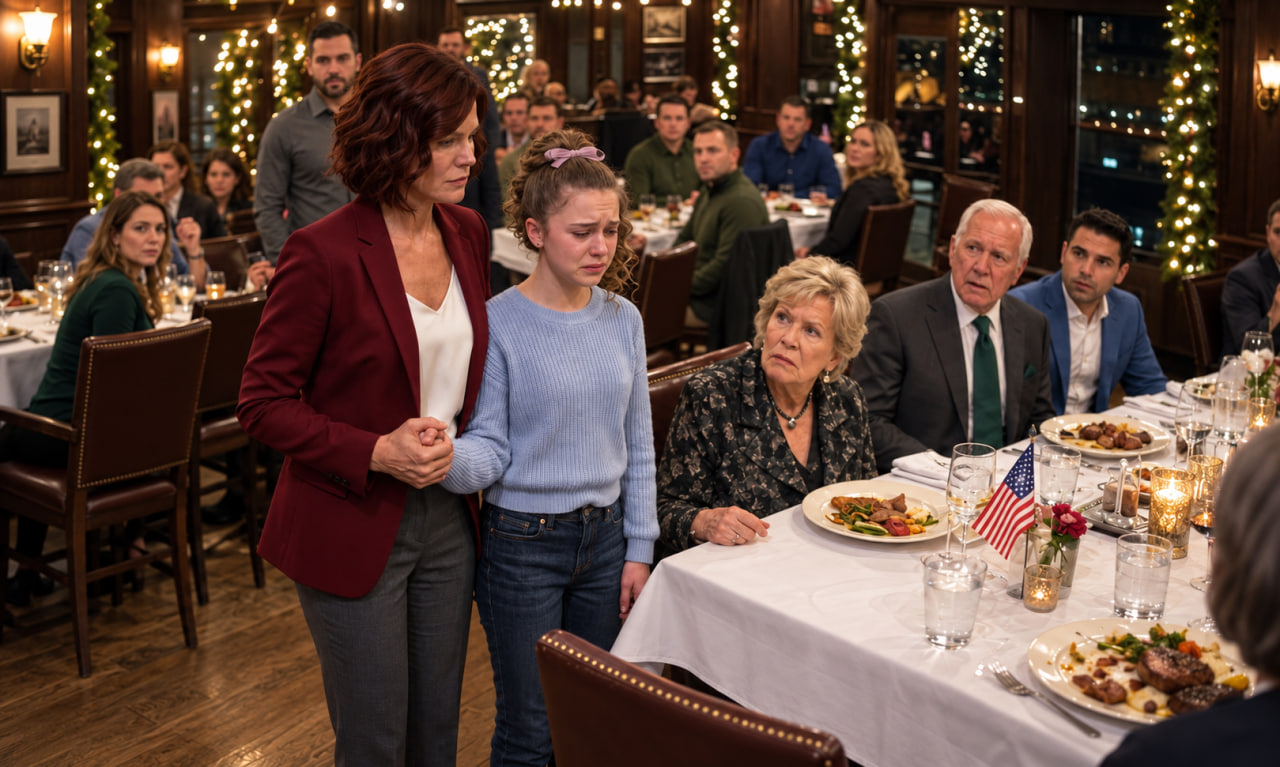
My choice.
Gone.
“You’re free,” she said.
I hadn’t expected that word to feel so large.
Two weeks passed.
Dad tried reaching me through a cousin, asking me to be reasonable and consider what I was doing to the family.
I sent one message back through that cousin.
“I am not available for this conversation.”
Mom tried another route.
She contacted a woman from my church who knew both of us and hoped she would intervene.
The woman called me kindly.
She asked if I was okay, and when I explained what happened at dinner and what I found on Sole’s phone, she didn’t push me toward reconciliation.
She only said, “I had no idea. I’m sorry, Marlo.”
That meant more than she knew.
Chris sent one last text from an unfamiliar number.
“You think you’re better than us. You always have. Enjoy your perfect little life.”
I read it once.
I didn’t answer.
Some messages aren’t invitations to talk.
They are demands for a reaction.
And there is a particular strength in giving people absolutely nothing when that is what they deserve.
The harder part wasn’t cutting them off.
The harder part was Sole.
Not because she was angry with me.
She wasn’t.
In many ways she seemed relieved, in that heartbreaking way children are relieved when something they always felt but couldn’t name finally becomes visible.
The harder part came later, when she would suddenly go quiet during dinner or stop halfway through homework and look at me with something careful in her eyes.
One evening, she asked, “Are you sad about it?”
I thought for a moment.
“I’m sad about what I thought they could be,” I told her. “I’m not sad about what I did.”
She nodded slowly.
“Me neither,” she said.
That was when I realized Sole had known for a long time.
She had only been waiting to see what I would do.
I think about that often.
I think about all the years she sat across from people who made her feel like a question mark and still showed up with a straight back and neatly folded napkin, trying to give them a reason to love her.
She deserved better.
She deserved someone who wouldn’t wait for a ninth incident, or a tenth, or a twenty-ninth voicemail.
She deserved someone who left the first time.
I was late.
But I left.
A few months after the dinner, I began making changes I had postponed for years.
I redid Sole’s room with a new paint color, shelves for her books, and a light she picked herself that made everything glow soft gold at night.
We visited the museum she had asked about for two years.
We drove three hours to see a band she loved and sang all the way home with the windows down.
I enrolled her in an art class.
Within six weeks, her teacher pulled me aside and said, “She has something real. I want you to know that.”
I already knew.
But I was glad someone else finally saw it.
I didn’t miss my family.
I want to be honest about that because people often expect a different ending.
They expect grief.
Eventually forgiveness.
At least some ambivalence.
I felt none of it.
For the first time in a very long time, my house felt like the right temperature.
Like I could stop bracing for whatever came next.
Like the air around us had finally stopped costing something.
Sole laughed more.
Not louder.
Just more freely.
More often.
From somewhere deeper.
She stopped making herself small.
She left shoes in the middle of the floor.
Sang off-key.
Fell asleep on the couch with a book over her face.
And I let her.
It was the most ordinary, beautiful thing I had ever seen.
During those months, we built something I don’t have a precise word for.
Not because it was complicated.
Because it was simpler than people expect.
Safety.
Warmth.
A home where nobody had to earn their seat at the table.
I heard from Dad one more time.
About four months after dinner.
Not a call.
Not a voicemail.
A handwritten letter mailed to my house.
He said he was sorry about the car payment situation.
He said Mom had been under stress.
He said family was family and surely I understood nobody was perfect.
He never mentioned what Mom said to Sole.
Never mentioned the messages.
Never mentioned Sole’s name.
I read the letter once, folded it, and put it into a folder in my desk.
Not because it meant something.
Because documentation matters, and I had learned that the hard way.
I never wrote back.
Here is what I know now that I didn’t fully understand before that dinner.
Protecting your child is not always dramatic.
It isn’t a speech, a scene, or some grand exit.
Sometimes it is simply standing up, taking a hand, and walking toward the door.
The money was not the point.
It never was.
The money was simply the last thing I had continued giving to people who had spent years hurting my daughter.
And the most important thing—the thing I want anyone hearing this story to understand—is that waiting for people to become ready to treat your child properly is not patience.
It is sacrifice.
And the person being sacrificed is not you.
Sole is fourteen now.
She still makes hot chocolate she doesn’t always finish.
Still reads past bedtime with a flashlight she thinks I don’t know about.
Still laughs with her whole face when something is genuinely funny.
She is not a mistake.
She is the reason I finally stopped confusing tolerance with love.
I used to believe keeping a family together was always worth the cost.
I don’t anymore.
Some tables aren’t worth returning to.
Some seats were only ever offered with conditions.
And when someone shows you they are willing to spend your child’s sense of worth, that is not a family disagreement.
That is a line.
I crossed it by leaving.
I have never regretted which direction I walked.
If you have ever had to choose between keeping the peace and protecting someone you love, I want to ask you something.
Looking back, do you think you made that choice too late, too early, or right on time?
Tell me in the comments.
I read every single one.