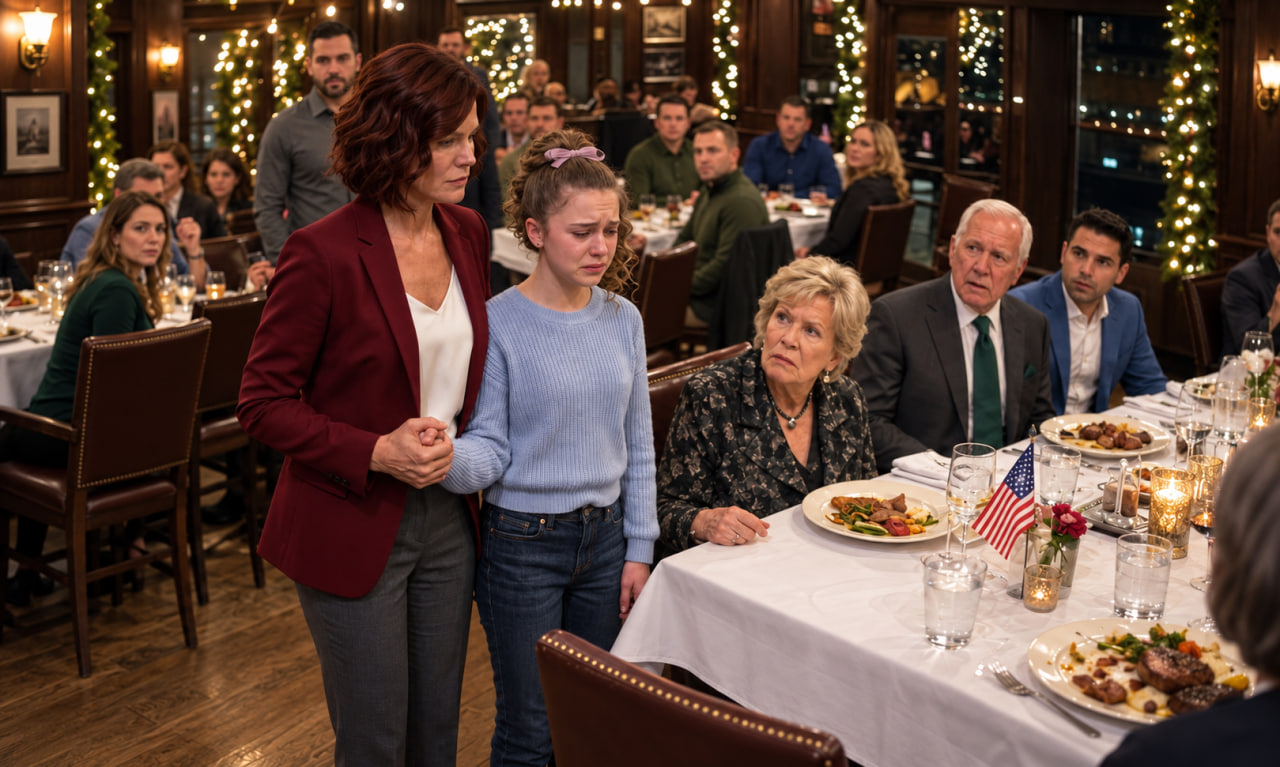
Dad looked offended before he looked surprised.
Chris finally put his phone away.
Mom blinked up at me as though I had embarrassed her by refusing to let her continue.
“Don’t be dramatic,” she said.
I looked straight at her.
“You just called my daughter a mistake.”
“She knows what I meant.”
“No,” I said. “You know what you meant.”
Then I walked Sole through the restaurant, past the hostess stand, the other tables, the little flag in the holiday centerpiece beside the door, while half the room pretended not to watch.
The cold outside was sharp.
Sole climbed carefully into my car, almost as if she were afraid to take up too much space.
She buckled herself in and stared straight ahead with that terrible stillness children use when trying not to fall apart.
I got behind the wheel.
Neither of us spoke at first.
Then she whispered, “Am I?”
“Are you what?”
“A mistake?”
I turned toward her.
“No,” I said. “Never. Not for one second. You are the best decision I have ever made.”
Her mouth trembled.
I reached across the console and held her hand until her fingers slowly uncurled.
“They are wrong,” I told her. “And they do not get to decide who you are.”
That was when she finally cried.
At home, I made hot chocolate she barely touched.
I settled her on the couch beneath two blankets with a movie she had watched a hundred times.
I stayed beside her in silence because I didn’t trust the temperature of my own words yet.
The kind of anger that changes your life isn’t loud.
It doesn’t arrive shaking.
It comes quiet, clean, and certain, the way winter air slips beneath a door.
That night, I felt it settle into me as if it had always been there.
At 10:14 p.m., Dad texted.
“You’re still making the car payment tomorrow, right?”
Not, Is Sole okay?
Not, Your mother went too far.
Not, I’m sorry.
Just the bill.
For three years, I had paid their car note, part of their utilities, Chris’s phone bill, and the pharmacy gap Mom called temporary every single month even though it had never been temporary.
I did it because after my divorce, I had more financial stability than they did.
I did it because I had been raised to believe taking care of family was a virtue, not a transaction.
I had been wrong about which one it was for them.
I opened my banking app.
Car payment canceled.
Utility transfer removed.
Chris’s phone autopay gone.
Pharmacy account closed.
Then I went through every linked account, saved card, and automatic transfer.
I changed passwords.
Revoked access.
I updated security questions with answers none of them could guess because they had never paid enough attention to know the small details of my life.
Not Sole’s favorite cereal.
Not my first pet’s name.
Not the street where I lived before we moved.
They knew the bill schedule.
They did not know me.
By midnight, I had blocked Mom.
At 12:07, Dad.
At 12:11, Chris.
Then I sat at the kitchen table and picked up Sole’s phone.
She had once casually mentioned that Grandma had sent her a few messages.
She hadn’t seemed worried.
I let it go.
I shouldn’t have.
There were three messages from Mom, all sent during the previous month, all disguised as gentle concern.
“Do kids at school ever make you feel different?”
“Do you ever worry your mom regrets taking on so much?”
“Do you ever wonder where you really belong?”
I sat at the kitchen table in the blue light of that phone and finally understood something I had refused to see for years.
My parents hadn’t simply been cruel at dinner.
They had been quietly working on my child from the side, the way people do when they want to hurt someone without being caught.
They had planted questions in a thirteen-year-old girl’s mind.
Questions designed to weaken her sense of herself, put distance between us, and make her doubt the one place and person she had always felt safe with.
I pictured Sole at seven arriving at my door with one bag and a stuffed rabbit missing an eye.
At nine, quietly asking whether Grandpa knew her name.
At dinner, folding herself smaller and smaller, trying to take up so little space that nobody would find a reason to look at her wrong.
She had spent six years trying to earn something that should have been hers from day one.
And while she was doing that, Mom had been messaging her, asking whether she thought I regretted her.
By morning, I had twenty-nine missed calls.
Dad left voicemails demanding explanations.
Mom cried about betrayal, ingratitude, and everything she had supposedly done for me.
Chris called me selfish for destroying the family over one comment.
One comment.
I stood at my kitchen counter and listened to every voicemail.
Not because any of them changed my decision.
Because I needed to hear clearly, one final time, what each person believed the real problem was.
None of them mentioned Sole.
Not one voicemail among twenty-nine calls contained the words, “Is she okay?” or “I went too far,” or even her name.
I deleted them all.
Then Sole’s phone lit up beside me.
Mom again.
I read the first line.
And unlike the dinner, the forgotten birthdays, or six years of quiet erosion, this time nothing in me wanted to explain.
Nothing wanted to give one more warning.
Nothing wanted to hope they could become better than what they had shown me.
I took screenshots of every message Mom had sent Sole during the previous month.
I forwarded them to my email.
I saved everything.
Then I did something I should have done years earlier.
I called a family attorney.
Not because I wanted anything dramatic.
Not because I planned to seek a restraining order or court action.
Sole was safe, and I wasn’t afraid of my parents in that way.
I called because I had spent three years financially supporting people who now had every reason to become vindictive, and I needed to understand exactly where I stood.
The attorney walked me through everything.
She confirmed that what I had done was legally clean.
No contracts.
No legal obligations.
No recourse.
The car.
Utilities.
Phone bill.
All voluntary.
My money.