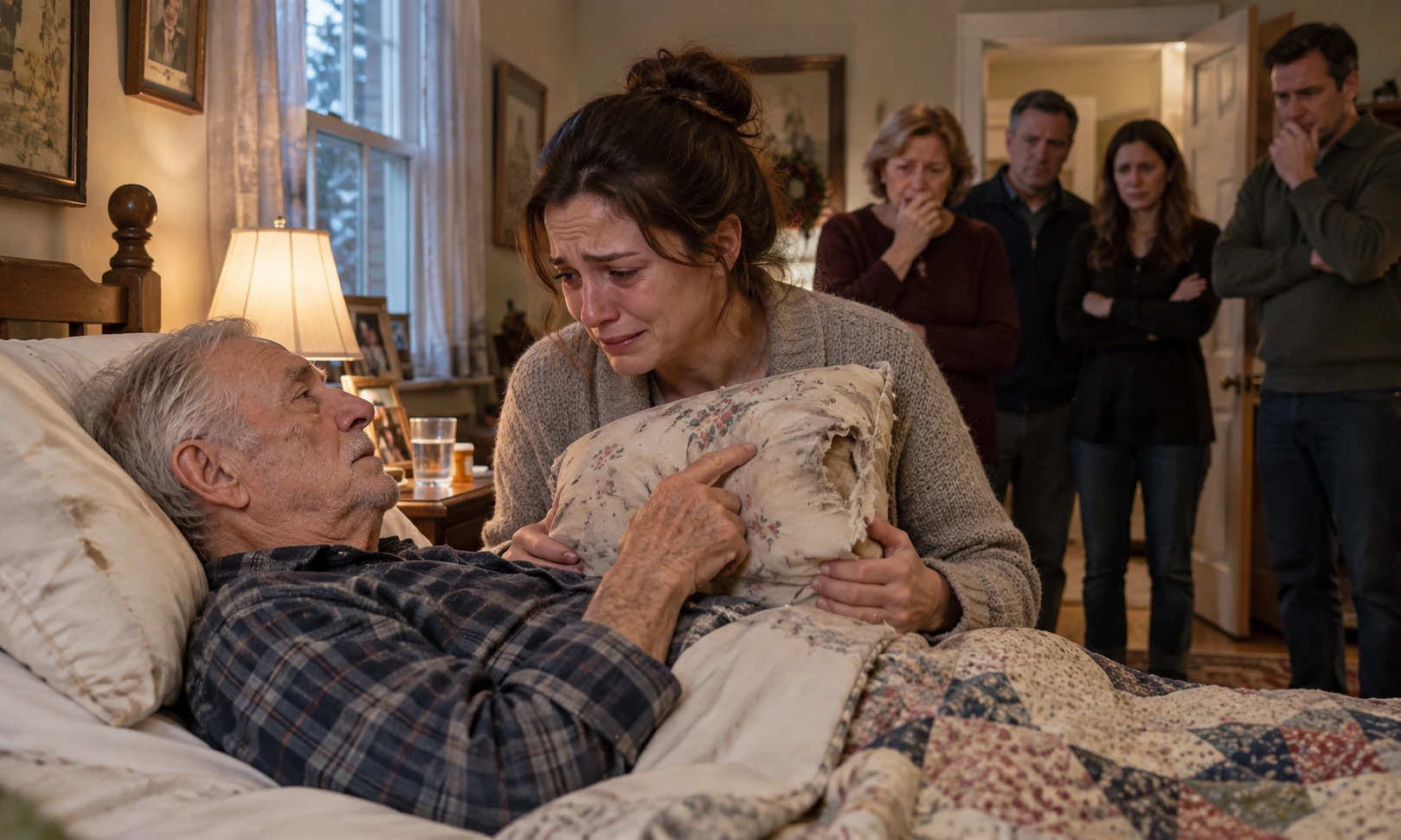
“Under the house is something that belongs to you. It is the reason I needed you to have the key.”
I stared at the page.
Under the house.
Again.
But this time there was something else.
A warning.
“Do not tell my children about the account yet.”
My heart began racing.
Why?
What did he know?
I read the next line.
“Before you give anyone anything, find the old stone wall behind the barn.”
I stopped.
The old stone wall.
I knew exactly what he meant.
It was the wall Ernest had forbidden everyone from touching.
For years, he had told the children that the wall was unstable.
“Leave it alone,” he would say.
“There is nothing there.”
But suddenly I remembered something.
When I was newly married, I once asked why the wall had a newer section in the middle.
Ernest had looked at me strangely.
Then he had said:
“Some things are better left buried.”
At the time, I thought he was talking about family memories.
Now I wasn’t so sure.
I folded the letter.
Then I heard footsteps upstairs.
I froze.
Someone had entered the house.
“Maria?”
It was my husband.
I quickly put the letter back inside the envelope.
“I’m downstairs!”
He came down the stairs.
“What are you doing?”
“Cleaning.”
He looked around.
Then he smiled weakly.
“Dad’s things?”
“Yeah.”
He sat beside me.
For a moment, neither of us spoke.
Then he said something that made me realize this wasn’t going to be easy.
“Maria…”
I looked at him.
“My brothers want to sell the farm.”
My heart sank.
“What?”
“They say none of us can afford to maintain it.”
I stared at him.
“Your father spent his entire life here.”
“I know.”
“And you want to sell it?”
He looked away.
“I don’t know what I want.”
I reached for his hand.
But before I could speak, he said:
“There is something else.”
“What?”
“My brother Daniel found some papers upstairs.”
My stomach tightened.
“What kind of papers?”
“He says Dad may have had an old account.”
I stayed completely still.
My husband looked directly into my eyes.
“Did Dad tell you anything before he died?”
I felt the brass key against my palm.
For the first time in twelve years, I understood why Ernest had made me promise nothing.
Because whatever was buried beneath that house wasn’t just about money.
It was about protecting the person he trusted most.
And somehow…
I knew the real secret had not yet been found.
That night, after my husband went upstairs, I returned to the basement.
I took the flashlight.
Then I went outside.
The air was freezing.
Snow covered the ground behind the barn.
I walked toward the old stone wall.
Every step felt heavier than the last.
When I reached it, I noticed something I had never noticed before.
One stone near the center had a tiny brass mark carved into it.
A number.
17.
My heart stopped.
I touched the stone.
It moved.
Just slightly.
I pulled it toward me.
Behind it was a narrow opening.
And inside that opening…
was a small black metal box.
I pulled it out.
There was no lock.
Only a faded piece of paper taped to the lid.
I peeled it away.
Three words were written across it.
“Maria, forgive me.”
I opened the box.
And what I saw inside made me forget how to breathe.
PART 4
Inside the black metal box were three things.
A bundle of old photographs.
A small leather notebook.
And a sealed envelope bearing my name.
But there was one more thing beneath them.
A key.
Not like the brass key from the pillow.
This one was newer.
Silver.
Attached to it was a tiny metal tag stamped with two words:
LOCKER 17.
I stood there in the freezing darkness, staring at it.
For a moment, I wondered if I should put everything back.
Maybe some secrets were meant to stay buried.
But then I remembered Ernest’s final words.
For you, Maria.
I carried the box back into the house.
I locked the kitchen door.
Then I sat at the table and opened the leather notebook.
The first page contained only one sentence.
“I didn’t hide this because I didn’t trust my children. I hid it because I knew exactly what they were capable of.”
My hands went cold.
I turned the page.
There were dates.
Names.
Property records.
Bank deposits.
And dozens of handwritten notes.
Ernest had documented everything.
Every acre of land.
Every loan.
Every payment.
Every piece of equipment.
But then I reached a section marked with a red line.
THE ORIGINAL FARM DEED
My heart began pounding.
I turned the page.
There was a photocopy of a deed.
I recognized the farm immediately.
But the name on the deed wasn’t Ernest’s.
It was his wife’s.
Eleanor Hayes.
I frowned.
I knew Ernest’s wife had been named Eleanor.
But she had died nearly thirty years earlier.
Why would the farm still be connected to her?
I read the next page.
And suddenly everything made sense.
When Eleanor was young, her father had owned the property.
He had transferred the land to Eleanor before she married Ernest.
According to the original agreement, the property could not be sold or transferred without the written approval of Eleanor’s direct descendants.
I stared at the page.
There was more.
Eleanor had left a handwritten amendment.
It named her children.
Daniel.
Rebecca.
Thomas.
And my husband.
But there was one additional condition.
If any of the children abandoned their responsibility toward the family elders, their inheritance could be reduced.
I read it twice.
Then I understood.
Ernest hadn’t been afraid of his children taking the farm.
He had been afraid of them taking it without honoring what their mother had intended.
But why was my name involved?
I turned another page.
There it was.
A letter from a lawyer dated eleven years earlier.
The year after I had started caring for Ernest full-time.
The lawyer had written:
“Mr. Hayes, if Maria continues to provide primary care and support for you, the amendment allows you to designate a portion of the estate directly to her.”
I stopped breathing.
He had planned this years ago.
Not because I asked.
Not because I expected anything.
Because he had been watching.
Every sacrifice.
Every sleepless night.
Every time I chose him over myself.
I wiped my tears.
Then I opened the sealed envelope.
Inside was a handwritten letter.
This time, the words were difficult to read because my vision had blurred with tears.
“Maria, I am sorry.”
I swallowed.
“I am sorry that I made you carry so much. I am sorry that you had to watch me become weak. And I am sorry that I waited until the end to tell you the truth.”
I pressed the letter against my chest.
Then I continued.
“You will probably wonder why I didn’t simply tell you everything while I was alive.”
The answer came next.
“Because if my children knew you were going to inherit anything, they would have treated you differently. And I wanted one thing in my final years that money could not buy: to know that your kindness was real.”
I began crying.
Not because of the money.
Because suddenly I understood.
Ernest had tested nothing.
He had simply trusted what he had seen.
The letter continued.
“You never once asked what you would receive.”
“That is why I know you deserve it.”
I covered my mouth.
Then came the sentence that changed everything.
“Locker 17 contains the evidence you will need.”
I looked at the silver key.
Locker 17.
But where?
The answer was written underneath.
“Philadelphia Union Station. Storage lockers. Number 17.”
I stared at the words.
My husband had been working in Philadelphia for years.
And suddenly I remembered something.
Ernest used to ask him strange questions.
“What time does your train leave?”
“Do you still use the station lockers?”
At the time, nobody thought anything of it.
Now I understood.
Ernest had been preparing for this moment.
The next morning, I drove to Philadelphia.
I didn’t tell my husband.
I told him I needed to take care of some paperwork.
The station was crowded.
People hurried around me carrying bags and coffee.
I found the storage lockers.
There were dozens.
I walked down the row until I saw it.
17.
My hands trembled as I inserted the key.
The lock opened.
Inside was a thick brown folder.
Nothing else.
I carried it to a quiet corner.
The first document was a bank statement.
The account belonged to Ernest.
The balance was enormous.
Not $486,700.
That had only been one account.
The actual amount was:
$1,284,613.42.
I stared at the number.
But the money wasn’t what shocked me.
It was the second document.
A property agreement.
Ernest had quietly purchased several small parcels of land surrounding the farm.
Together, they formed one large piece of property.
And according to the agreement, he had placed them into a trust.
I kept reading.
The beneficiary wasn’t his four children.