PART 3
I should have waited until morning.
But something inside me told me not to.
Ernest had looked directly into my eyes before he died.
“For you, Maria… only for you.”
Those weren’t the words of a confused old man.
He had been weak, yes.
But his eyes had been clear.
He had known exactly what he was doing.
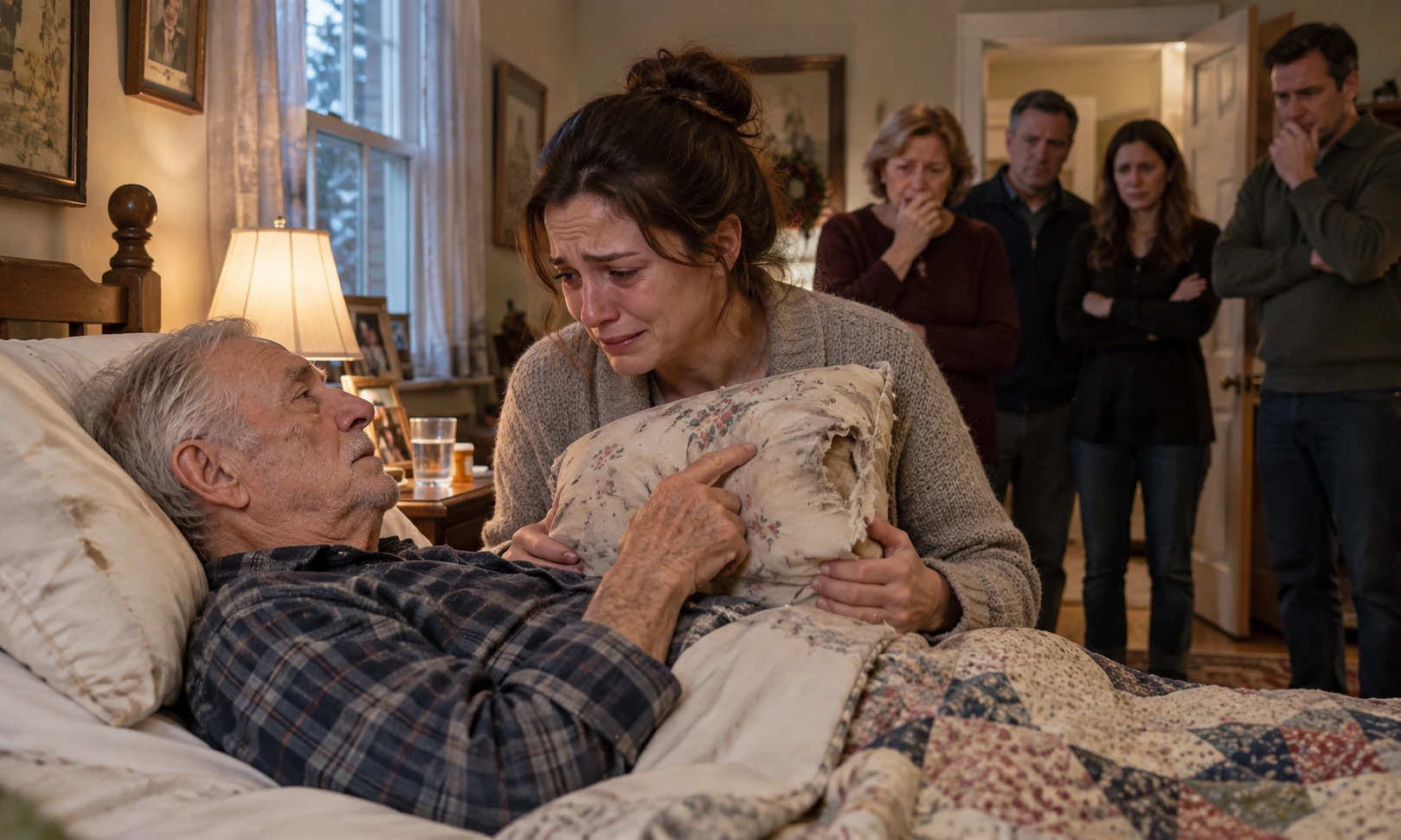
I carefully pulled the object from the pillow.
It was wrapped in a small piece of faded blue cloth.
My hands began trembling.
I unfolded the cloth.
A small brass key fell onto the kitchen table.
Beside it was a folded piece of paper.
I stared at it for nearly a minute before opening it.
The handwriting was unmistakably Ernest’s.
His letters were shaky, but I could still recognize every curve.
There were only six words.
“Not the house. Look beneath it.”
I read the sentence again.
Then again.
My heart began pounding.
“What did you leave me, Dad?”
I whispered the question into the empty kitchen.
There was no answer.
Only the refrigerator humming in the corner.
I picked up the key.
It was old, but not rusty.
On the metal head was a tiny number engraved into it.
17.
I had no idea what it meant.
I looked at the note again.
Not the house. Look beneath it.
For twelve years, I had lived in Ernest’s home.
I knew almost every corner.
I knew which floorboard creaked outside the bathroom.
I knew where the basement flooded after heavy rain.
I knew which kitchen cabinet refused to close properly.
I knew the old furnace made a strange clicking noise every winter.
But I had never looked beneath the house.
At least, not seriously.
The next morning, I barely slept.
At breakfast, my husband noticed immediately.
“You okay?”
I nodded.
“Just tired.”
He poured coffee into his mug.
The funeral had left everyone emotionally exhausted, but his siblings were already calling.
His older brother, Daniel, wanted to come over.
His sister, Rebecca, wanted to go through Ernest’s belongings.
And his younger brother, Thomas, had apparently already started asking about the property.
I listened quietly.
Then Daniel arrived around ten.
He didn’t knock.
He walked straight into the house as though nothing had changed.
“Where’s Dad’s paperwork?”
My husband looked at him.
“What paperwork?”
“The property documents. Bank statements. Insurance. Anything like that.”
I stood in the kitchen doorway.
“It’s only been one day.”
Daniel sighed.
“I know, Maria. But we need to get organized.”
Rebecca arrived twenty minutes later.
She brought two empty cardboard boxes.
I knew immediately what they were for.
She went upstairs and began sorting through Ernest’s clothes.
“This can be donated.”
She held up an old sweater.
Then another.
Then a pair of shoes.
She didn’t cry.
None of them did.
Not really.
Maybe they had their own way of grieving.
I didn’t judge them.
But watching them handle his belongings so quickly made something inside me ache.
His whole life had been reduced to boxes.
Old clothes.
Medicine bottles.
Photographs.
Tools.
A wooden radio.
And a torn pillow.
The pillow was the only thing I had kept.
I had hidden it inside my bedroom closet before they came.
The brass key was in my pocket.
I could feel its weight against my hand.
I kept thinking about the note.
Not the house. Look beneath it.
Around noon, Daniel asked me something that made my stomach tighten.
“Maria, did Dad leave you anything?”
I looked at him.
“Anything?”
“Money. A letter. Something.”
“Why would you ask me that?”
He shrugged.
“Because he gave you that pillow.”
Rebecca suddenly looked up.
“What pillow?”
Daniel laughed.
“The ugly old one from his bed. She wouldn’t let me throw it away.”
Rebecca rolled her eyes.
“Dad was sick. He probably didn’t even know what he was doing.”
I said nothing.
But my fingers closed around the key in my pocket.
Daniel continued.
“We should probably check everything before anyone takes anything.”
My husband frowned.
“Daniel, we’re not going to fight over Dad’s things.”
“I’m not fighting.”
“You sound like you are.”
“I just want everything to be fair.”
Fair.
The word stayed with me.
Because for twelve years, fairness had never been part of the arrangement.
I had given Ernest my time.
My sleep.
My strength.
My patience.
I had missed birthdays because he needed me.
I had canceled trips because he couldn’t be left alone.
I had spent countless nights sitting beside his bed while everyone else lived their lives.
And I had never once asked for payment.
Not once.
So if Ernest had wanted to leave me something, why had he hidden it inside a pillow?
That afternoon, everyone finally left.
My husband took our son to the grocery store.
I stood alone in the kitchen.
I took the key from my pocket.
Then I went downstairs.
The basement smelled like damp earth.
A single bulb hung from the ceiling.
I walked slowly across the concrete floor.
I had seen this basement hundreds of times.
There were shelves along the walls.
Old farming equipment.
Boxes.
Broken chairs.
Cans of paint.
A workbench Ernest had built himself decades ago.
I remembered him sitting there when I first married into the family.
He had been sixty-seven then.
Strong.
Broad-shouldered.
His hands were covered with calluses.
He could still lift a fifty-pound bag of feed.
Now those same hands had struggled to lift a glass of water.
I swallowed hard.
“I’m looking, Dad.”
I whispered.
“But I don’t know what I’m looking for.”
I checked the walls.
Nothing.
The shelves.
Nothing.
The old workbench.
Nothing.
Then I remembered something.
The number.
17.
I looked around.
There was an old wooden cabinet beneath the stairs.
It had seventeen small drawers.
I had never paid attention to it.
I walked toward it.
My heart started beating faster.
I counted the drawers.
One.
Two.
Three.
…
Seventeen.
The key fit the seventeenth drawer.
I stood completely still.
For some reason, I was afraid to turn it.
I don’t know why.
Maybe because opening it meant accepting that Ernest had kept something from us.
Maybe because I was afraid of what I might find.
I inserted the key.
It turned easily.
Click.
The drawer opened.
Inside was a single envelope.
My name was written on it.
MARIA
My breath caught.
I pulled it out.
The envelope was thick.
There was another note on the front.
“Read this alone.”
I sat down on the basement floor.
My hands were shaking as I opened it.
Inside was a letter.
This one was much longer.
And the first sentence made my heart stop.
“Maria, if you are reading this, then I am already gone, and the others are probably asking questions about what I left behind.”
I pressed my hand against my mouth.
I kept reading.
“I know my children will think you received nothing from me because you were only my daughter-in-law.”
My eyes filled with tears.
“But you were the only child I had left.”
I couldn’t continue.
I lowered the letter.
For several seconds, I simply cried.
Then I forced myself to read on.
Ernest explained that years earlier, after his wife died, he had made a decision.
He knew he wasn’t wealthy.
He knew his children expected the farm to be divided someday.
But there was something they didn’t know.
Something he had hidden for nearly twenty years.
He had sold a small parcel of land that nobody used.
The money had not been spent.
Instead, he had invested it.
Quietly.
Carefully.
He had opened an account in a different state.
And over the years, he had added to it.
Small amounts.
Farm payments.
Crop profits.
Money from equipment he sold.
Even checks from an old mineral rights agreement that had suddenly become valuable.
I read the same paragraph three times.
Then I saw the amount.
My eyes widened.
I thought I had misread it.
I brought the letter closer to the light.
$486,700.
Nearly half a million dollars.
My hands went numb.
“No…”
I whispered.
“That can’t be right.”
But Ernest’s handwriting continued beneath the number.
“I did not tell my children because money changed them.”
I stopped.
That sentence hurt more than the amount.
He had known.
He had watched his children grow up.
He had watched them become distant.
He had seen how quickly they asked about property whenever his health worsened.
He had heard conversations they thought he couldn’t hear.
And he had become afraid.
Not for himself.
For what would happen after he died.
The letter continued.
“I know what you will think. You will wonder why I trusted you when you were not my blood.”
I wiped my tears.
The next sentence destroyed me.
“Because blood is not what makes a family.”
I covered my face.
For twelve years, I had wondered whether Ernest truly considered me family.
Now I had my answer.
But then I reached the final paragraph.
And everything changed.
“Maria, the money is not the most important thing I left you.”
I frowned.
There was more.