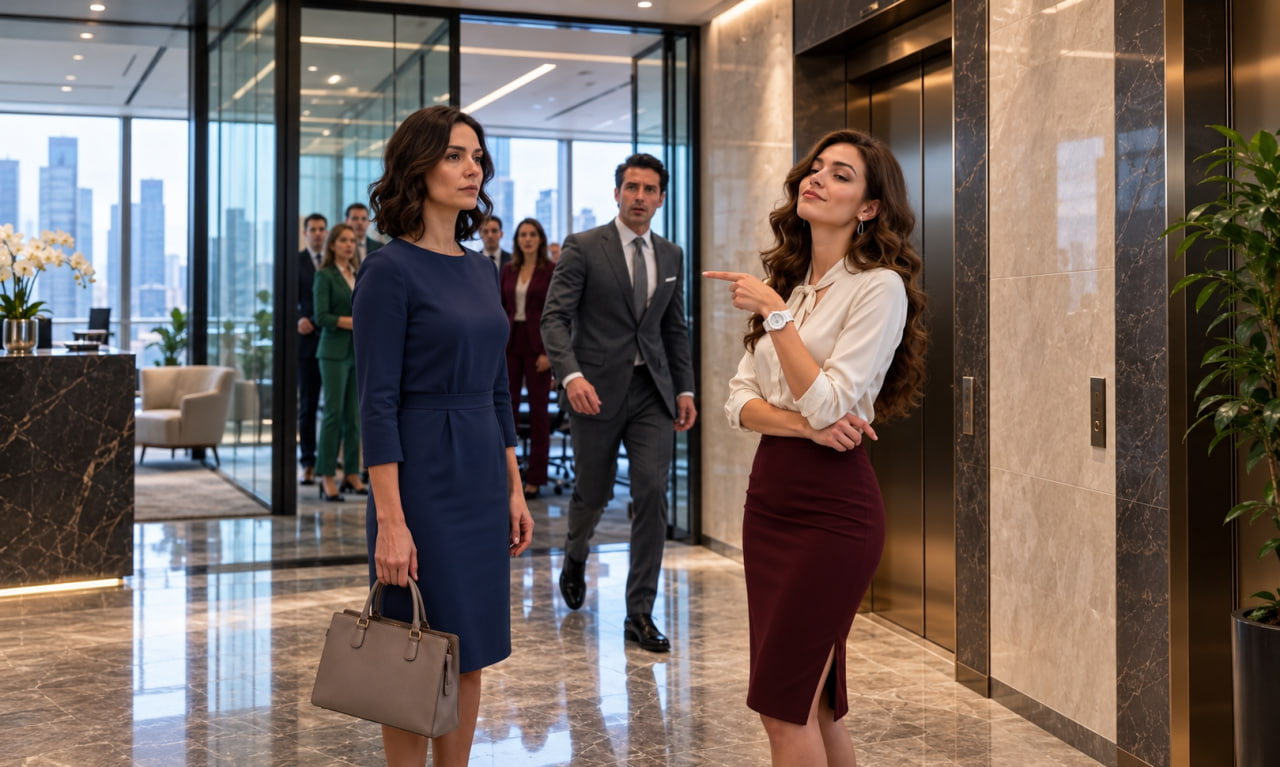
His wife.
And his sister.
Shiaoza pushed away from the table.
“You still think this meeting matters.”
He removed a document from his briefcase.
“I control the voting trust.”
The directors murmured.
“Fifty-one percent. Effective upon any incapacity of Eleanor Shiao. Her medical filing last month triggered it.”
He looked at me.
“You can call yourself CEO until midnight. Tomorrow, I replace the board.”
For the first time, I saw fear on Martin Hale’s face.
Shiaoza smiled.
That was his mistake.
Eleanor began laughing.
“My medical filing?”
His smile disappeared.
She pulled a blue envelope from her handbag.
“I wondered when you would try that.”
Inside was a trust amendment dated eight months earlier.
“I discovered someone had inserted an incapacity clause into an old draft,” Eleanor said. “So I revoked it.”
Shiaoza seized the amendment.
His eyes stopped on the last page.
The voting shares had not transferred to him.
They had transferred that morning at 9:00 a.m., when the board certified the new CEO.
To me.
I controlled the company.
“Why?” I whispered.
Eleanor looked at me.
“Because for ten years, every person in this family tried to make you smaller so you would be easier to manage. And every year, you became more capable anyway.”
Shiaoza jumped to his feet.
“This is theft!”
“It is my company,” Eleanor said.
“It’s my birthright!”
Her expression became completely still.
Then came the truth none of us had expected.
“No, Shiaoza.”
He stopped.
Eleanor looked first at Jang, then him.
“You never had a birthright.”
No one moved.
“Lian is my only biological child.”
The room seemed to lose air.
After losing Lian to family pressure at nineteen, Eleanor had been unable to have another child. Years later, she and her husband privately adopted a baby.
Shiaoza.
They loved him, raised him, and gave him their name.
But the old trust he had attempted to manipulate contained a biological-heir provision he believed protected him.
It did not.
He had hidden his half-sister because her existence destroyed the inheritance claim he intended to use.
That was why he never told Eleanor he had found her.
That was why he kept Jang nearby.
That was why companies had been placed in her name.
She was not simply a convenient scapegoat.
She was the only person whose identity could prove he had no automatic claim at all.
Shiaoza sank into his chair.
For the first time in ten years, my husband seemed to have no strategy left.
Only panic.
The doors opened again.
Two federal investigators entered with building security.
Shiaoza turned toward me.
“You called them?”
I shook my head.
Jang wiped her cheeks.
“I did.”
Everyone turned.
She pulled a small recorder from her purse.
“I found one of the shell-company files three weeks ago. At first, I thought he was stealing from me. Then I realized he was using me.”
Her voice cracked.
“So I sent copies to the board and the authorities anonymously.”
Martin Hale stared. “You were the whistleblower?”
She nodded.
That explained why the board had moved so quickly to bring me back.
An anonymous source had warned them that the president was preparing to shift liability before the annual audit.
They needed someone outside his control.
They chose me.
Shiaoza glared at his sister.
“You ungrateful—”
I stood.
“Careful.”
He looked at me.
For the first time in our marriage, he had to look up.
“You are terminated as president, effective immediately.”
His attorney rose. “You cannot—”
“I control the voting trust.”
The attorney sat back down.
I turned to Jang.
“You are also terminated.”
Her eyes widened.
“You humiliated employees, created discriminatory rules, and abused your position. What he did to you was wrong. What you did to them was also wrong.”
Jang lowered her head.
After a moment, she nodded.
“Understood.”
Eleanor finally walked across the room.
She stopped before the daughter she had lost more than fifty years earlier.
Neither woman knew what to say.
So Eleanor reached toward the white watch.
Jang flinched.
Eleanor simply wrapped her fingers around her wrist.
“That watch was supposed to be mine.”
Jang started crying.
“I’m sorry.”
Eleanor looked at the watch, then at me.
“Keep it,” she whispered.
Jang stared at her.
“It brought my daughter home.”
Six months later, the executive elevator no longer had an executive label.
Anyone could use it.
The woman who had once told me she climbed five flights every morning was promoted after the audit revealed she had been doing the work of two supervisors for years.
Jang accepted a cooperation agreement and avoided criminal charges.
I did not rehire her.
Being a victim does not erase the harm you do to other people.
But she and Eleanor began meeting privately every Sunday.
Slowly.
Carefully.
No titles. No company.
Just two women trying to recover a lifetime neither had chosen to lose.
Shiaoza pleaded guilty to fraud, identity misuse, and conspiracy.
Our divorce took less time than our last annual budget review.
The day the papers became final, I sat alone in my office until the city lights came on.
For years, I had mistaken trust for never asking questions.
I know better now.
Trust is not blindness. Love is not permission. And loyalty that requires you to become smaller is not loyalty at all.
As I left that evening, the elevator doors opened.
The same woman who had warned me not to anger Jang stood inside with a janitor, two interns, and a senior vice president.
They automatically moved aside.
I smiled.
“Don’t move.”
I stepped in beside them.
No executive car.
No service car.
No invisible ladder measuring human worth.
Just one elevator going down.
As the doors closed, my reflection appeared in the polished metal.
Six months earlier, I had entered that building as a wife who believed she knew her husband.
I left as something else.
The CEO. The controlling shareholder. The woman who had finally stopped asking permission to stand where she belonged.
And the strangest part was this:
The white watch I believed had exposed an affair had never proved my husband loved another woman.
It proved something much darker.
He had been willing to destroy every woman in his family to protect a future that had never belonged to him.
He thought the elevator was the place where I would learn my rank.
Instead, it was where he lost his.