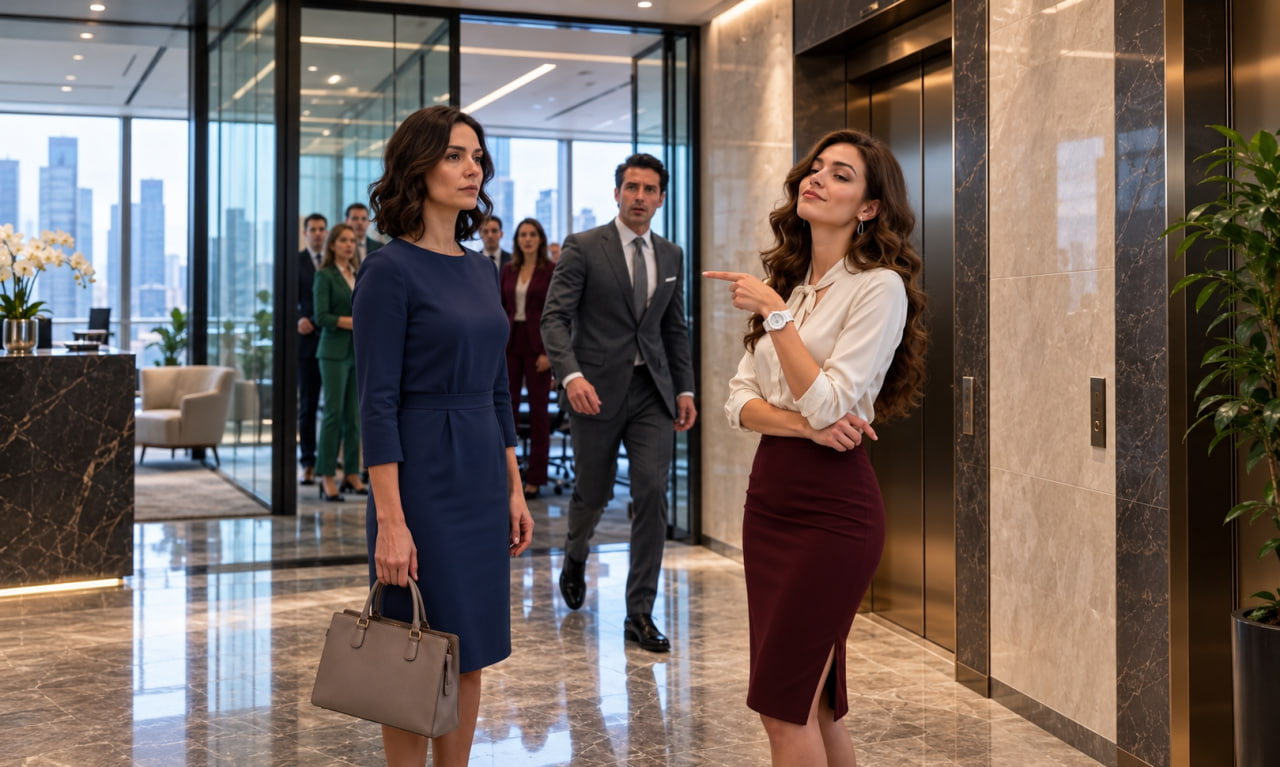
By noon, the audit team found the first irregularity.
The executive elevator policy did not exist.
Jang had invented it eighteen months earlier and instructed security to enforce it verbally, leaving no paper trail.
The financial records were worse.
Nine consulting vendors had received $18.4 million over four years.
All nine had been approved by the president’s office.
Four were tied to addresses associated with Jang.
At twelve-thirty, she appeared in my office.
Without an audience, she seemed younger. Still proud, but afraid.
“You’re investigating me.”
“I’m investigating the company.”
“You’re punishing me because of this morning.”
“If that were true, HR would already have your termination papers.”
I slid the vendor report toward her.
“Do you own Meridian Strategy?”
“No.”
“North Axis?”
“No.”
“Then why are they registered to addresses connected to you?”
Her face lost color.
“I don’t know.”
“Think.”
“I said I don’t know.”
This fear was different.
Not fear of losing her job.
It was the fear of realizing the ground beneath you had disappeared.
She whispered, “He told me those were reimbursement entities.”
“Who?”
She glanced toward the door.
“President Shiao.”
My husband.
Then she said, “You think I’m his mistress.”
I said nothing.
“I’m not.”
“The watch says otherwise.”
Her face twisted.
“You really don’t know.”
“Know what?”
She opened her mouth.
The office door swung open.
Shiaoza walked in.
“Jang. Don’t.”
She froze.
I looked between them.
“What exactly am I not supposed to know?”
Neither answered.
So I called security.
Shiaoza laughed. “You’re having me removed from my own office?”
“My office. The board was clear.”
His expression hardened.
The husband vanished.
What remained was the man who had controlled this building while I was overseas.
“You have no idea what you’re walking into.”
“Then stop standing in my way.”
Security escorted him out.
Jang remained motionless.
Finally, she whispered, “He’s my brother.”
I stared at her.
“Half-brother.”
Eleanor had given birth to a daughter at nineteen, long before marrying into the Shiao family. The child had been raised by relatives overseas, and the truth buried to protect reputations.
Jang Chin Tong was that daughter.
Shiaoza had discovered her six years earlier and quietly brought her into the company.
That explained the affection.
The nickname.
Perhaps even the watch.
But not the money.
“Does Eleanor know you work here?”
Jang shook her head.
“Does she know he found you?”
Another shake.
I leaned back.
“Then why would he hide you from your own mother?”
Jang’s expression shifted.
She had never asked herself that.
At two o’clock, the board called an emergency meeting.
Shiaoza arrived with two attorneys.
He was already speaking when I entered.
“My wife is emotionally compromised,” he told the directors. “She has turned a personal misunderstanding into an unauthorized investigation.”
I took the chair at the head of the table.
Chairman Martin Hale said, “The CEO has authority to initiate an internal audit.”
Shiaoza smiled.
“Not if the CEO herself is implicated.”
A folder slid toward me.
Inside were wire approvals, invoices, and electronic authorizations.
Each carried my name.
My signature.
My executive credentials.
The transactions totaled $41.7 million.
Shiaoza leaned back.
“That is why I opposed her appointment.”
I stared at him.
He had never opposed it.
When the board first discussed my appointment, he had congratulated me, poured champagne, and said, “Maybe this is finally our chance to work together.”
Now I understood.
“Those signatures are forged.”
“Digital approvals don’t lie,” his attorney said.
Then Shiaoza delivered the blow he had clearly prepared.
“The board should suspend her immediately and refer this to federal authorities.”
He looked genuinely saddened.
He had rehearsed this.
Possibly for years.
The conference-room door opened.
Eleanor Shiao entered.
At seventy-two, my mother-in-law moved slowly, never weakly. Behind her came General Counsel, a forensic auditor—and Jang.
Shiaoza stood.
“Mother?”
Eleanor ignored him.
Her gaze settled on Jang.
For the first time that day, Jang looked like a child waiting to be recognized.
Eleanor whispered, “Lian.”
Jang covered her mouth.
Tears filled Eleanor’s eyes, but she turned toward her son.
“You found her six years ago. And you never told me.”
“I was protecting you.”
“No,” Eleanor said. “You were using her.”
The auditor opened his laptop.
What followed destroyed ten years of lies.
The signatures bearing my name had been generated using a cloned credential issued through the president’s technology office.
My login had been copied during a security migration four years earlier.
Every fraudulent approval originated from devices controlled by Shiaoza’s executive suite.
The vendors connected to Jang were not hers. They had been created using identity documents she had given Shiaoza when he helped her “regularize payroll and family records.”
Without knowing it, she had become the paper owner of shell companies.
If the fraud surfaced, she would take the fall.
If investigators dug deeper, I would follow.
I looked at my husband.
“You brought your own sister here to frame her.”
His mask finally cracked.
“You don’t understand what it takes to keep this company alive.”
“Forty-one million dollars?”
“It wasn’t stolen.”
The auditor replied, “We traced eleven million to private investment accounts, seven million to real estate, and six million to political access consultants. The rest moved through layered accounts.”
“Investments for the company,” he snapped.
“In your name.”
Silence.
Jang sprang to her feet.
“You told me those companies were for tax reporting.”
“You wanted a life here,” Shiaoza said coldly. “I gave you one.”
“You gave me a prison sentence waiting to happen.”
“You had nothing before me.”
Jang flinched.
Eleanor closed her eyes.
I had hated Jang that morning. Part of me still did.
Her cruelty had been real. Being manipulated did not erase what she had done.
But seeing my husband reduce his own sister to a tool finally revealed what I had refused to understand.
He did not love people.
He positioned them.
Me included.
“Why did you support my becoming CEO?” I asked.
He stayed silent.
Martin Hale answered.
“Because he recommended you.”
I turned toward him.
“Three months ago, Shiaoza privately encouraged several directors to consider you. He said the company needed ‘clean operational leadership’ before the next audit cycle.”
The truth settled over me.
He had not supported my career.
He had placed me on the tracks before the train arrived.
Once the fraud surfaced with me as CEO, my name would appear on the approvals, my office would own the restatement, and Jang’s shell companies would supply another villain.
He had designed a collapse with two women underneath it.