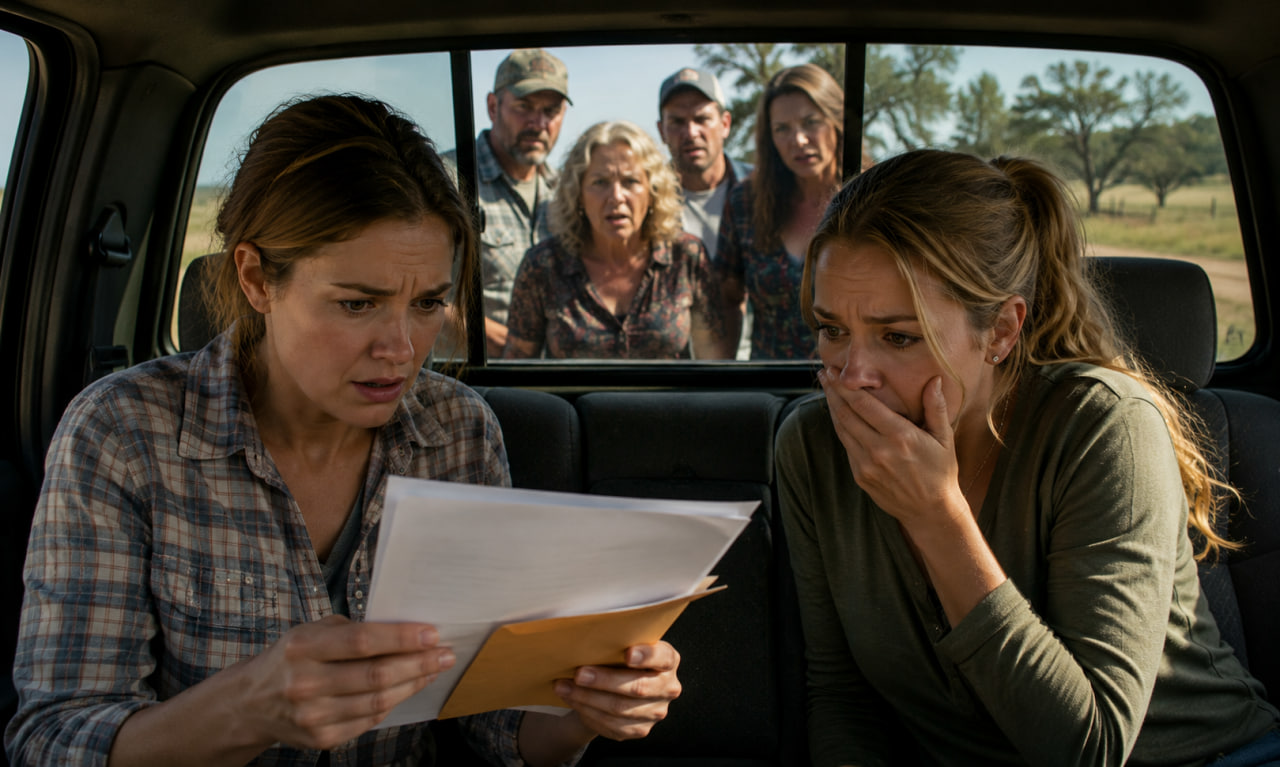
June’s voice was barely audible.
“Who?”
Mr. Albright slid a photograph across the table.
It showed Grandpa thirty years younger.
Beside him stood a woman.
June recognized her immediately.
Her grandmother.
But there was another person in the photograph.
A little girl.
Maybe six years old.
June picked up the picture.
“Who is she?”
Mr. Albright didn’t answer.
June looked closer.
The little girl had Grandpa’s eyes.
And on the back of the photograph, written in her grandfather’s handwriting, were seven words:
The child your grandmother wanted me to find.
June looked up.
“Mr. Albright?”
He took a slow breath.
“That girl is alive.”
June’s fingers went cold.
“Where?”
Mr. Albright looked at the others.
Then back at June.
“That’s what the rest of your grandfather’s letter is about.”
Nobody followed us when we left the house.
Not immediately.
Mr. Albright drove his sedan.
June followed.
I rode beside her.
We drove north for nearly forty minutes.
No explanation.
No conversation.
Finally, June said:
“Who do you think she is?”
“I don’t know.”
“Maybe a cousin.”
“Maybe.”
She shook her head.
“No.”
“What?”
“Grandpa wouldn’t hide a cousin for thirty years.”
She was right.
When we arrived at a small cemetery, Mr. Albright parked beside the office.
June got out.
There were no cars.
No family.
Just wind moving through the grass.
Mr. Albright waited for us.
He held another envelope.
“This was supposed to be given to you only after the bank verified your identity.”
June took it.
“Why didn’t you give me this yesterday?”
“Because yesterday you were grieving.”
“And today?”
“Today you’re beginning to understand.”
June opened the envelope.
Inside was one handwritten page.
She read silently.
Then she handed it to me.
I read it.
And my stomach dropped.
June,
If you have reached this point, you now know about the money.
You also know about the girl.
Her name is Ruth.
She is your mother’s older sister.
I looked at June.
She stared at the cemetery.
Her mother had always told everyone she was an only child.
Grandpa had apparently known otherwise.
The letter continued.
Your grandmother had a daughter before she married me.
Her name was Ruth Eleanor Bennett.
She was six when her father took her away.
Your grandmother spent the rest of her life trying to find her.
June whispered:
“Why didn’t Grandpa tell us?”
I kept reading.
Because Ruth did not want to be found.
And because someone in this family made sure she stayed hidden.
June looked up.
“Someone in our family?”
Mr. Albright nodded.
“Your grandfather believed so.”
June’s voice changed.
“Who?”
Mr. Albright looked at the paper.
“I don’t know.”
“You do.”
He shook his head.
“Your grandfather never wrote the name.”
June folded the letter.
“Then why bring me here?”
Mr. Albright pointed toward a grave.
June followed his finger.
Her grandmother’s name was carved into the stone.
Eleanor Marie Bennett Parker.
June stood there for a long time.
Then she noticed something.
The date beneath her grandmother’s name.
And another date.
Someone had scratched initials into the stone years ago.
R.E.B.
June touched them.
“Ruth Eleanor Bennett.”
Mr. Albright nodded.
June looked at him.
“She came here.”
“Yes.”
“When?”
“Last year.”
June’s breath caught.
“She’s alive?”
“Yes.”
“Where is she?”
Mr. Albright reached into his pocket.
He pulled out a folded piece of paper.
“There is one address.”
June took it.
She read it.
Then looked at me.
The address was in a small town three hours away.
A nursing home.
June stared at the paper.
“Why would she be there?”
Mr. Albright’s expression changed.
“Because she is sick.”
June swallowed.
“Does she know about Grandpa?”
“She knew him.”
“Did she know who I was?”
Mr. Albright nodded.
“She asked about you.”
June’s eyes filled.
“When?”
“Two weeks before your grandfather died.”
“Why?”
Mr. Albright hesitated.
Then he said:
“She wanted to know whether you were still the girl who visited an old man every Wednesday.”
June wiped her cheek.
“Why?”
“Because,” he said, “your grandfather told her that if anything happened to him, you were the only person in the family he trusted.”
June looked down at the address.
Then something clicked.
She remembered something Grandpa had said months earlier.
A sentence she’d dismissed as another confused story.
She’d been shaving his face.
He’d looked at her in the mirror and said:
“Sometimes the person who loves you most isn’t the person who shares your blood.”
June had laughed.
“Grandpa, that’s deep for a Wednesday.”
He’d smiled.
“Wednesday is when the truth comes.”
She had forgotten.
Until now.
June looked at the road.
“We’re going.”
Mr. Albright nodded.
“There’s one more thing.”
She stopped.
“What?”
He reached into his briefcase.
Pulled out a second photograph.
And handed it to her.
It showed Ruth as an adult.
Standing beside a man.
June stared at the man.
She knew him.
We all did.
He had been at the funeral.
He had hugged Aunt Carol.
He had stood behind Mark during the will reading.
June’s face turned white.
“That’s impossible.”
I took the photograph.
My stomach tightened.
It was Dale’s father.
The man who had died eighteen years earlier.
June looked at Mr. Albright.
“Why was Ruth standing with him?”
Mr. Albright’s voice was quiet.
“Because your grandfather believed Ruth didn’t disappear from the family.”
He looked at June.
“She was pushed out.”
June stared at the photograph.
“By who?”
Mr. Albright didn’t answer.
He didn’t need to.
Behind us, gravel crunched.
We turned.
Aunt Carol’s Buick was coming down the road.
She had followed us.
And this time, she wasn’t laughing.
She got out of the car slowly.
Her face was pale.
She looked at the photograph in June’s hand.
Then she whispered:
“Your grandfather finally told you.”
June froze.
Carol looked at her.
“I wondered how long he’d keep the secret.”
June stepped forward.
“What secret?”
Carol’s eyes filled with tears.
And for the first time in my life, I saw fear in my aunt’s face.
She whispered:
“Ruth wasn’t the only child.”
June stopped breathing.
Carol looked toward the cemetery.
“There were three of us.”
Then she looked directly at June.
“And one of them was your mother.”
June’s face went completely still.
Carol continued:
“Your grandfather didn’t leave you the money because you took care of him.”
She pointed toward the envelope.
“He left it to you because you’re the last person in this family who doesn’t know what happened.”
And then Aunt Carol said the words that changed everything:
“Your mother wasn’t an only child. She was the reason Ruth disappeared.”
PART 4
“Your mother wasn’t an only child. She was the reason Ruth disappeared.”
For several seconds, nobody moved.
The wind pushed dry grass against the cemetery fence.
Somewhere far away, a tractor engine rumbled.
June stared at Aunt Carol as if she were speaking another language.
“My mother?” June finally whispered.
Carol nodded.
“Your mother.”
“My mother made Ruth disappear?”
“I didn’t say that.”
“You just did.”
“I said she was the reason.”
June stepped closer.
“Then tell me what happened.”
Carol looked at Mr. Albright.
He said nothing.
That seemed to give her permission.
Carol took a long breath.
“Your grandmother had three daughters.”
She pointed toward the cemetery.
“Ruth was the oldest. Your mother, Linda, was the middle one. I was the youngest.”
June’s mouth opened slightly.
“You?”
“Yes.”
“My mother never told me.”
“She couldn’t.”
“Why?”
“Because she was ashamed.”
June laughed once.
There was no humor in it.
“My mother lied to me my entire life.”
Carol looked down.
“She lied to everybody.”
Then she told us the story.
Ruth had been six when Eleanor married June’s grandfather.
The marriage was complicated.
Eleanor loved Ruth fiercely, but Ruth’s biological father had custody.
When Ruth’s father died, Eleanor finally had the chance to bring her home permanently.
But Ruth came back changed.
She was angry.
Frightened.
Difficult.
And she wanted the attention she had missed.
Linda was fourteen at the time.
Carol was ten.
According to Carol, Linda hated that.
“She thought Ruth was stealing Grandma from her,” Carol said.
June’s eyes narrowed.
“And what did she do?”
Carol hesitated.
“She told a lie.”
“What lie?”
“She told Grandpa that Ruth had stolen money from the house.”
June stared.
“Did she?”
“No.”
Carol shook her head.
“She didn’t steal anything.”
“What happened?”
“Your grandfather believed Linda.”
“And he sent Ruth away?”
“No.”
Carol’s eyes filled with tears.
“Worse.”
She looked at the grave.
“Ruth was sent to live with relatives in Nebraska. She was told she was going there for a few weeks.”
June whispered:
“And she never came back.”
“No.”
“Why?”
“Because when she tried, Linda told her she wasn’t wanted.”
June covered her mouth.
Carol continued.
“Ruth wrote letters. Your grandmother answered them. But Linda intercepted some of them.”
June looked sick.
“You’re saying my mother kept Ruth away from Grandma?”
“Yes.”
“For how long?”
“Years.”
“And Grandpa knew?”
“Eventually.”
Carol’s voice cracked.
“He found out after your grandmother died.”
June looked toward the grave.
“And that’s when he started looking for her.”
Mr. Albright finally spoke.
“Your grandfather spent years trying to locate Ruth.”
June looked at him.
“Did he find her?”
“Yes.”
“When?”
“Twenty-seven years ago.”
June’s eyes widened.
“The photograph.”
Mr. Albright nodded.
“That photograph was taken the day he found her.”
June looked down at the picture again.
Ruth was standing beside Dale’s father.
She had looked young.
Healthy.
Almost happy.
“Why didn’t Grandpa bring her home?”
Mr. Albright answered.
“She didn’t want to come.”
“Because of my mother?”
“Yes.”
June closed her eyes.
“What happened between them?”
Carol answered.
“Ruth forgave your grandfather.”
She swallowed.
“But she never forgave Linda.”
June’s face crumpled.
“My mother is dead.”
“I know.”
“And I never knew any of this.”
“I know.”
June turned toward Carol.
“Why didn’t you tell me?”
Carol looked at the ground.
“Because I was afraid.”
“Of what?”
“Of losing my family.”
June stared at her.
“You already lost it.”
That sentence broke something in Carol.
She sat down on the cemetery bench and began to cry.
We drove to the nursing home that afternoon.
June didn’t speak much.
Neither did I.
The three-hour drive felt longer.
When we finally arrived, the receptionist looked at June’s name and immediately called someone.
A few minutes later, an elderly woman in a wheelchair appeared at the end of the hallway.
She was thin.
Very thin.
Her white hair was pulled into a braid.
Her hands trembled.
But her eyes were sharp.
She looked at June.
And smiled.
“Eleanor’s eyes.”
June stopped.
The woman’s voice trembled.
“You have your grandmother’s eyes.”
June couldn’t move.
The woman reached toward her.
“Come here.”
June walked forward.
Ruth touched her cheek.
“You look just like her.”
June started crying.
Ruth pulled her into a hug.
For almost a minute, neither of them said anything.
Then Ruth whispered:
“Your grandfather kept his promise.”
June pulled away.
“What promise?”
“He promised me that one day you’d know.”
June sat beside her.
“What happened?”
Ruth looked at me.
Then at June.
“You really want to know?”
“Yes.”
“Even if it changes how you remember your mother?”
June nodded.
“My memories already changed.”
Ruth sighed.
“Your mother was young. That’s not an excuse. But she was afraid.”
“Of you?”