But it didn’t stop there.
It continued toward the main road.
“This is the original stormwater access corridor,” Denise said.
Rachel pointed to the section behind Tyler’s house.
“And this?”
“That was supposed to remain accessible.”
“Supposed to?”
Denise nodded.
“Someone altered the development records over the years.”
I looked at her.
“Who?”
She hesitated.
“We’re still investigating.”
Then a voice came from behind us.
“You’re making this sound much worse than it is.”
Tyler.
He stood on his porch.
His arms were crossed.
His face looked different.
The confidence was gone.
But the arrogance wasn’t.
Denise turned.
“Mr. Bennett, your construction permit is suspended.”
Tyler blinked.
“What?”
“Effective immediately.”
“You can’t do that.”
“We already did.”
His attorney stepped outside.
“This is an unreasonable interference with my client’s property rights.”
Denise looked at him.
“Your client’s property rights don’t include county easements, unauthorized construction, or an encroachment onto another parcel.”
The attorney’s expression hardened.
“My client relied on the approved plans.”
Rachel stepped forward.
“Then he should have relied on the correct ones.”
The attorney looked at her.
“You’re Ms. Monroe?”
“Yes.”
“I’d be careful about making accusations.”
Rachel smiled.
“I am.”
She held up a copy of the altered survey.
“That’s why I brought documents.”
The attorney’s eyes moved to the page.
Then stopped.
For a moment, nobody spoke.
Tyler walked down from his porch.
“What documents?”
His attorney didn’t answer.
Tyler looked at him.
“What documents?”
The attorney finally said:
“We need to discuss this privately.”
Tyler’s face changed.
“No.”
“What?”
“You said this was fine.”
“I said—”
“You said the survey was clean.”
“I said the title company had no objection.”
Tyler’s voice rose.
“You told me the fence line was protected.”
His attorney looked around.
“Not here.”
But it was already too late.
The county officials had heard everything.
So had I.
And Rachel.
Tyler turned toward me.
“You knew.”
I shook my head.
“I knew where my property line was.”
“You knew about the easement.”
“No.”
“You knew!”
“I didn’t.”
He stared at me.
Then suddenly he laughed.
A short, bitter laugh.
“You have no idea what you’ve ruined.”
I looked at him.
“I didn’t ruin anything.”
I pointed toward the fence.
“You did.”
The next few hours became a blur.
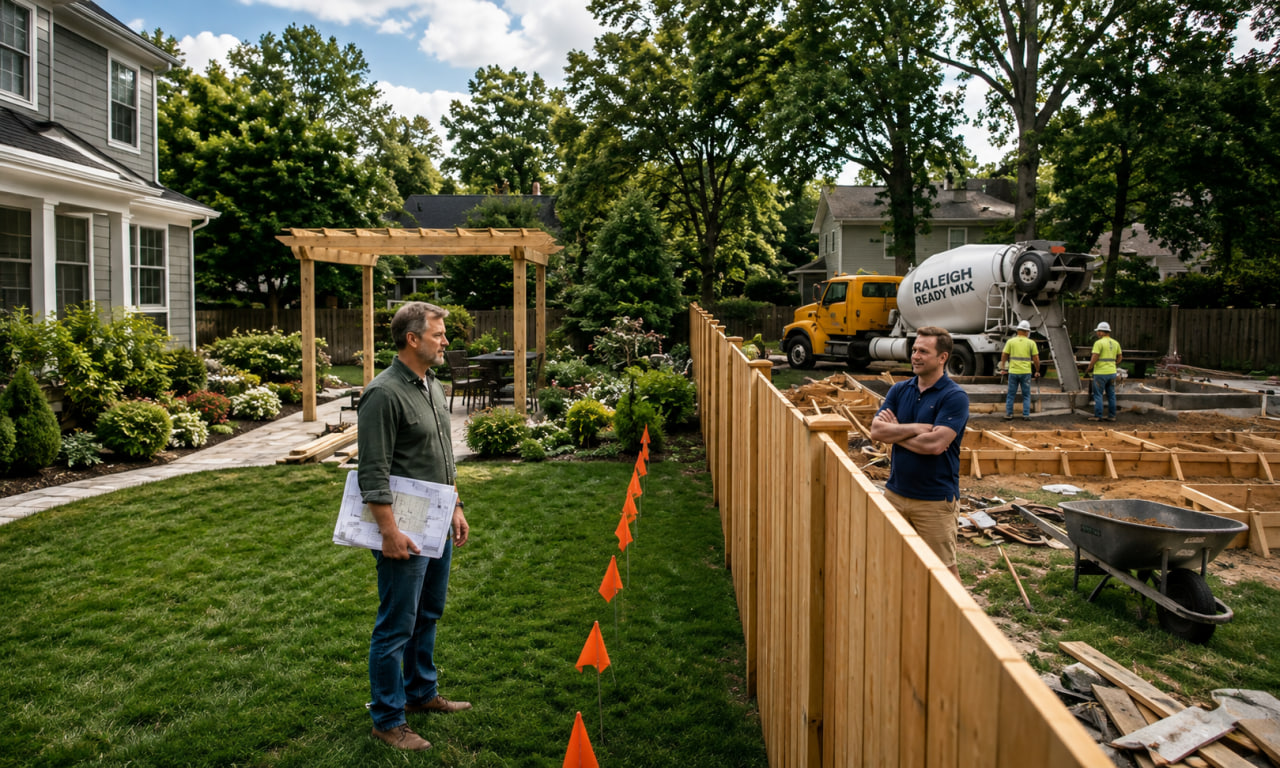
The county ordered the construction stopped.
The pool excavation was declared noncompliant.
The pergola had to be removed.
The concrete foundation had to be demolished.
The landscaping within the easement had to be cleared.
And the fence?
It had to come down.
Not moved.
Down.
Because part of it had been anchored directly across the recorded access corridor.
But that still wasn’t the biggest discovery.
That came later that afternoon.
Rachel called me.
“Jason.”
I could tell from her voice that something had happened.
“What?”
“Remember the development company I showed you last night?”
“Yes.”
“They’ve been trying to acquire properties in your neighborhood for almost two years.”
“So?”
“So your house is the last one they need.”
I sat down.
“For what?”
“A drainage expansion and access project.”
I frowned.
“That doesn’t make sense.”
“It will.”
She sent me a document.
I opened it.
The county had been planning a major stormwater improvement project because the subdivision had repeatedly flooded during heavy storms.
The existing drainage system was too small.
The new system required access through the corridor behind my house.
And because of the way my parcel sat at the end of the line, my property was the key access point.
The development company wanted the land.
Not because of my house.
Because of what was underneath it.
The drainage corridor.
The access.
The future development rights.
Tyler’s house was part of the company’s planned expansion.
His backyard wasn’t the destination.
It was the first piece.
I thought about the fence.
The eight feet.
The expensive trees.
The pool.
The concrete.
The pergola.
It suddenly made sense.
Tyler hadn’t simply wanted a bigger backyard.
He had been trying to establish control over the land before anyone questioned it.
If the fence stayed long enough, if the improvements stayed long enough, if nobody challenged him…
he could later argue that the boundary had been accepted.
Maybe he had believed time would do the rest.
Rachel sat across from me.
“There’s one more thing.”
I sighed.
“Of course there is.”
She smiled faintly.
“The company offered Tyler money.”
“For what?”
“To purchase the strip behind his house.”
“How much?”
“Enough to make the pool and landscaping look cheap.”
I stared at her.
“And he said no?”
“He never owned the strip.”
I laughed.
“No. I mean—why would they offer him money for land he didn’t own?”
“They didn’t know the records had been altered.”
I stopped laughing.
“So Tyler thought he was sitting on valuable development land.”
“Exactly.”
“And when I challenged the fence…”
“He realized you were standing between him and the deal.”
Everything became clear.
The threats.
The confidence.
The sudden hostility.
The way he’d told me, “It’s my yard now.”
He hadn’t been protecting a fence.
He’d been protecting a plan.
Three weeks later, the fence was gone.
The pool was gone.
The pergola was gone.
The Japanese maples were carefully removed and replanted on Tyler’s actual property.
The concrete pad was demolished.
The drainage corridor was cleared.
And my eight feet of grass came back.
I stood there one Saturday morning holding the mower.
For a moment, I didn’t move.
The yard looked strangely unfamiliar.
Not because it had changed.
Because it hadn’t.
That was the strange part.
The oak tree was still there.
The swing was still there.
The shed was still there.
The same patch of grass where Emma had fallen off her bicycle was still there.
I started the mower.
The engine rattled to life.
I pushed it forward.
One straight line.
Then another.
For the first time in months, the wheels crossed the boundary without stopping at a fence.
I almost cried.
Not because of the grass.
Because of what the grass represented.
Someone had looked at something that belonged to me and decided that wanting it badly enough made it theirs.
They had built over it.
They had threatened me.
They had told me I was wrong.
And for a while, they had made me question something I had known for eleven years.
But the property line had never moved.
I had.
I’d been pushed back.
Until I decided not to be.
A month later, Tyler sold his house.
He didn’t get nearly what he expected.
The buyer’s attorney found the entire history of the property during due diligence.
The buyer backed out.
Eventually, Tyler sold to someone else at a significant loss.
The attorney who had represented him was no longer involved.
The county opened an investigation into the altered site plans.
The surveying company that had produced the questionable documents was already under investigation for unrelated complaints.
And the development company?
They withdrew their acquisition proposal.
At least for the time being.
Rachel told me the county was rebuilding the drainage system using the original access corridor.
My property would remain mine.
No fence.
No pool.
No disputed boundary.
Just grass.
One afternoon, Emma came home.
She walked into the backyard and looked around.
“You got the yard back.”
I smiled.
“I never lost it.”
She looked at me.
Then toward the oak tree.
“Can we sit?”
We sat beneath the branches.
For a while, neither of us spoke.
Then she said:
“You know what I remember about this place?”
“What?”
“When I was little, you told me nobody could take our home away.”
I looked at her.
“I remember.”
She smiled.
“You were right.”
I looked across the yard.
The afternoon sun stretched long shadows over the grass.
For months, I’d thought the lesson was about property lines.
It wasn’t.
It was about what happens when someone assumes you won’t fight for what belongs to you.
Tyler had believed the cost of correcting his mistake was my responsibility.
He’d believed a fence could become a boundary simply because he’d built it.
He’d believed confidence was the same thing as ownership.
He was wrong.
Because a fence can divide a yard.
It can block a view.
It can make something look permanent.
But it can’t rewrite a deed.
It can’t erase a recorded boundary.
And it can’t turn someone else’s property into yours.
I never yelled at Tyler.
I never tore down his fence.
I never threatened him.
I just documented everything.
I found the line.
And I stood on it.
The funny thing is, Tyler spent thousands of dollars trying to make eight feet of my property disappear.
In the end, those eight feet cost him far more than moving a fence ever would have.
And every Saturday after that, I mowed those eight feet first.
Slowly.
Carefully.
Almost like a ritual.
Because sometimes the most satisfying way to win a fight…
is to never lose your temper in the first place.
And sometimes the line someone crosses isn’t the one between two yards.
It’s the line between what you are willing to tolerate…
and what you finally decide is yours.
I had found mine.
And this time, I wasn’t moving.