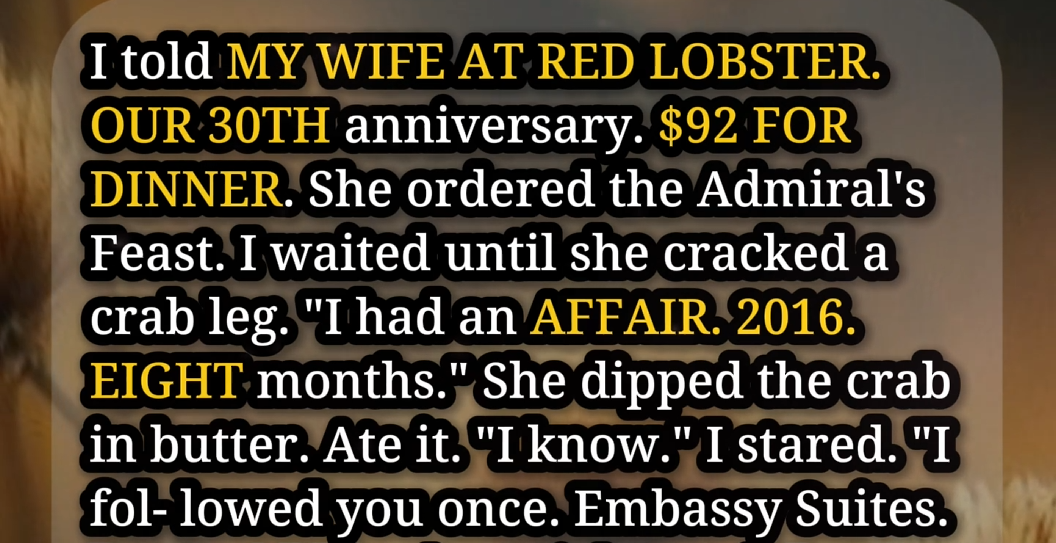
I stared at her.
What was I trying to prevent?
The answer rose in me, ugly and clear:
I was trying to prevent her from hating me in a way I couldn’t control.
I was trying to prevent the moment from being purely hers.
She leaned forward slightly.
“There it is,” she said. “That’s the part you never confess.”
I felt my hands loosen on the letter.
My voice came out small. “So you were waiting… to see if I would finally tell the truth?”
My wife’s eyes didn’t waver.
“No,” she said. “I was waiting to see what you did when you couldn’t.”
She reached for her mug, the same mug I’d been using for years, and took a slow sip like she was pacing herself for what came next.
Then she set the mug down and gave me three rules—quiet, deliberate, like steps on a staircase.
“First,” she said, “you stop contacting her.”
I swallowed hard. “I—”
“Don’t argue,” she cut in, firm but not angry. “Second. Give me access to the accounts we share. Third. You do not try to speak to me like this is still your confession.”
My heart hammered.
“Because,” she added, “it isn’t.”
She stood.
And when she walked away, she didn’t leave me with answers.
She left me with only one thing I couldn’t endure:
The knowledge that the night I chose for control had already ended.
The only next chapter was hers.
Part 5 — The Rules She Gave Me (Without Asking)
I tried to breathe.
Not because I was calm—because my body had decided panic wouldn’t be useful anymore. It just made me loud inside, and loud inside didn’t change anything.
My wife set the mug down carefully and looked at me like she was already living with the version of this conversation where I didn’t get to push back.
“First,” she said, “you stop contacting her.”
My mouth opened. “But I—”
“No,” she repeated, still quiet. “Not another explanation. Just compliance.”
I stared at her, confused and ashamed at the same time.
Because I’d expected anger. I’d expected punishment. I’d expected her to need my participation in order to move forward.
But she didn’t need my cooperation to be powerful.
She needed it to be clean.
“Second,” she continued, “you give me access to the accounts we share.”
My fingers twitched toward my phone like it might save me. Like I could still manage the narrative if I could just delete the right things fast enough.
“Third,” she said, “you do not speak to me as if this is your confession.”
That one line felt personal in a way the affair never had.
I’d confessed—so why was I still the problem?
I reached for an apology, but what came out was defensive instead.
“I’m trying,” I said. “I already told you the truth.”
Her expression didn’t soften.
“I know you told me,” she replied. “I also know you told me like a man trying to steer his own consequences.”
Then she did something that made my stomach drop further.
She slid the letter toward herself—like she was making room on the table for the next action.
“Tonight was the truth,” she said. “Tomorrow is the work.”
And for the first time, I realized what she’d been waiting eight years for wasn’t the moment I admitted it.
It was the moment I stopped treating it like a transaction—like confession bought access back into her life.
I nodded quickly, too quickly.
“Okay,” I said. “Okay. I’ll do it.”
She looked at me for a long moment, as if deciding whether my agreement was real or just fear dressed up.
Then she stood.
“Good,” she said. “Because you’re not the only one who planned.”
I followed her movement with my eyes.
She walked to the kitchen counter, grabbed a kitchen chair, and set it a little farther from the table than before—an adjustment so small it barely counted as symbolism.
But it told me everything:
She was arranging her life around absence.
And I had been the one who didn’t notice until it was already done.
Later that night, I kept thinking about crab legs cooling on plates.
About how I’d chosen the “nice” timing to make the truth easier to swallow.
But the truth wasn’t meant to be swallowed.
It was meant to be processed.
And then—like the world had been waiting for her rules to take effect—my phone buzzed.
A missed call.
Unknown number.
Then another.
Then a voicemail.
I didn’t listen right away. I told myself I’d do it in the morning—because I still believed in pacing, still believed in control, still believed I could delay consequences until they stopped feeling sharp.
But when the screen went dark, the house seemed to get quieter, and my wife’s voice sounded faint from the hallway.
“Don’t.”
Just that word.
No threat.
No argument.
A boundary spoken like it was already part of the plan.
So I didn’t.
Not because I was suddenly noble.
Because for the first time, I understood what she’d opened that box for:
Not to punish me with the content.
To remove me from the process.
And the twist I couldn’t ignore was this—
She wasn’t waiting eight years to hear my confession.
She was waiting eight years to take back the power I’d tried to hand her on my schedule.
The End
I did what she asked, not because I suddenly became a better man, but because I finally ran out of places to hide.
I stopped reaching out. I handed over what she requested. I stopped turning every silence into a chance for “one more talk,” one more version of myself that would sound more responsible than I felt.
At night, I replayed the dinner—crab legs cooling on plates, candlelight, the careful way I’d chosen the timing so my confession wouldn’t feel like a rupture.
But the truth wasn’t a performance anymore.
It was eight years old.
The box wasn’t waiting to catch me. It was waiting to prove something I couldn’t refute: that she hadn’t been reacting on instinct. She’d been surviving on preparation. She’d been building a life that didn’t depend on my honesty being real—only on my honesty being unavoidable.
When the paperwork started moving, she didn’t look defeated or broken. She looked clear. Tired, yes—but clear. Like her anger had already been spent doing the one thing anger should do: creating a future.
I wanted to believe my confession mattered most.
I wanted that to be the turning point, because that’s how I’d lived for years—by searching for the moment where I could still steer.
But the turning point was earlier.
It was the moment she decided to stop hoping I would become trustworthy enough to keep her from trembling inside her own life.
So I sat with the only lesson left, the one my ego hated:
I confessed to be forgiven.
She waited to be safe.
And once she had safety, she no longer needed my story.
The end wasn’t dramatic. No final blow, no courtroom monologue, no cinematic redemption arc I could ruin myself with.
The end was quieter than that.
It was me learning that consequences don’t negotiate—and that a box opened years too late can still change everything.
End of story .