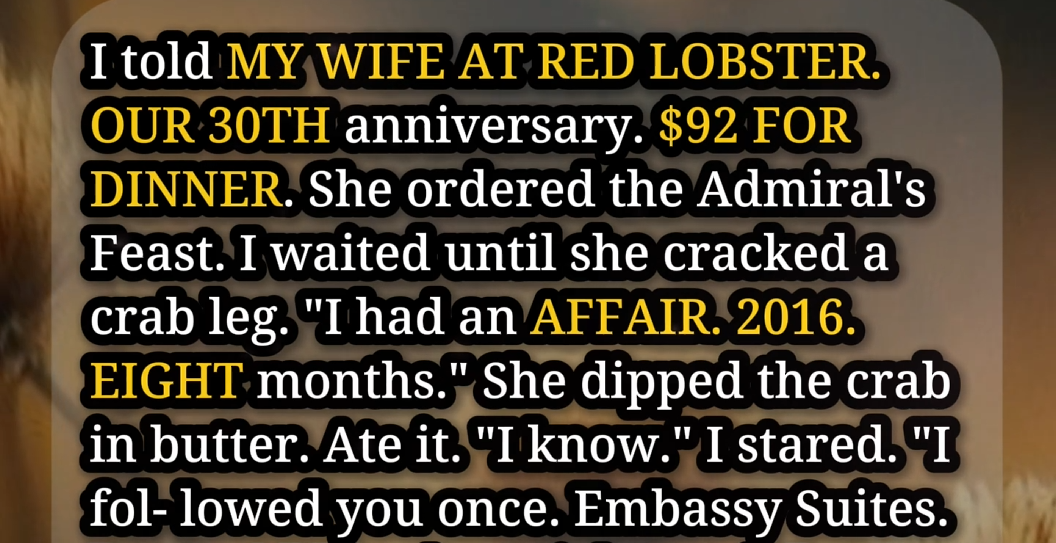
And when I flipped it over and saw the first line, my throat closed completely.
Because it started exactly where my “confession” had always started in my head—
If I tell her, I’ll finally be forgiven.
And my wife watched me read it like she’d been waiting eight years to hear whether I’d still believe the same lie.
Part 3 — The Note I Swore I Deleted
My fingers shook as I held the paper.
Not because the words were unfamiliar—because I knew every line like it had been stitched into me. I remembered writing it at 2:17 a.m., sitting on the edge of the bed, my phone glowing in my palm, the guilt so loud it felt like it was coming from outside my skull.
I remembered deleting it.
I remembered telling myself I’d erased the part of me that would eventually betray me.
But the sheet in my hands wasn’t erased.
My wife’s calm made it worse. She didn’t watch me like she wanted to gloat.
She watched me like a person checking a lock she already knew was broken.
“Read the part about forgiveness,” she said.
I looked up, and for the first time my composure cracked.
“I can’t,” I said. “It’s—private.”
“It’s private only to the version of me you thought you could manage,” she replied.
My throat burned. I lowered my eyes and finished reading.
The note didn’t just admit the affair. It revealed the thing I’d been doing even while pretending to be sorry—scripted the moment after.
It said things like:
I’d confess when I was ready.
I’d make it sound like regret and not strategy.
I’d choose the dinner, choose the timing, choose the tone.
And if she looked hurt, I’d use my tears like proof I deserved mercy.
I read a line aloud that made the room tilt.
If I tell her, I’ll finally get to stop feeling like a liar.
My wife nodded once, slow.
“That,” she said, tapping the paper with one finger, “is why I waited eight years.”
I stared at her. “What does that even mean?”
“It means I wasn’t waiting for you to confess,” she said. “I was waiting for you to be honest about what confession was for.”
My stomach twisted. “I was honest.”
“You were honest about the affair,” she corrected. “But you weren’t honest about the purpose.”
She leaned forward, voice still controlled, but it carried weight now—like the calm was a decision, not a mood.
“You chose crab legs,” she continued, “because you wanted the truth served warm. You wanted it to land easier. You wanted it to be a scene you could direct.”
My hands tightened around the letter until the paper bent.
“I didn’t think—” I began.
“You did,” she said. “Not in words. In behavior.”
She reached into the box again and pulled out a second stack—smaller, thinner. Not as dramatic as the note, but more devastating because it was quieter.
Copies of messages.
Screenshots of drafts.
Dates.
Evidence of how long I’d been rehearsing my “better man” routine.
Then she placed one envelope on the table.
“This is what you never knew about,” she said.
I stared at it. My name was on it. My handwriting again—only I’d never written on that envelope.
I looked at the seal. It had been opened once.
Not by a stranger.
By my wife.
And that’s when I finally understood the cruelty of the waiting: she hadn’t been waiting to punish me.
She’d been waiting to stop reacting to me.
Waiting to see what kind of man I really was when the box didn’t belong to me anymore.
I swallowed hard. “So what happens now?”
My wife slid the box back toward herself, finally standing.
“Now,” she said, “you don’t get to perform an ending. You get to face consequences without trying to manage my reaction.”
She paused at the doorway.
And before she left, she gave me one last sentence—soft, but final:
“Go ahead. Tell me your version.”
Then she walked away—leaving me alone with the note I swore I’d destroyed, and the truth I couldn’t rewrite fast enough to save myself.
Part 4 — The Room After “Go On”
I sat there until the crab legs smelled like nothing.
Until the wine stopped being a choice and turned into a reminder of how carefully I’d tried to make the night feel safe for me.
My wife didn’t slam anything. She didn’t cry. She didn’t even raise her voice while she spoke.
That calm was the first thing that truly terrified me, because calm meant she wasn’t improvising.
She was following something she’d decided eight years ago.
The paper in my hands blurred whenever I blinked. Not because I couldn’t read it—because reading it made my body relive the exact moment I’d written it.
The moment I’d decided that confession was something I could time to control the outcome.
My throat finally worked.
“I didn’t know you kept all this,” I said, like ignorance could be a defense.
My wife paused in the doorway.
“You did know,” she said quietly.
I blinked. “What?”
“You knew you’d written it,” she replied. “You knew you deleted it. And you knew you didn’t destroy it all the way, because you left a version of yourself behind you—one you couldn’t fully erase.”
I wanted to argue, to claw my way back into the role I understood.
But every sentence I formed felt like it belonged to a different man.
A man who still believed he could negotiate with reality.
So I swallowed and tried again—this time with what I assumed was the right kind of remorse.
“I’m sorry,” I said. “I understand why you’re upset. I don’t want to lose you. I’ll do anything.”
My wife turned back to the table, and for the first time her face looked tired instead of composed.
“That,” she said, “is the old script.”
I flinched.
She stepped closer—just close enough that I could smell the soap on her hands from where she’d been washing dishes. It grounded me, made the situation real in a way pleading couldn’t.
“You keep offering ‘anything’ because you think love is a transaction,” she continued. “You think if you pay the right price, I’ll return to the place where you feel safe.”
My chest tightened.
“Don’t,” she said, then softened the word by adding, “I’m not asking you to earn forgiveness tonight.”
“What are you asking?” I whispered.
She looked at the box, then at me.
“I’m asking you to stop trying to be the narrator of your own consequences.”
The words landed like a verdict.
Because I realized she wasn’t waiting for me to say the right thing.
She was waiting for me to stop saying things that protected me.
She gestured toward the letter.
“You wanted relief,” she said. “So you confessed. But relief doesn’t rebuild trust. It just makes you feel clean.”
I opened my mouth.
She raised a hand again, gentle but unmovable.
“No more defending,” she said. “No more explaining. Not yet.”
Then she did something I hadn’t expected.
She sat down across from me.
Not as a judge.
As someone preparing to live.
“Tell me,” she said, “why you confessed on crab legs.”
My body went cold. “Because I wanted it to be nice.”
She nodded, like that confirmed something.
“And why did you choose that ‘nice’ version?” she asked, tone even. “What were you trying to prevent?”