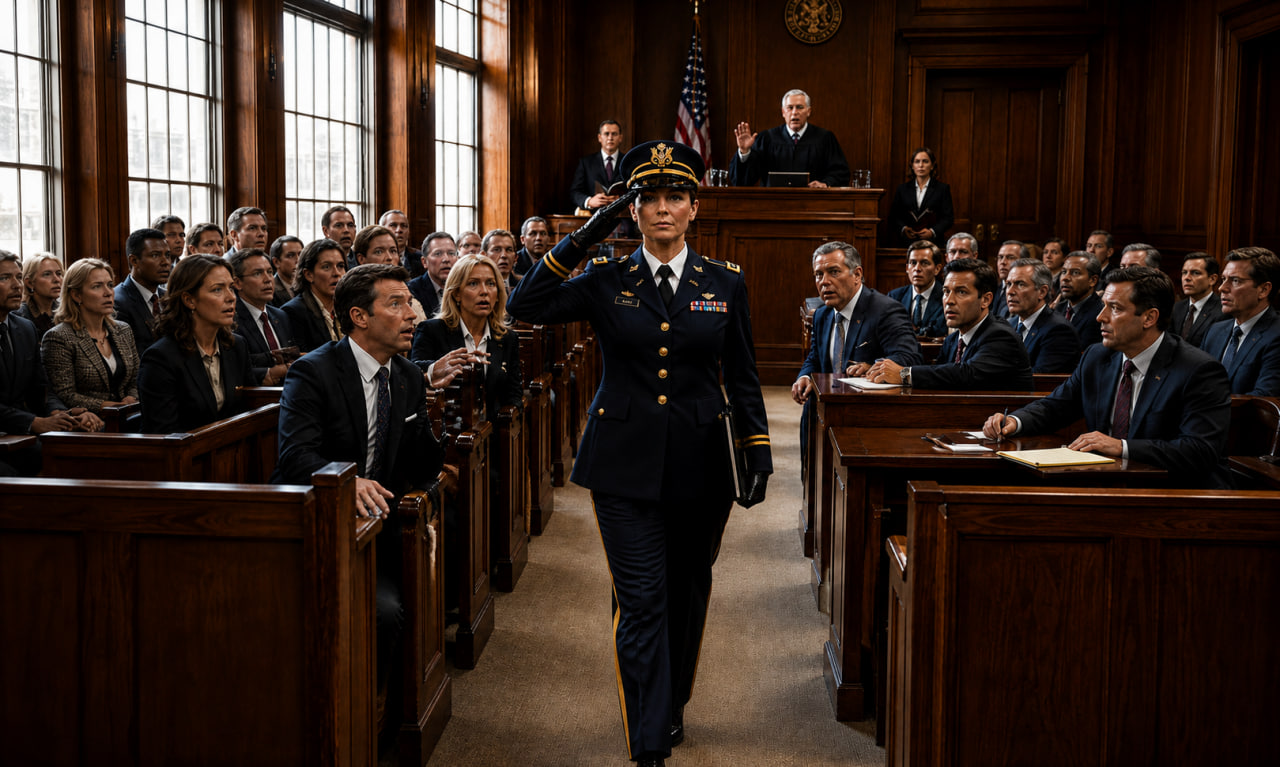
Back in my office, I found a letter from my father.
He admitted he had laughed when I entered the courtroom because he had spent years reducing my accomplishments and could not face what everyone else already knew.
He wrote that I had become someone he should have respected.
I stopped there.
Become.
As if the girl who studied while Adrian was praised for showing up had not deserved respect.
As if I needed a uniform, commendations, and a judge’s recognition before my own father could see me.
Still, I kept reading.
He admitted he had punished me for being capable. He said he was proud because I chose what was right over what was easy.
A younger version of me would have called immediately.
She would have treated those words like proof the years had finally meant something.
But that woman no longer existed.
Not because she had become cold.
Because she had learned the difference between forgiveness and access.
I folded the letter and placed it in a personal folder.
My family was not the case.
They were simply people who showed me what they were willing to sacrifice when loyalty became inconvenient.
Later, I went to dinner with Maya and her friends near the harbor. No one compared me to anyone. No one told me I took myself too seriously. No one asked me to shrink so someone else could feel taller.
They did not need Commander Emma Lane.
They liked Emma.
Months later, I called my father once about a hospitalized aunt. At the end, he asked if we would ever be a family again.
“We are family,” I said. “But that does not mean we go back to what we were.”
“Do you forgive us?”
“I don’t hate you,” I answered. “But forgiveness doesn’t mean pretending none of it happened.”
The following spring, I received orders for a new position: director of a joint legal-cyber training program.
On my first morning, I placed a photograph of Grandpa Samuel on my shelf and set a small Harbor Veil challenge coin beside it.
Honor is the only inheritance worth keeping.
The case had stripped away everything I once mistook for strength: approval, family reputation, being the easy daughter, never causing trouble, staying endlessly available.
What remained was better.
At 0800, the first officers entered the classroom.
No laughter.
No sigh.
No family waiting to decide whether I was worth listening to.
Just people ready to learn.
I looked at the first slide.
INTEGRITY UNDER CONFLICT.
“Good morning,” I said. “There will come a day when doing the right thing costs more than you expected. You may lose friends, opportunities, and people who believe loyalty means obedience. You may even lose your place in a family you spent your whole life trying to earn.”
The room went still.
“But if your integrity survives the price, don’t mistake what you lost for what you were worth.”
For the next hour, I taught.
Afterward, I walked outside into clean spring sunlight. My phone stayed quiet in my pocket.
No demands.
No accusations.
No messages telling me whom to protect.
For once, the quiet did not feel like exile.
It felt like freedom.
My father had laughed because he still saw me as the daughter trying too hard to matter.
My mother had sighed because she believed I had chosen rules over family.
Adrian had smiled because he thought blood would make me weak.
They were all wrong.
The judge had recognized the work, the discipline, and the years no one at home had bothered to see.
But even that was not the ending that mattered.
The real ending came later, when my parents finally said the words I had once wanted more than anything:
We’re proud of you.
And I discovered I no longer needed them.
I had spent years waiting for my family to recognize my worth.
In the end, the most important verdict was the one I finally gave myself.