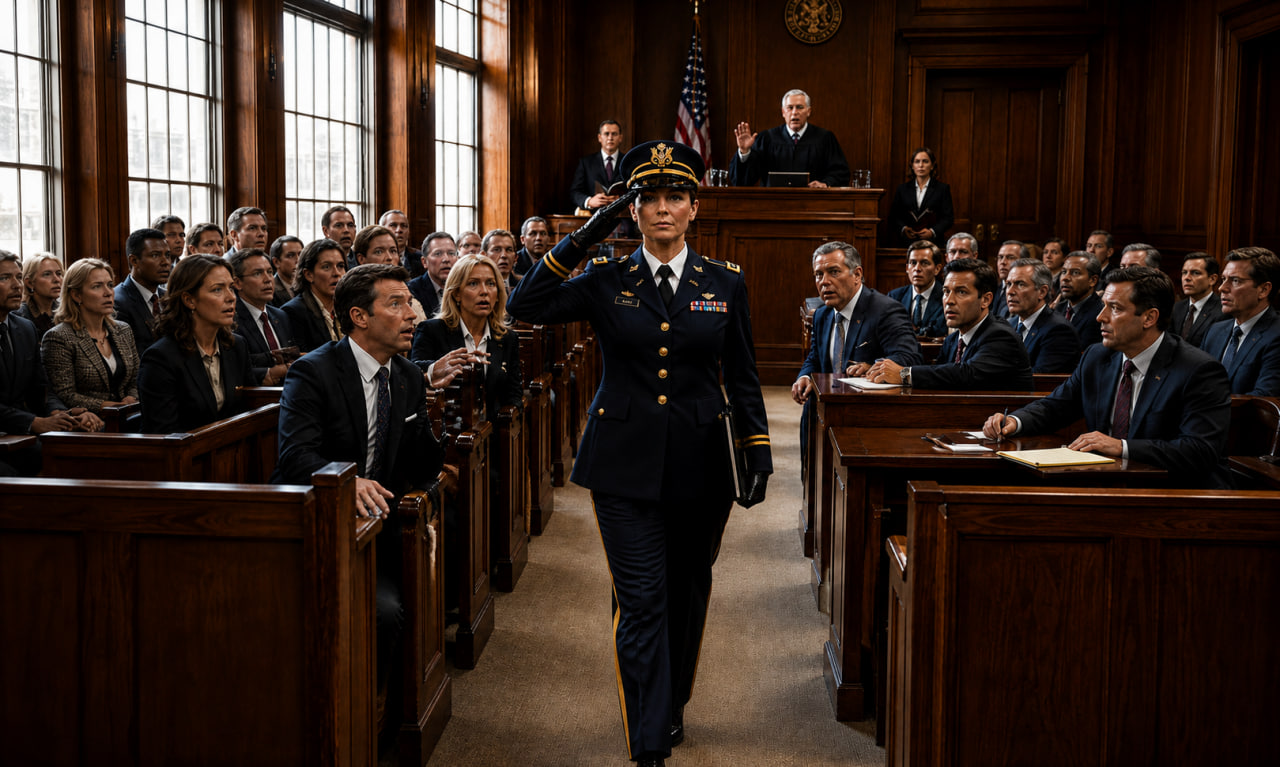
Part 3: The Courtroom
Morning in Honolulu was painfully bright.
Reporters shouted as I walked into the courthouse.
“Commander Lane, did you target your cousin?”
“Are you under investigation?”
“Did family tensions influence the case?”
I kept walking.
Near the entrance, my parents stood beside Adrian.
He wore a gray suit and the same polished smile.
“Nice uniform,” he said. “Trying to impress the judge?”
“No.”
He leaned closer.
“You know this doesn’t have to get worse.”
“It already got worse.”
“Because you made it worse.”
“No, Adrian. Someone accessed Navy systems using a dead man’s credentials, routed restricted data through my parents’ home, and sent it through your company infrastructure.”
His smile hardened.
“Careful. Accusations have consequences.”
“So do actions.”
Dad muttered, “Unbelievable.”
I turned.
“What’s unbelievable?”
“You walking in there dressed like that.”
“I’m ordered to appear in uniform.”
“You know what I mean.”
I did.
The uniform challenged the story he had told for years—that I had a safe little desk job and nothing more.
Inside, the courtroom was cold and silent.
The defense attorney argued bias, conflict, and improper scope. He pointed to my family connection, old tensions, and my parents’ home being part of the evidence trail.
Then Dad laughed behind me.
Mom sighed.
For one second, I was twelve again, holding a science medal while Dad asked why I had not won first place overall.
Then the moment passed.
Judge Ross opened the Harbor Veil binder. She read the certification page, then stopped.
“My God,” she whispered.
She looked at me.
“Commander Lane, you authored the forensic protocol attached here?”
“Yes, Your Honor.”
“And an adapted version later became fleet investigative guidance?”
“Yes, Your Honor.”
Most of my family never knew that. Years earlier, I helped design a method for preserving compromised operational systems without corrupting volatile network evidence. It became part of a training package.
The defense tried to dismiss it.
The judge cut him down calmly.
“Expertise is relevant when the defense describes an investigator as unqualified.”
My father stopped laughing.
When I testified, I walked the court through everything: the automated alert, the contractor registration, the dead credential, the San Diego source address, my supervisor notification, my conflict disclosure, and my recusal.
Then the defense came for what it truly wanted.
“Commander Lane, you don’t like my client, do you?”
“Our personal relationship has been strained.”
“He mocked your career?”
“Sometimes.”
“Your family compared you unfavorably with him?”
“Frequently.”
“So when his company appeared on your screen, you had every personal reason to assume the worst.”
“No,” I said. “I had every personal reason to hope I was wrong.”
He recovered and pushed harder.
He suggested I had the skill, access, and motive to create the digital trail myself.
“Isn’t it possible someone with your expertise could manufacture authentication activity?”
“In theory.”
“And aren’t you exactly such a person?”
“Yes.”
He smiled.
Then government counsel stood for redirect.
“Commander, could you have manufactured the authentication event on page 183?”
“No.”
“Why not?”
“Because it occurred while I was aboard a Navy transport returning from Guam.”
The timestamp appeared beside the flight manifest.
Passenger record.
Government travel record.
Entry logs.
Same dead credential.
Same route.
Different continent.
For the first time all morning, Adrian stopped looking at me.
The judge turned to the defense.
“Unless you have evidence contradicting these timestamps, we will move beyond unsupported theories of fabrication.”
The motion failed.
As I passed Adrian’s table, fear entered his face.
He had believed the family connection was my weakness.
He never realized growing up in that family had trained me to survive him.
Part 4: The Verdict
Once the evidence was admitted, investigators found far more than the original transfer.
Shell companies.
False invoices.
Foreign storage accounts.
Internal messages.
Adrian’s problem was no longer one suspicious route.
It was a pattern.
Then Dad appeared outside my apartment.
“We need to talk.”
“No.”
He blinked.
“We can talk here.”
He admitted Adrian had come to him before the search, saying he had borrowed access from an old account as an “administrative shortcut.”