PART 3
Charlie stared at me.
“Mom, where’s the key?”
“Good morning, Charlie.”
He glanced at the others, embarrassed by my calmness.
“Mom, come on. We’ve been driving for two hours. Just give me the key.”
“What key?”
He removed his sunglasses.
“The farmhouse key. You always leave it under the flowerpot.”
“I used to.”
He stared at me as if I had deliberately forgotten how our family worked.
“Okay. Then where is it now?”
“Somewhere safe.”
Lauren let out an impatient sigh.
“Barbara, please don’t start this today. The children are hungry, and we have all this food in the cars.”
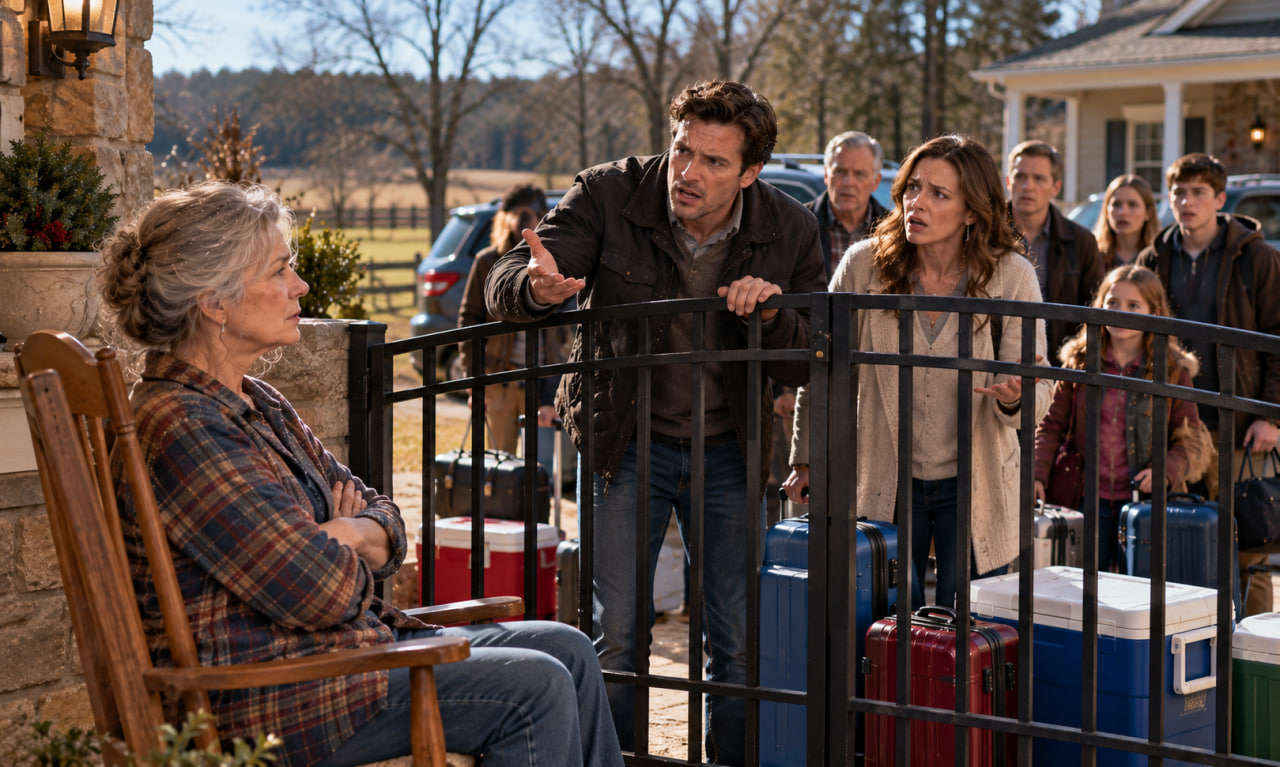
I looked past her at the twelve people standing outside my gate.
Twelve people who had planned a weekend in my home without asking me.
Twelve people who had removed me from their family conversation because they believed I had nothing useful to contribute.
Twelve people who had assumed that, no matter how badly they treated me, I would still open the door.
“I have a question for you,” I said.
Charlie rubbed his forehead.
“Can we do this inside?”
“No. We can do it here.”
I took a folded sheet of paper from my cardigan pocket.
“Who decided that I wasn’t welcome in the family group chat anymore?”
Nobody answered.
Charlie shifted his weight.
“Mom, we already talked about that.”
“No, you explained it. You said it was for working adults because I didn’t understand anything you talked about. I’m asking who decided that I wasn’t worth including.”
My daughter-in-law looked away.
One of my nephews suddenly became fascinated with his phone.
Finally, Charlie spoke.
“It wasn’t meant to hurt you.”
“Then why did nobody apologize?”
He opened his mouth, but no words came out.
I folded the paper again.
“That’s what I thought.”
“Mom, you’re making a big deal out of nothing,” Charlie said. “It’s just a group chat.”
I nodded slowly.
“You’re right. It is just a group chat. And this is just a gate. That house is just a building. The beds are just furniture. The food in the pantry is just groceries. The land beneath your feet is just dirt.”
I looked him straight in the eye.
“But somehow, all those little things become very important when you want to use them.”
His face reddened.
“That’s unfair.”
“Is it?”
I stood up and walked toward the small table beside the gate. On it lay a black notebook, a pen, and a large envelope.
The brown leather notebook Joe had made was inside my cardigan. The black one was new.
Charlie noticed it.
“What is that?”
“Something I should have started years ago.”
I opened the black notebook to the first page.
At the top, I had written one sentence in careful handwriting:
A record of everything I gave, everything I paid for, and everything my family forgot.
Lauren’s expression changed.
“What does that mean?”
“It means that today, we’re going to talk about the farmhouse.”
Charlie laughed nervously.
“Mom, nobody is trying to take your farmhouse.”
I looked at the twelve suitcases, the coolers full of meat, the bags of groceries, and the children already asking when they could go inside.
“No,” I replied. “You were simply planning to enjoy it without asking the person who owns it.”
“That isn’t fair!” he repeated.
I opened the notebook.
“Let’s find out.”
Charlie folded his arms.
“Fine. What exactly do you want us to do?”
I looked down at the first page.
“Listen.”
For a moment, nobody spoke. The wind moved through the old oak trees, scattering dry leaves across the driveway. Somewhere behind the house, the wind chimes Joe had hung twenty years earlier began to ring.
I remembered the day he installed them. Charlie had been seventeen, impatient to leave for a football game, and had complained that his father wasted too much time fixing things nobody noticed.
Joe had smiled and continued working.
“Someday,” he had told me, “our boy will understand that the things people don’t notice are often the things holding everything together.”
Standing before my locked gate, I wondered whether Joe had been wrong.
I opened the notebook.
“Charlie, do you remember the summer you lost your job?”
He looked uncomfortable.
“What does that have to do with anything?”
“Three years ago. You called me because you couldn’t make your mortgage payment. You said you needed help for one month.”
“I paid you back.”
“Eventually. But you forgot to mention the other eleven payments I made afterward.”
His expression changed.
I turned a page.
“Lauren, do you remember when your car broke down? The transmission needed replacing, and you said you couldn’t afford it because you were paying for the children’s school expenses.”
She blinked.
“I thought Charlie told you about that.”
“He did. I paid $3,800.”
“You offered to help,” she said defensively.
“Yes. I did. Because you were struggling, and I wanted to help.”
I turned another page.
“David, the roof on your house. Your daughter’s hospital bill. The refrigerator you needed before Christmas. The emergency flight when your mother was sick.”
David lowered his eyes.
I wasn’t trying to embarrass them. I was simply reading what I had written down over the years, because I had finally realized that memories become strangely unreliable when people prefer to forget what they owe someone.
“I never asked for repayment,” I continued. “Not once. I helped because I loved you.”
Charlie looked toward the farmhouse.
“Mom, nobody is denying that you’ve helped us.”
“Then why do you treat me as though I have nothing to offer except a spare bedroom?”
Silence.
A little girl tugged on her mother’s sleeve.
“Mommy, why can’t we go inside Grandma’s house?”
Her mother gently pulled her closer.
I felt my heart tighten. The children had done nothing wrong. They had been brought here believing their grandmother would welcome them, because that was what I had always done.
I turned to them.
“Sweethearts, Grandma loves you. This isn’t your fault.”
One of the boys asked, “Did we do something bad?”
“No, darling. You didn’t.”
I looked back at the adults.
“But the grown-ups need to learn something today.”
Charlie sighed heavily.
“Okay. We’ve heard you. We’re sorry. Can we go inside now?”
There it was again.
An apology offered like a coin dropped into a machine, with the expectation that it would immediately produce the desired result.
I closed the notebook.
“No.”
His face hardened.
“What do you mean, no?”
“I mean that you’re not staying here this weekend.”
Lauren stared at me.
“You can’t be serious.”
“I have never been more serious in my life.”
“But everything is packed!” she protested. “We bought food. We took time off work. The children have been looking forward to this for weeks.”
“And I have spent seventy-six years learning how to say yes when my heart wanted to say no.”
I paused.
“I’m finished doing that.”
Charlie stepped closer to the gate.
“Mom, you’re going to regret this.”
For the first time that morning, I felt something other than hurt.
I felt peace.
“No, Charlie. I think I’ve regretted the opposite for far too long.”
Then I picked up the envelope from the table.
Inside was a single sheet of paper.
I held it against the bars so they could read the heading.
NOTICE REGARDING ACCESS TO PRIVATE PROPERTY.
Charlie’s eyes moved across the page.
“Are you threatening your own family with a legal notice?”
“I’m informing you that this is my home, and visits must be arranged with my permission.”
He looked at me as though he no longer recognized me.
Perhaps he didn’t.
For decades, he had known the mother who would sacrifice her comfort to protect his. He had known the woman who would stay awake waiting for his phone call, who would send money even when she needed to repair her own roof, who would cook enough food for twenty people because she was afraid somebody might arrive hungry.
He had never met the woman who could close a gate.
Until that morning.
Lauren whispered something to him.
He shook his head.
Then he turned toward the others.
“Everybody, put the coolers back in the cars. We’re leaving.”
Nobody moved immediately.
They had expected tears, perhaps. An argument. A dramatic threat that would dissolve into forgiveness by lunchtime.
They hadn’t expected a quiet old woman with a notebook.
As they began loading their belongings, my youngest granddaughter, Emily, approached the gate.
She was nine years old, with two uneven braids and a pink backpack decorated with little stars.
“Grandma?”
I walked over.
“Hello, sweetheart.”
She slipped a folded piece of paper through the bars.
“I made you something at school. Daddy said we might be too busy this weekend, but I wanted you to have it.”
My hands trembled as I unfolded it.
It was a drawing of the farmhouse. Twelve little people stood in front of the house, and a woman with silver hair stood in the middle.
Above them, in crooked purple letters, Emily had written:
MY GRANDMA’S HOUSE IS WHERE EVERYBODY BELONGS.
I pressed the paper to my chest.
“Oh, Emily.”
Her eyes filled with tears.
“Are you mad at us?”
I knelt beside the gate.
“Never at you, sweetheart. Never.”
“Will you still make apple pie for me?”
A small laugh escaped me through my tears.