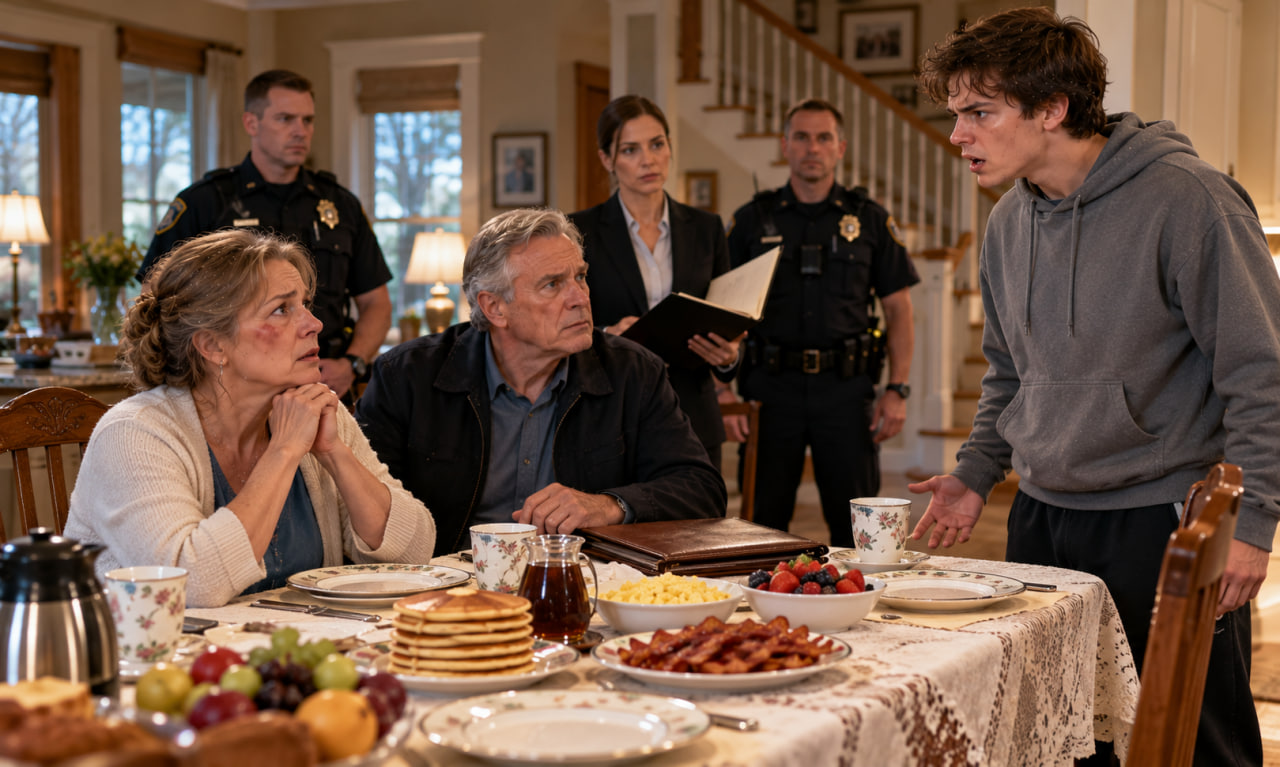
For several seconds, Tyler stood frozen at the bottom of the stairs.
His eyes moved from his father to the attorney, then to the two uniformed officers standing near the front door. Finally, his gaze settled on the brown folder in front of his empty plate.
“What the hell is this?” he demanded.
Richard didn’t answer immediately. He lifted his coffee cup, took a slow sip, and placed it back on its saucer.
“Sit down, Tyler.”
Tyler laughed, but there was no humor in it.
“Are you serious? You show up at my house before sunrise with cops and lawyers, and you tell me to sit down?”
I watched him carefully.
My son had spent months making everyone in the house nervous.
He slammed doors because he wanted attention.
He shouted because he wanted control.
He threatened me because he had learned that fear could make people surrender what he wanted.
And yesterday, I had surrendered nothing.
That was why he had hit me.
“It’s my house,” I said quietly. “And you’re going to listen.”
His head snapped toward me.
For a moment, I saw the familiar anger rising behind his eyes.
“Mom, don’t start this nonsense.
You said no to me last night, and things got out of hand. It happens.
You’re making it sound like I committed a crime.”
One of the officers shifted his weight.
Ms. Harrison, my attorney, opened her notebook.
“Tyler Collins,” she said, “your mother reported an incident of physical assault.
She has described what happened, and the officers are here to address the report and explain the next steps.”
Tyler stared at her.
Then he looked at me.
“You called the police on your own son?”
I felt those words land somewhere deep inside me.
For twenty-three years, I had been the person who protected him.
I had defended him when teachers complained about his behavior.
I had helped him after he dropped out of college. I had paid bills after he lost jobs.
I had lied to relatives about why he needed money again.
I had even apologized to him for things I hadn’t done, simply because I wanted peace in my home.
Now he was looking at me as if I had betrayed him by refusing to accept being hit.
“Yes,” I answered. “I told the truth about what you did.”
His mouth opened, then closed.
Richard finally pushed the brown folder toward him.
“Open it.”
Tyler looked at the folder as though it contained something dangerous.
“What is this supposed to be?”
“Documents,” Richard replied. “Read them before you start shouting.”
Tyler pulled out the first page.
His eyes moved across the lines.
Then he flipped to the second page.
His face changed.
“What the hell?” he whispered.
I folded my hands in my lap.
The folder contained the paperwork Ms. Harrison had prepared after I called her at two in the morning.
It included information about my ownership of the house, a formal written notice concerning Tyler’s living arrangements, and documentation related to the steps I was taking to protect myself.
Nothing in that folder could magically make the previous night’s assault disappear.
Nothing could guarantee that Tyler would leave without an argument.
But it established one thing clearly: I was no longer going to let him treat my home as a place where he could threaten me without consequences.
The exact legal process would depend on the circumstances and applicable Ohio law. Ms. Harrison had explained that to me before dawn.
I wasn’t trying to punish my son with paperwork.
I was trying to stop living in fear.
Tyler threw the pages onto the table.
“You can’t kick me out!”
Ms. Harrison remained composed.
“The documents explain the process your mother is beginning.
You can seek your own legal advice.
But you cannot threaten or assault someone simply because you live in their home.”
“I didn’t assault anybody!”
The words came out so quickly that I almost laughed.
Almost.
I remembered the sting of his hand against my face.
I remembered the refrigerator humming while I stood perfectly still, unable to believe that my own child had struck me.
I remembered how he had shrugged and walked upstairs without offering a single apology.
“I was standing right there,” I said. “You hit me.”
“It was a slap!”
The room went silent.
Tyler seemed to realize what he had admitted only after the words had escaped his mouth.
Richard slowly lowered his cup.
“A slap?” he repeated.
Tyler turned toward him.
“Dad, stay out of this.
You haven’t been around enough to understand what she’s like.”
Richard’s expression tightened.
“You’re right about one thing. I haven’t been around enough.
I should have been there more often when you were growing up.
I should have helped your mother carry the responsibility instead of leaving so much of it on her shoulders.”
I looked at him, surprised.
Richard and I had divorced when Tyler was young.
Our marriage had ended with arguments, disappointments, and the kind of exhaustion that comes from trying to repair something that both people have stopped knowing how to fix.
After the divorce, Richard moved to Cleveland.
He visited, called, and contributed financially, but I remained the parent who handled the daily emergencies.
The missed school days.
The broken promises.
The sleepless nights.
The desperate phone calls asking for another chance.
I had resented Richard for years, sometimes for good reasons and sometimes because resentment was easier than admitting how lonely I had been.
But that morning, he wasn’t there to argue about our marriage.
He was there because his son had hurt me.
Richard leaned forward.
“My mistakes as a father do not give you permission to hurt your mother.”
Tyler scoffed.
“Oh, so now you’re Father of the Year?”
“No,” Richard answered. “I’m a father who should have done more.
And I’m not going to use that failure as an excuse to let you become a man who hurts people.”
For the first time since coming downstairs, Tyler had nothing to say.
Then he turned back to me.
His voice softened suddenly.
“Mom, come on. You know I didn’t mean it.”
That sentence nearly broke me.
Not because I believed it, but because I had heard versions of it so many times.
I didn’t mean to break the television.
I didn’t mean to scare you.
I didn’t mean to spend your money.
I didn’t mean to lose my temper.
I didn’t mean it.
Somehow, every explanation had become a request for me to forget what happened before the next incident arrived.
“I’m your mother,” I said. “I’m not your punching bag.”
Tyler’s expression hardened again.
“You’re seriously going to destroy my life over one mistake?”
I looked at the untouched pancakes.
When Tyler was little, I used to cut his pancakes into small pieces because he would get impatient and try to eat them too quickly.
He loved the crispy edges of the bacon and always asked for more syrup.
I had made this breakfast partly because I wanted to remember that child.
But I was beginning to understand something painful.
Remembering the little boy he had been could not make the grown man standing before me harmless.
“Your life is not being destroyed,” I said. “You are being asked to take responsibility for what you did.”