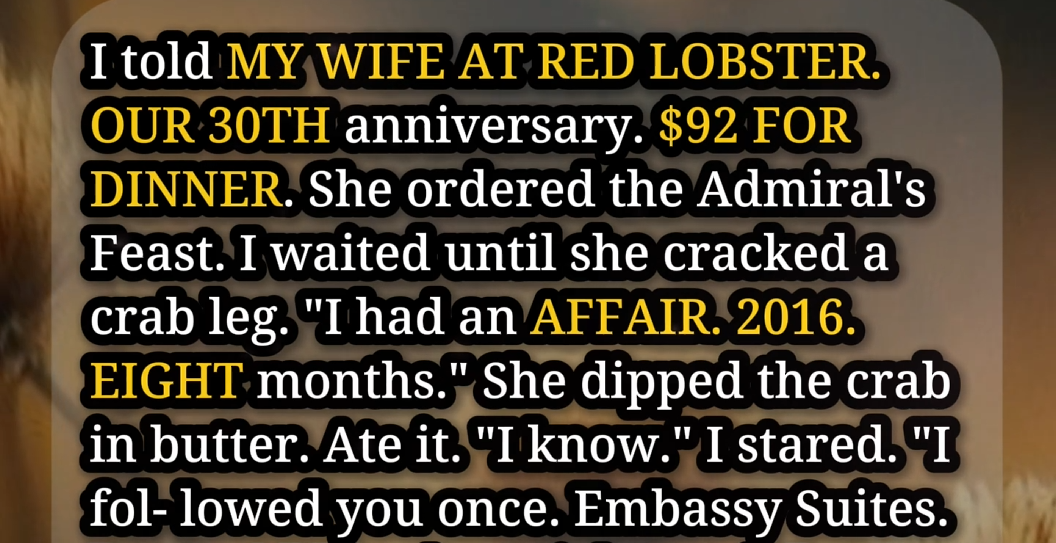
Part 1 — The Dinner I Picked to Control the Ending
I chose crab legs because they felt like something we could both pretend was normal.
White wine in the fridge. Butter warming on the stove. A little candle on the table—nothing fancy, just enough to make the night look softer than it was. I’d spent the whole afternoon arranging the house like comfort could be curated.
Because I wasn’t just going to confess.
I was going to do it right.
In my head, confession had rules: admit the truth, show remorse, say the right phrases at the right times, and then—somehow—my wife would meet me in the middle. She’d look at me, hear the words, and all the damage I’d done would finally be something we could clean up.
I told myself that.
I told myself I’d become better the moment I decided to be honest.
Then she came home.
When she walked in, she smiled the way she always did when she thought the day had gone well. The smile wasn’t fake. It was just automatic—like it belonged to a version of her that hadn’t learned all the ways love can be bent.
“Crab legs?” she asked, stepping out of her shoes.
I nodded too quickly. “I thought we could have a nice night.”
She didn’t ask why my voice sounded careful. She didn’t notice how my hands kept hovering over the table like I wanted to rearrange my life one utensil at a time.
We sat.
She reached for the first claw with steady fingers. I watched her—watched her ring catch the light, watched her relax into the rhythm of a normal meal.
And it made me feel almost brave.
Almost.
Then, with the soft clink of shells against the plate, I finally said it.
“I need to tell you something,” I said, as calm as I could make my voice.
My wife paused—not suspicious, just attentive.
So I pushed the words out like I could throw them far enough away to make them less dangerous.
“I’ve been having an affair.”
For a moment, the house held its breath.
Not with shouting. Not with collapsing. Not with dramatic tears.
Just silence.
Then my wife lowered the claw in her hand and looked at me like she’d been waiting for a specific chapter to arrive.
And she didn’t ask, Why?
She didn’t cry.
She didn’t even look disgusted.
She just said, softly, like she was confirming something she already knew:
“Do you really think I didn’t know?”
My stomach dropped.
Because I’d pictured her finding out as chaos—like the truth would hit her and break her. I’d pictured myself as the villain arriving late to a disaster.
But she didn’t look broken.
She looked… prepared.
That was when she stood up, walked to the sideboard, and reached into a drawer I never paid attention to.
When she came back, she wasn’t holding a weapon.
She was holding a box.
Small. Plain. Worn at the edges.
She set it between us with both hands like it mattered.
Then she said one sentence that stole all the air from the room:
“I’ve been waiting eight years to open that box.”
And before I could ask what she meant, she added—quiet, certain—
“Go on. Tell me your version.”
Part 2 — “Go On. Tell Me Your Version.”
My mouth opened, and nothing useful came out.
All I could do was stare at the box like it might explain itself if I looked hard enough—like my eyes could force the years inside it to make sense on my terms.
My wife sat back down. She folded her hands in front of her, steady and almost gentle, as if we were having a conversation about a bill, not a marriage.
“Go on,” she repeated. “Tell me your version.”
I swallowed. “My version of what?”
“Of why you confessed tonight,” she said. “Of why you chose crab legs. Of why you thought the timing would change what you already did.”
Her tone wasn’t cruel.
It was precise.
So I tried to do what I’d always done when I was afraid: I tried to sound reasonable. I tried to be controlled. I tried to translate my guilt into something that looked like growth.
“I was tired,” I said. “I couldn’t carry it anymore. I didn’t want to keep lying to you.”
My wife nodded once, like she was listening for something specific.
“Keep going.”
“I thought if I told you,” I said, voice tightening, “you’d finally hear me. You’d finally understand that I’m—at least—sorry.”
I hesitated, then added the line I’d practiced, the one that always made me feel like a better man when I said it alone in the dark.
“I want to fix it.”
Silence again.
This time it felt heavier, like the room had decided my sentences weren’t enough to earn an ending.
Then my wife reached toward the box.
Not to open it.
Just to touch it—like she was reminding herself she still had it.
“I believed you would say that,” she said.
I blinked. “What do you mean?”
She looked at me—really looked, not just at my face, but through it.
“I mean I’ve heard this exact kind of apology before,” she said. “Not from you talking to me. From you talking to yourself. From you talking to your own conscience like you could bargain with it.”
My skin prickled.
“What are you saying?”
She exhaled slowly. “I’m saying that confession isn’t a rescue boat if you use it to steer.”
I tried to interrupt. “I’m not—”
She held up a hand. One small motion, firm enough to stop me without raising her voice.
“Tonight, you confessed like it was the start of something,” she continued. “Like the box hadn’t been waiting all these years.”
Her eyes flicked to the candle on the table, the crab legs cooling on plates, the careful dinner I’d chosen to make the moment feel less ugly.
Then she looked back at me.
“You thought setting the scene would make your truth easier to swallow,” she said. “But I’m not a stomach. I’m a person.”
My chest tightened.
“What’s in it?” I asked, finally giving myself permission to feel afraid.
My wife didn’t answer right away.
She let the question sit between us, and then she said, “It’s receipts.”
My breath caught.
“Evidence?” I whispered.
“No,” she corrected. “Not just evidence. A record of how long I’ve known. A record of what you tried to hide. A record of what you wrote and deleted and rewrote.”
I stared at her.
I realized then that the box wasn’t just physical.
It was time made solid.
“So,” she said, voice lowering, “tell me again. Why crab legs?”
I laughed once, badly. “Because it was… supposed to be nice.”
“Nice,” she repeated, like tasting the word. “Or controlled?”
I didn’t answer.
She nodded, as if that was the answer.
Then, finally, she opened the box.
Inside were printed pages—cleanly organized—and a small stack of envelopes with dates written on them in her handwriting.
And at the very bottom…
A letter.
The top looked familiar in a way that made my stomach turn.
Because I recognized my own handwriting.
My note.
The one I swore I’d deleted.
“I want you to read it,” she said quietly. “Out loud.”
I reached for the letter with fingers that didn’t feel like mine.