They don’t hope problems solve themselves.
My mother-in-law suddenly burst into tears.
The performance was impressive.
I’d seen versions of it before.
Every disagreement somehow transformed into her suffering.
“I never wanted to cause problems.”
I looked at her.
Maybe she believed that.
Maybe not.
But intentions didn’t matter much when someone spent years benefiting from
someone else’s silence.
“I believe you,” I said.
That surprised her.
Then I added,
“But you accepted the money anyway.”
The crying stopped.
Not immediately.
But noticeably.
Because there wasn’t an argument for that.
The truth is uncomfortable that way.
An hour later they left.
No leftovers.
No extra bread.
No casual conversation.
No promises to return next Sunday.
Just silence.
Heavy silence.
The kind that follows years of pretending.
After the front door closed, Ethan and I sat across from each other.
The house felt strange.
Larger somehow.
Like it could finally breathe.
He stared at the table.
“I don’t know how to fix this.”
I nodded.
Neither did I.
But for the first time, he wasn’t asking me to tolerate it.
That mattered.
The next few months weren’t easy.
There were arguments.
Counseling sessions.
Painful conversations.
More honesty than either of us was comfortable with.
I learned that Ethan had spent his entire life trying to earn love by solving
problems.
His parents needed money.
He paid.
His sister needed rescuing.
He rescued.
Everyone needed something.
And he’d been taught that saying no made him selfish.
What he never realized was that every yes to them became a no to us.
Slowly, things changed.
Boundaries appeared.
The word no entered his vocabulary.
His family hated it.
At first.
Then they adapted.
Because people usually do.
A year later, Sunday dinners still happened.
But differently.
Now they called first.
They knocked.
They brought food.
Sometimes Amanda cooked.
Sometimes his mother baked dessert.
His father even brought groceries once.
The first time it happened, I nearly fell out of my chair.
More importantly, Ethan noticed the difference.
One evening he stood beside me while we washed dishes.
The family had just left.
The house was quiet.
Peaceful.
He handed me a plate.
“You know,” he said softly, “I used to think keeping everyone happy was my job.”
I looked at him.
“And now?”
He smiled.
“Now I think protecting my marriage is my job.”
I didn’t answer immediately.
Instead I leaned against the counter and looked around the kitchen.
The same kitchen.
The same table.
The same family.
Yet everything felt different.
Not because people had become perfect.
They hadn’t.
Not because old wounds disappeared.
Some never fully do.
Things changed because someone finally told the truth.
The folder still sits in the linen closet.
I never threw it away.
Not because I’m angry.
Not because I’m keeping score.
I keep it because it reminds me of something important.
Relationships don’t break because of one big betrayal.
Most of the time they crack slowly.
One excuse.
One compromise.
One ignored problem at a time.
And healing starts the same way.
One honest conversation.
One boundary.
One difficult choice at a time.
Every now and then I see that folder and remember the night everything changed.
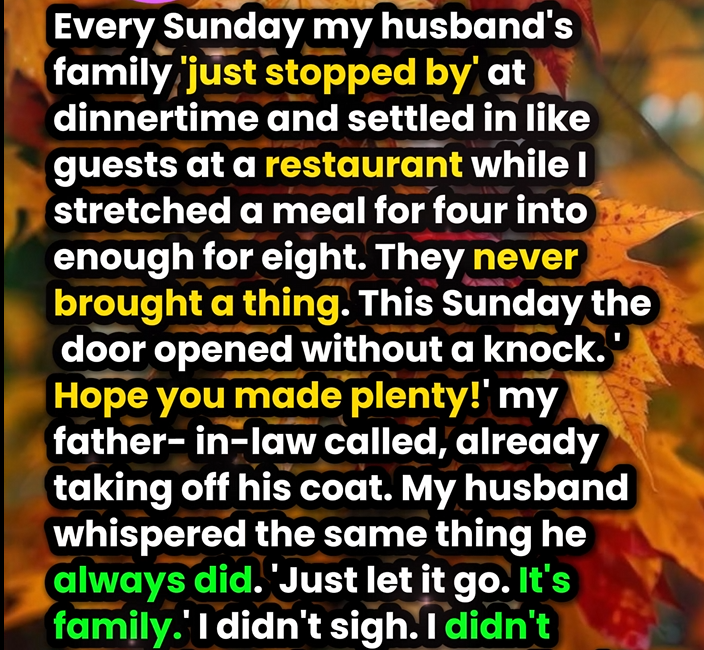
The night my husband’s family walked in expecting another free dinner.
The night they expected me to stretch one meal into enough for eight.
The night they expected me to smile and say nothing.
Instead, I opened a closet.
Pulled out the truth.
And finally served that.
THE END