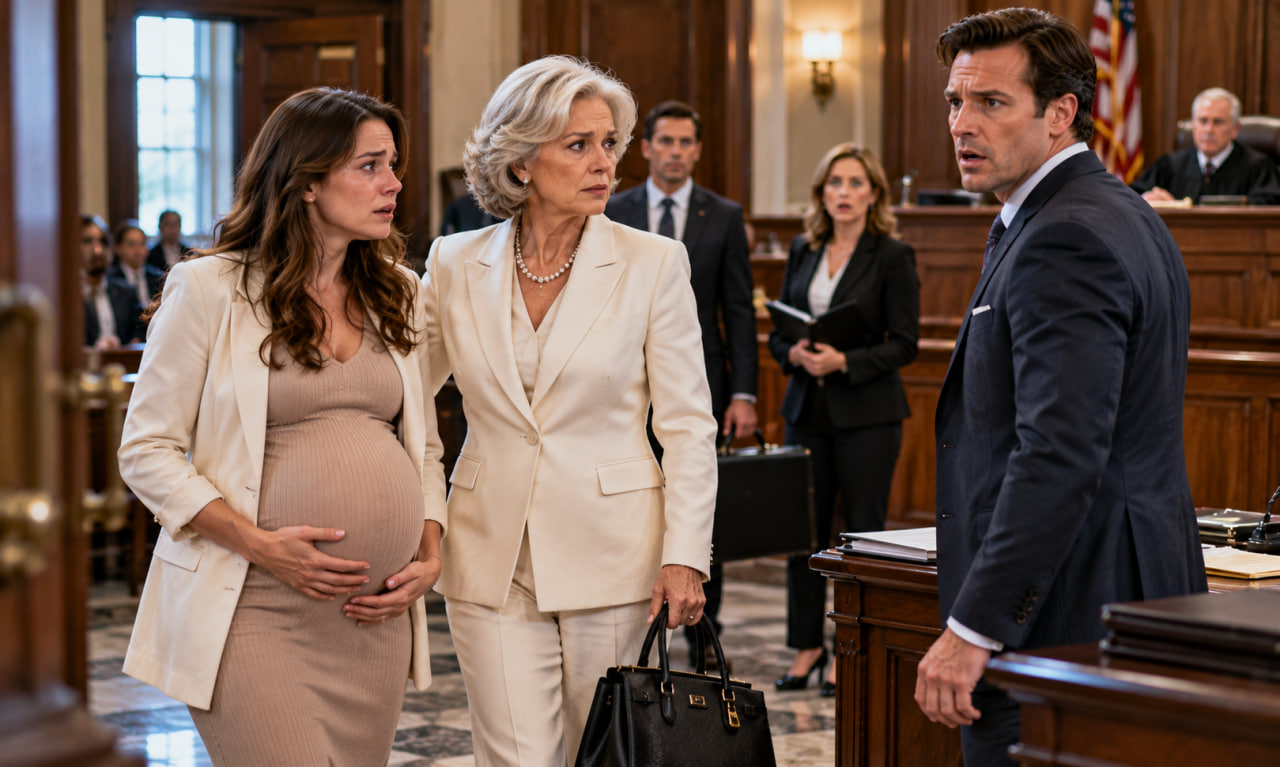
My mother closed her eyes for a moment.
Then she kissed my hand.
“Thank you,” she whispered.
We sat together in silence while Grace slept.
And I understood that even if the court case did not end the way I hoped, my life had already begun to change.
I had a daughter who needed me.
I had a mother who was trying to make amends.
I had work I could return to.
And I had discovered that my worth was not determined by a husband’s willingness to recognize it.
For the first time, I had a future that did not depend on Ethan.
Three months after the divorce hearing, the financial review reached a decisive stage.
The independent professionals examining the records had identified inconsistencies that could not be reconciled with Ethan’s original disclosures.
Additional documents obtained through the appropriate procedures connected several of the disputed transactions to entities associated with his business interests.
The six-point-four-million-dollar transfer remained particularly significant.
Records indicated that the money had moved through a holding company shortly before the divorce filing. Other documents raised questions about whether the transfer had been properly disclosed and whether it represented an actual business obligation.
The court would still need to determine the legal significance of those findings.
But Ethan could no longer rely solely on the assertion that the money belonged outside the marital estate.
At the same time, the financial concerns involving Bennett Logistics were being reviewed separately from the divorce.
The company faced questions from lenders and investors.
Some contracts were temporarily delayed while the relevant parties sought clarification.
Ethan’s attorneys issued statements emphasizing that the transactions had legitimate explanations and that their client denied any wrongdoing.
I didn’t celebrate.
A company employs people whose livelihoods may have nothing to do with the decisions of its executives. Employees had families, mortgages, and children. I didn’t want them to suffer because of something they hadn’t done.
I wanted accountability for the people responsible.
Nothing more.
Nothing less.
One evening, my mother received a call from Daniel.
After speaking with him, she came into the living room where I was feeding Grace.
“They’ve reached a preliminary understanding about the financial review,” she said.
I looked up.
“What does that mean?”
“It means the relevant parties have agreed on a process for resolving several outstanding questions. Some documents will be produced, and certain transactions will undergo further independent examination.”
“So they haven’t proved everything?”
“No. Not everything. But the process is moving forward.”
I nodded.
I had learned to be cautious about good news.
“What about my divorce?”
“Claire believes the evidence gives you a stronger basis for negotiating a fair resolution. But the court still has to decide what is appropriate, and nothing is final yet.”
I looked down at Grace.
“That’s enough for tonight.”
My mother smiled.
“You sound like someone who has learned patience.”
“I’ve had a lot of practice.”
She laughed softly.
And for the first time, the uncertainty ahead no longer felt like a cliff edge.
It felt like a road.
A difficult road, perhaps.
But one I could walk.
The final divorce proceedings took place several months later.
By then, Grace was nearly six months old.
She had learned to smile when I entered a room, and she had developed a habit of gripping my finger with surprising strength.
Every morning, I woke to her little sounds from the crib beside my bed.
Every night, I kissed her forehead before putting her down.
She had become the center of my world.
And in the quiet moments between feeding, changing, and soothing her, I began to recognize the woman I had been before my marriage consumed so much of my identity.
I started reading again.
I took short walks.
I began updating my professional skills and reconnecting with former colleagues.
I even found myself laughing at things that had nothing to do with Ethan.
It was a strange experience, realizing how much room happiness required when fear was no longer occupying every corner.
The morning of the final hearing, I wore a simple navy dress.
I didn’t borrow jewelry from my mother.
I didn’t wear designer shoes.
I wanted to walk into that courtroom as myself.
My mother accompanied me but sat quietly behind Claire.
She had made it clear from the beginning that she would not interfere with my decisions or use her wealth to pressure the court.
This was my marriage.
My daughter.
My future.
And I wanted to be able to look back one day and know that I had stood up for myself.
Ethan arrived with his attorney.
He looked thinner.
His once-perfect confidence had become something more brittle.
He glanced toward my mother, then quickly looked away.
The proceedings began.
Claire presented our position concerning the incomplete financial disclosures, the disputed transfers, and the contributions I had made during the marriage.
She explained that I had provided evidence of work performed for Bennett Logistics, including correspondence, project documents, and records showing my involvement in negotiations and operational decisions.
She also addressed the question of the company’s financial arrangements.
“We are not asking the court to punish Mr. Bennett for being successful,” she said. “We are asking the court to determine the marital rights of both parties based on complete and accurate information.”
Ethan’s attorney argued that several assets were protected by preexisting structures and that some of the transactions had legitimate commercial explanations.
The judge listened carefully.
He asked questions.
He reviewed the documents.
He considered the evidence from both sides.
For once, the case was not decided by whoever spoke most confidently.
It was decided through a process that required explanations, records, and scrutiny.
When the judge finally addressed the disputed assets, my heart began pounding.
He explained that the evidence justified rejecting the assumption that every contested transaction could automatically be excluded from consideration. The court would determine the treatment of specific assets based on the applicable law, the established facts, and the evidence properly before it.
The earlier ruling that I would receive nothing was no longer the basis for the final resolution.
Some claims were accepted.
Others were limited or rejected.
The result was not a magical reversal in which every dollar Ethan had ever earned became mine.
It was something more grounded.
A fairer accounting.
A recognition that my contributions mattered.
And an enforceable resolution of the marital financial issues that had remained in dispute.
The court approved a settlement based on the established financial record and the parties’ remaining claims.
I would receive a substantial financial award, together with the property and support arrangements specified in the final orders. The agreement also required the parties to comply with the applicable financial obligations and preserved any duties they had under separate lawful proceedings.
The exact terms were private.
But one thing was clear.
I was not leaving with nothing.
When the judge finished speaking, I sat very still.
Claire squeezed my hand.
“It’s done,” she whispered.
I looked across the courtroom.
Ethan was staring at the papers in front of him.
For months, he had told me that I was helpless without him.
He had laughed when I said I would be fine.
He had assumed that my lack of a billionaire’s fortune meant I had no power.
But the court had examined the evidence, and the outcome had not followed the script he had written for me.
I did not feel triumphant.
I felt relieved.
The kind of relief that comes when you have been holding your breath for so long that you almost forget what breathing normally feels like.
Outside the courtroom, Ethan approached me.
“Are you happy now?” he demanded.
I looked at him.
“No.”
His expression shifted, as though he had expected me to gloat.
“Then what did you want?”
I took a breath.
“I wanted a fair process. I wanted the truth examined. I wanted the opportunity to rebuild my life without being threatened into silence.”
He shook his head.
“Your mother could have given you all of this without dragging me through court.”
I stared at him.
“My mother didn’t create the financial records, Ethan. She didn’t make the transfers. She didn’t write the emails. And she didn’t tell you to leave your pregnant wife with nothing.”
His face hardened.
“You’re going to regret turning everyone against me.”
I looked at him for a long moment.
“No, Ethan. I regret how long I believed I had to keep everyone happy, even when I was the one being hurt.”
Then I walked away.
This time, I didn’t look back.
The investigation into Bennett Logistics continued after the divorce.
Additional reviews revealed further problems with the company’s financial reporting and internal controls. Some matters were resolved through corrections and financial agreements, while other questions were referred to the appropriate authorities for consideration.
Ethan continued to deny that he had intentionally concealed assets or misrepresented the company’s finances.
I didn’t claim to know everything that had happened behind closed doors.
I didn’t need to.
The records had been examined by professionals, the relevant proceedings had followed their own course, and the consequences of Ethan’s business decisions were no longer mine to manage.
Vanessa eventually left Bennett Logistics.
Through her attorney, she confirmed that she would cooperate with legitimate requests for information concerning the transactions she knew about.
I never met with her.
I had once imagined confronting her in a crowded room and asking her how she could do what she did.
But as time passed, I realized that I didn’t need her explanation to move forward.
She had made her choices.
Ethan had made his.
I had made mine.
And my future no longer required either of them to admit that they were wrong.
One year after the day of the divorce hearing, my mother invited me to dinner.
It wasn’t a grand event.
There were no reporters, no speeches, and no expensive guests.
It was just the two of us, Grace, and a small table near the garden.
Grace was now a lively toddler who had recently discovered that she could make everyone in the room laugh by dropping a spoon and then looking innocently surprised when someone picked it up.
My mother was completely helpless against her charm.
“She knows exactly what she’s doing,” Margaret said, retrieving the spoon for the fourth time.
I laughed.
“She learned from you.”
My mother placed a hand over her heart.
“An outrageous accusation.”
For a while, we talked about ordinary things.
Grace’s latest words.
A book I had been reading.
A restaurant my mother wanted to try.
Then, after dinner, she asked me to walk with her through the garden.
The evening air was cool, and the lights along the path glowed softly.
“I’ve been thinking about something,” she said.
I glanced at her.
“What?”
“The years I missed.”
I didn’t answer immediately.
She continued.
“I can’t give them back to you. I can’t be there for your childhood or undo the loneliness you experienced. And I know that buying you things or paying your expenses won’t change that.”
She stopped beside a small fountain.
“I want to be your mother in the ordinary ways now. I want to know what makes you happy. I want to hear about your difficult days. I want to be there when Grace takes her first steps, when she starts school, and when she asks questions you don’t know how to answer.”
Her voice trembled.
“But I don’t want you to feel obligated to forgive me simply because I’m here.”
I looked at her.
For a long time, I had imagined this conversation ending with an apology that would somehow make everything right.
But life was rarely that simple.
“You hurt me,” I said quietly.
She nodded.
“I know.”
“I spent years believing you didn’t want me.”
Tears filled her eyes.
“I am so sorry.”
“And sometimes, even now, I wonder why you didn’t find me sooner.”
She didn’t defend herself.
She didn’t blame my father.
She simply nodded again.
“You have every right to wonder.”
I took a slow breath.
“But I don’t want the rest of my life to be defined by what happened between us.”
She looked at me.
“I want us to build something better.”
Her lips trembled.
“Do you mean that?”
I smiled through my tears.
“Yes, Mom.”
It was the first time I had called her that since the day she walked into the courtroom.
She covered her mouth with one hand.
Then she pulled me into her arms.
We stood beneath the garden lights, holding each other while the fountain murmured behind us.
We could not recover the years we had lost.
But we could choose what to do with the years we still had.
And for the first time, that felt like enough.
Two years later, I stood in front of a group of young business professionals and spoke about the experience that had changed my life.
I had returned to work gradually, first consulting on operational projects and later helping develop a small advisory firm focused on business processes, financial controls, and responsible corporate management.
I did not join my mother’s company.
She had offered me the opportunity, but I wanted to build something of my own.
My firm began with two former colleagues and a modest office.
We helped small businesses organize their financial systems, improve internal procedures, and create clearer records of their operations.
I found the work meaningful.
I knew what it felt like to work behind the scenes while someone else took the credit.
I knew what it felt like to be dismissed because I didn’t have the right title.
And I knew how dangerous it could be when a company’s culture discouraged people from asking questions.
I wanted to help build workplaces where honesty was valued more than appearances.
My mother’s investment company eventually became one of our clients, although we maintained clear professional boundaries.
She never asked me to give her special treatment.
I never asked her to guarantee my success.
We learned to respect one another as both family and professionals.
During my presentation, a young woman raised her hand.
“Can I ask something personal?”
I smiled.
“Of course.”
She hesitated.
“How do you find the courage to start over when someone has made you feel like you’re nothing?”
The room became quiet.
I thought about the courtroom.
I thought about Ethan’s smirk.
I thought about the months I had spent wondering whether I could survive without the man who had once promised to love me forever.
Then I thought about Grace.
I thought about my mother’s hand in mine as I walked into the hospital.
I thought about the first morning I woke without fear.
“You don’t always feel courageous when you begin,” I said. “Sometimes you begin while you’re frightened. Sometimes you begin while you’re exhausted. Sometimes you begin because staying where you are has become more painful than taking the first step.”
The young woman listened carefully.
“And you don’t have to rebuild everything in one day. You can start by protecting one thing. Your peace. Your health. Your ability to make decisions. Your right to ask questions.”
I paused.
“Someone else’s opinion of you is not the final measure of your worth. And someone else’s success does not mean you have no future without them.”
After the presentation, several people approached me.
Some wanted professional advice.
Others simply wanted to tell me that they had been through difficult separations of their own.
I listened to them.
I didn’t pretend that every story ended happily or that courage could solve every problem.
But I told them what I had learned.
That asking for help was not weakness.
That evidence mattered more than threats.
That financial independence could take time, but even small steps toward it were meaningful.
And that leaving a harmful relationship did not require you to become rich, powerful, or famous.
It required you to recognize that your life was worth protecting.
Ethan and I eventually established a formal arrangement concerning Grace.
The process was not always easy.
There were disagreements, difficult conversations, and moments when old resentments threatened to return.
But I refused to turn our daughter into a weapon.
I followed the legal arrangements, communicated through the appropriate channels when necessary, and kept records of important matters.
When Ethan made an effort to participate responsibly in Grace’s life, I allowed the agreed arrangements to proceed.
When disagreements arose, I dealt with them through the proper process rather than responding in anger.
I did not pretend that our marriage had ended peacefully.
It hadn’t.
But Grace deserved the opportunity to grow up without being forced to carry the emotional burden of her parents’ conflict.
One afternoon, when she was old enough to ask questions about why her parents lived in separate homes, I sat beside her on the sofa.
She held a stuffed rabbit in her lap.
“Mommy,” she asked, “why don’t you and Daddy live together?”
I took a breath.
It was the question I had known would eventually come.
“Sometimes grown-ups discover that they cannot be happy together,” I said gently. “Your daddy and I made choices that meant we couldn’t continue being married.”
She looked down at her rabbit.
“Was it because of me?”
My heart broke.
I immediately took her hands.
“No, sweetheart. Never.”
She looked up.
“Not even a little?”
“Not even a little.”
I brushed a strand of hair away from her face.
“You were never the reason. You were never responsible for fixing anything between us. Adults are responsible for their own choices, and children are never to blame for those choices.”
She considered that for a moment.
“Do you still love me?”
I pulled her into my arms.
“More than you can imagine.”
She hugged me tightly.
“Then I’m happy.”
I kissed the top of her head.
And in that moment, I knew that whatever Ethan and I had failed to give one another, I could still give Grace something essential.
The freedom to be a child.
The freedom to love without fear.
The freedom to know that she was not responsible for the mistakes of the adults around her.
That was the future I wanted for her.
And I would protect it for as long as I could.
Five years after the divorce hearing, I returned to the courthouse.
Not for another hearing.
Not to sign another document.
And certainly not because Ethan had threatened me.
I had been invited to speak at a legal aid event supporting women who needed help understanding their financial rights during separation and divorce.
The organizers had chosen the courthouse because it was where the local program had first been established.
As I walked through the entrance, memories came flooding back.
I remembered the cold courtroom.
The judge’s exhausted expression.
Ethan’s smug smile.
The words that had nearly broken me.
Let’s see how you and that baby survive without me.
For a moment, I stood still.
Then I remembered the doors swinging open.
My mother’s cream suit.
Her steady voice.
My daughter will live far better without you.
I smiled.
Not because my mother had defeated Ethan.
Not because her fortune had rescued me.
But because that day had marked the beginning of a life I had never imagined for myself.
A life built on my own choices.
A life in which I no longer measured my worth by someone else’s willingness to love me.
After the event, I walked outside and found my mother waiting beside the steps.
She was older now.
Her hair had become almost entirely silver, and she moved a little more slowly than she once had.
But her eyes were still the same.
She held Grace’s hand.
My daughter, now five years old, ran toward me as soon as she saw me.
“Mommy!”
I bent down and caught her in my arms.
“How was your day?”
“I drew a picture!”
She held up a sheet of paper.
It showed three figures beneath a bright yellow sun.
One was tall, one was small, and one had silver hair.
I smiled.
“Who’s this?”
“That’s me.”
“And who’s this?”
“That’s you.”
I pointed to the third figure.
“And who’s this?”
“Grandma!”
My mother laughed.
“I think you’ve made my head too big.”
Grace giggled.
“It means you’re smart!”
My mother pretended to consider that explanation.
“Well, I suppose I can’t argue with the artist.”
We walked toward the car together.
For a few moments, I watched them talking.
My mother asked Grace about her drawing.
Grace described the sun, the flowers, and the enormous tree she had added at the last minute.
Their conversation was ordinary.
Beautifully ordinary.
And that was when I realized how much my life had changed.
I had once believed that happiness meant having the perfect marriage.
Then I believed it meant winning the divorce.
Later, I thought it might mean proving Ethan wrong.
But none of those things had given me lasting peace.
Peace came slowly.
It came from building a life in which I could make decisions without fear.
It came from learning to trust my judgment again.
It came from repairing a relationship with my mother while accepting that some wounds would always leave scars.
It came from watching my daughter grow up knowing that she was loved.
And it came from understanding that my future was not a prize someone else could grant or withhold.
It was something I could build.
That evening, after Grace had fallen asleep, I sat on the balcony with a cup of tea.
My phone vibrated.
A message from an unfamiliar number appeared on the screen.
It was Ethan.
“I heard about your event today. I suppose you’ve become quite successful.”
I read it without feeling the old rush of anxiety.
Another message followed.
“I was wrong about some things. I should never have spoken to you the way I did during the divorce.”
I stared at the screen.
For years, I had imagined receiving an apology from him.
I had imagined how satisfying it would feel to hear him admit that I had been right.
But now, the message felt smaller than I had expected.
Not meaningless.
Just insufficient to rewrite the past.
I typed a response, deleted it, and started again.
Finally, I wrote:
“I appreciate you acknowledging that. I hope we can continue making decisions that are best for Grace. I wish you well.”
I sent the message.
Then I put the phone down.
I did not ask him whether he regretted losing me.
I did not ask whether he remembered the woman who had helped him build his company.
I did not ask whether Vanessa was still in his life or whether his business had recovered.
Those questions belonged to a chapter I no longer needed to reopen.
I went inside and checked on Grace.
She was sleeping peacefully, one hand resting beneath her cheek.
I tucked her blanket around her and kissed her forehead.
“Goodnight, my love,” I whispered.
Then I turned off the light.
And for the first time in years, I realized that I no longer needed the ending to be perfect.
Ethan did not need to lose everything for me to have a good life.
My mother did not need to make up for every lost year for us to build a loving relationship.
I did not need to forget the pain to move beyond it.
I simply needed to keep choosing the future over the past.
And I would.
Because the woman who had walked into that courtroom eight months pregnant, frightened, and convinced she might lose everything had discovered something more valuable than a settlement or an inheritance.
She had discovered that she could survive.
She could rebuild.
She could love again.
And she could raise a daughter who would never mistake cruelty for love or control for commitment.
The day Ethan told me I would leave with nothing, he believed he had taken away my entire future.
He was wrong.
I left that courtroom with my dignity wounded, my heart broken, and a child growing beneath my heart.
But I also left with the truth still waiting to be heard.
And when the courtroom doors opened, my mother walked in.
She helped me find the strength to fight for what was fair.
She helped me rediscover the family I thought I had lost.
But she did not give me my worth.
I had possessed that all along.
Ethan thought he had won because the judge had ruled against me that morning.
He never understood that a courtroom could decide a financial dispute, but it could not decide the value of my life.
And that was the victory I carried with me long after the hearing ended.
Not revenge.
Not humiliation.
Not the satisfaction of watching someone else fall.
Just freedom.
The freedom to live without begging for love.
The freedom to protect my daughter.
The freedom to build a future that belonged to me.
And, at last, the freedom to be happy.