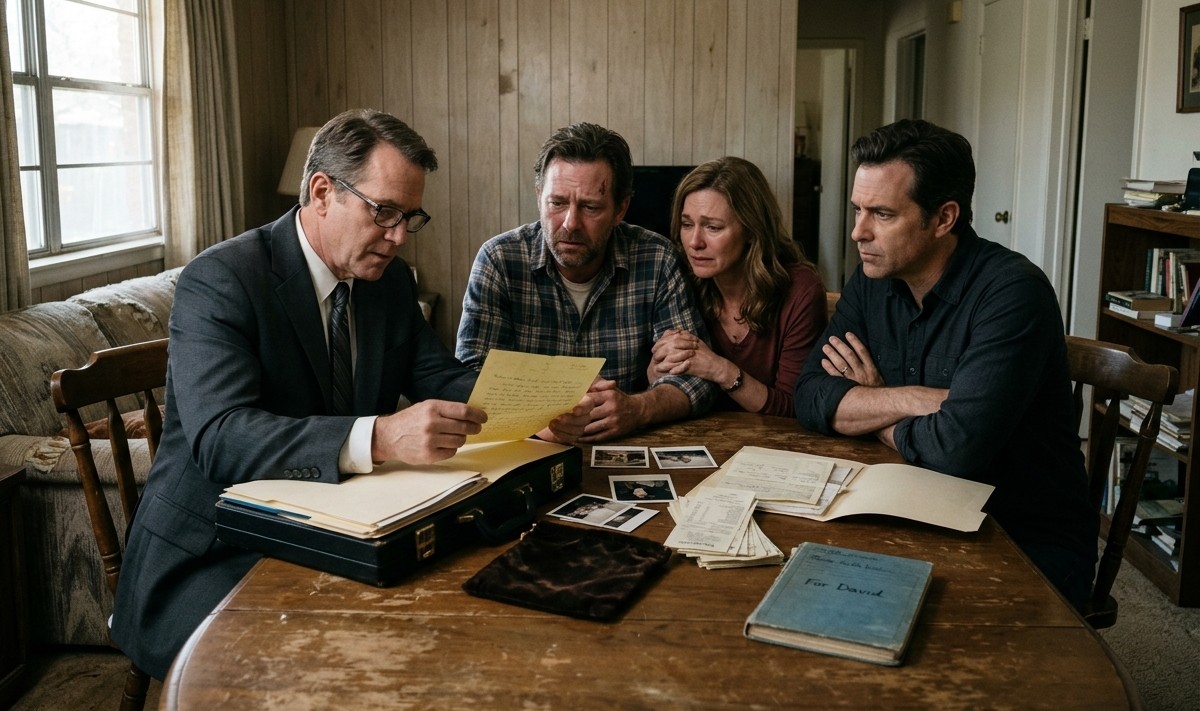
PART 13: THE VISITOR WHO CHANGED EVERYTHING
Three months after we buried Arthur, I thought every surprise he had left behind had finally come to an end.
The investment account had been transferred.
The cabin had become our family’s favorite place on weekends.
Kevin visited every Sunday for dinner.
Slowly, painfully, our broken family was beginning to heal.
Then, on a rainy Thursday afternoon, someone knocked on my front door.
When I opened it, an elderly woman stood on the porch holding a small bouquet of wildflowers.
She looked to be in her eighties.
Her silver hair was tucked beneath a blue rain hat, and her eyes immediately drifted toward Arthur’s empty lawn chair.
“I’m sorry to bother you,” she said softly.
“My name is Eleanor Brooks.”
“I was hoping Arthur still lived here.”
My chest tightened.
“I’m sorry.”
“He passed away a few months ago.”
The flowers slipped slightly in her hands.
She lowered her head.
“I was afraid of that.”
Sarah invited her inside.
As soon as Eleanor stepped into our living room, her eyes filled with tears.
“It’s exactly how he described it,” she whispered.
“The family photographs.”
“The old clock.”
“The boys’ baseball trophies.”
She smiled through her tears.
“He talked about all of you every week.”
I frowned.
“You knew Arthur?”
She gave a gentle laugh.
“For almost fifty years.”
Kevin happened to be visiting that afternoon.
He looked just as confused as the rest of us.
“Dad never mentioned you.”
“No,” Eleanor replied.
“He wouldn’t.”
“He thought some friendships didn’t need applause.”
She carefully opened her handbag and removed a faded envelope.
Across the front, in Arthur’s familiar handwriting, were the words:
Deliver only after I’m gone.
My heart skipped.
Another letter.
Eleanor handed it to me.
“He gave this to me eleven years ago.”
“He made me promise never to open it.”
“He said it belonged to David.”
I slowly unfolded the letter.
“My dear David,”
“If Mrs. Brooks is standing in your home, then I have finally kept my last appointment.”
I looked up.
“What appointment?”
Eleanor smiled sadly.
“Arthur visited me on the first Tuesday of every month.”
“For nineteen years.”
“He never missed.”
Sarah frowned.
“Why?”
The old woman looked toward Arthur’s empty chair.
“Because my husband died in 2004.”
“I had no children.”
“I could barely walk.”
“I was completely alone.”
She wiped away a tear.
“Arthur fixed my broken fence.”
“He repaired my roof after a storm.”
“He drove me to doctor’s appointments.”
“He shoveled my driveway every winter.”
“He even changed the batteries in my smoke detectors every spring.”
None of us spoke.
“He refused every dollar I offered.”
“He always said…”
“‘Someone once showed kindness to me.”
“‘I’m simply passing it forward.’”
I looked back at Arthur’s letter.
It continued.
“David, if you’re reading this, you’ve already discovered what I secretly saved.”
“But there was something else I quietly invested.”
“It wasn’t money.”
“It was people.”
My eyes blurred again.
Arthur wrote:
“Real wealth is measured by how many lives become easier because you existed.”
“I hope you’ll meet a few of them.”
Before I could finish reading, another knock echoed through the house.
Then another.
Then another.
Kevin opened the front door.
Outside stood a retired mail carrier.
A former mechanic.
A widowed schoolteacher.
An Army veteran walking with a cane.
Each of them carried flowers.
Each of them asked exactly the same question.
“Is this where Arthur Henderson lived?”
And for the very first time…
I realized our family had never truly known the quiet old man who had shared our table for twenty years.
PART 14: THE MAN WHO NEVER SENT A BILL
By sunset, our living room was full.
Not with lawyers.
Not with bankers.
Not with relatives hoping for another inheritance.
With ordinary people.
People none of us had ever met.
People whose lives had somehow been touched by Arthur.
The retired mail carrier stepped forward first.
“My name is Frank.”
“I delivered Arthur’s mail for almost fifteen years.”
“He used to leave a cup of coffee on the porch every winter.”
I smiled.
“That sounds like him.”
Frank shook his head.
“That’s not why I’m here.”
He reached into his jacket and pulled out a worn photograph.
It showed a young boy standing beside a rusty bicycle.
“The bike belonged to my son.”
“I couldn’t afford to fix it after I lost my job.”
“Arthur picked it up one afternoon.”
“I figured he’d found someone to repair it.”
Frank laughed softly.
“The next morning it was back on my porch.”
“Brand-new tires.”
“New brakes.”
“Fresh paint.”
“There wasn’t a note.”
“There wasn’t a bill.”
“There was only one sentence written on a piece of masking tape.”
He unfolded the faded strip of tape.
It read:
Every kid deserves to ride.
Frank wiped his eyes.
“My son still has that bicycle.”
The room fell silent.
Next came the Army veteran.
He leaned heavily on his cane as he walked toward us.
“My name’s Walter.”
“I served with Arthur’s younger brother.”
“I lost my wife five years ago.”
“I didn’t tell anyone.”
“I just… stopped taking care of myself.”
He stared at the floor.
“Arthur noticed.”
“He started showing up every Saturday.”
“He’d mow my lawn.”
“We’d watch baseball.”
“He’d pretend he needed help fixing something.”
“I knew he was lying.”
“He just didn’t want me to feel like a charity case.”
Walter smiled through his tears.
“He saved my life.”
Then came the widowed schoolteacher.
“My furnace broke during the coldest week of winter.”
“I had blankets hanging over every doorway.”
“I was too embarrassed to ask for help.”
“The next morning, Arthur knocked.”
“He said…”
“‘I heard your furnace making funny noises from half a mile away.’”
Everyone laughed.
She smiled.
“The man could barely hear his own television.”
“He never heard my furnace.”
“He simply wanted to protect my pride.”
Sarah quietly whispered,
“That’s exactly what he did for everyone.”
The former mechanic stepped forward next.
His hands looked as rough as mine.
“I worked with Arthur years ago.”
“He talked about you all the time, David.”
I looked up.
“He did?”
The man nodded.
“He carried pictures of your boys in his wallet.”
“He called them his grandsons.”
“He said…”
“‘Those boys are growing into good men because they have an even better father.’”
I lowered my head.
I wasn’t sure I deserved those words.
The mechanic reached into his pocket.
“Arthur gave me something before he died.”
He handed me a small folded piece of paper.
It wasn’t another letter.
It was a simple list.
Across the top, Arthur had written:
People who may need a friend someday.
There were twelve names.
Frank.
Walter.
Eleanor.
Mrs. Ramirez.
Tom Ellis.
Mrs. Cooper.
Each name had a short note beside it.
Lives alone.
Too proud to ask for help.
Recently lost spouse.
Bad knees.
Loves fishing.
Needs rides to the doctor.
Sarah stared at the page.
“Dad was keeping track of people.”
The mechanic gently shook his head.
“No.”
“He wasn’t keeping track.”
“He was making sure nobody disappeared.”
The attorney, who had remained quietly in the corner all afternoon, finally spoke.
“I’ve handled estates for thirty-two years.”
“I’ve seen wealthy people leave millions.”
“I’ve seen families destroy themselves over money.”
He looked around the room.
“I’ve never seen anything like this.”
“What do you mean?” I asked.
He smiled.
“Arthur didn’t leave behind beneficiaries.”
“He left behind caretakers.”
Just then, my youngest son walked into the room carrying Arthur’s old blue ledger.
“Dad?”
He looked at me.
“I don’t think Grandpa wanted this book to end.”
I looked at the final page.
It was blank.
Completely blank.
Then my son handed me a fountain pen that had been tucked inside the back cover.
I uncapped it.
On the inside cover, in Arthur’s familiar handwriting, was one final sentence I had never noticed before.
When you’ve finished counting what others sacrificed for you…
Start counting what you can do for someone else.
PART 15: THE FIRST NAME IN THE LEDGER
I couldn’t stop staring at the blank page.
For twenty years, Arthur had filled that ledger with every sacrifice he believed I made.
Now, for the first time, the book belonged to me.
I held the fountain pen over the paper.
But I couldn’t write.
“What am I supposed to put?” I whispered.
The attorney smiled.
“I don’t think Mr. Henderson wanted you to write about yourself.”
I looked up.
“What do you mean?”
He nodded toward the list of names Arthur had left behind.
“I think he wanted you to continue his work.”
The room fell silent.
I looked at the first name.
Walter.
Lives alone.
Too proud to ask for help.
The next Saturday morning, I loaded my toolbox into the truck.
Sarah walked outside carrying two travel mugs of black coffee.
“You going somewhere?”
I smiled.
“I’m making a house call.”
She kissed my cheek.
“Dad would approve.”
Walter looked surprised when he opened the door.
“David?”
“I was in the neighborhood.”
“No, you weren’t.”
I laughed.
“No.”
“I wasn’t.”
He looked down at my toolbox.
“My sink’s been leaking for weeks.”
“I know.”
“How?”
I smiled.
“Arthur kept good notes.”
Walter stepped aside without another word.
The leak took less than an hour to fix.
When I finished, Walter reached for his wallet.
“How much do I owe you?”
I shook my head.
“Nothing.”
“I can’t let you work for free.”
I smiled.
“You don’t have to.”
He frowned.
“I don’t understand.”
I picked up the old blue ledger.
“Someone once taught me that kindness isn’t something you pay back.”
“It’s something you pass on.”
Walter’s eyes filled with tears.
“You sound just like Arthur.”
“I hope someday I do.”
Before leaving, I wrote the first new entry in the ledger.
Walter.
Kitchen sink repaired.
Coffee shared.
Stories told.
Payment received.
One smile.
The following week, Sarah and I visited Eleanor.
We repaired the loose railing on her porch.
Our boys cleaned her flower beds.
She baked us an apple pie that tasted exactly like childhood.
That night, another entry appeared in the ledger.
Eleanor.
Front porch repaired.
Pie accepted.
Hugs received.
Two weeks later, Kevin called.
“I’ve been thinking.”
“About what?”
“Dad’s list.”
I waited.
“Do you…”
He hesitated.
“Do you mind if I help?”
For a moment, I couldn’t answer.
This was the same brother-in-law who had mocked Arthur’s letter.
The same man who had called him a freeloader.
Now his voice sounded different.
Smaller.
“I don’t know where to start,” Kevin admitted.
“I just know I wasted too much time.”
I smiled.
“You can start Saturday.”
“We’re building a wheelchair ramp.”
He didn’t hesitate.
“I’ll be there.”
Saturday morning came.
Then another.
Before long, it wasn’t just Kevin.
My sons joined us.
Neighbors volunteered.
Friends brought lumber.
A retired electrician donated wiring.
Someone always brought coffee.
Someone always brought donuts.
Nobody asked for recognition.
Nobody asked for payment.
One evening, nearly a year after Arthur’s funeral, I sat on the porch watching the sunset.
The aluminum lawn chair was still beside mine.
It would always stay there.
My youngest son carried the ledger outside.
“Dad?”
“Yeah?”
“Can I see something?”
He opened to the very last page.
The blank page Arthur had left me…
…wasn’t blank anymore.
It was full.
Dozens of names.
Dozens of small acts of kindness.
Dozens of ordinary people who no longer faced life alone.
My son smiled.
“I think Grandpa would be proud.”
I looked toward the empty chair.
For just a second, I could almost picture Arthur sitting there with his black coffee, smiling beneath that faded baseball cap.
I smiled back.
Then I picked up my pen.
There was still plenty of room left in the ledger.
And I wasn’t finished writing.
PART 16: FIVE YEARS LATER
Five years passed faster than I ever imagined.
The gray in my beard spread.
My boys became men.
The transmission shop finally belonged to me after the old owner retired.
Life wasn’t perfect.
It never would be.
But it was peaceful.
On the first Saturday of every month, our driveway filled with pickup trucks before sunrise.
Nobody received an invitation anymore.
They simply knew.
Coffee would be ready.
Donuts would be on the kitchen table.
And somewhere in town, someone would need a helping hand.
Walter still came.
Even though his knees had gotten worse.
“I can’t climb ladders anymore,” he’d joke.
“But I can supervise.”
Eleanor never missed a single gathering.
She insisted on baking two apple pies every month.
One for the volunteers.
One “for Arthur.”
She always placed the second pie on the porch beside his old aluminum lawn chair.
Nobody questioned it.
Some traditions didn’t need explaining.
Kevin changed more than anyone.
The man who had once measured life in dollars now measured it in Saturdays.
He rarely talked about business anymore.
Instead, he’d ask,
“Who’s next on the list?”
One afternoon, while cleaning the garage, my oldest son found the original blue ledger.
Its leather cover had become even softer with age.
He carried it into the kitchen.
“Dad.”
“I think we filled it.”
I looked inside.
He was right.
Arthur’s final blank pages…
The ones he’d left for me…
Were now completely covered.
Every page held another family.
Another repaired roof.
Another hospital ride.
Another meal delivered.
Another lonely neighbor visited.
Thousands of little moments.
None of them important enough to make the evening news.
Every one of them important enough to change someone’s life.
That evening, Sarah found me sitting on the porch.
“You look worried.”
“I am.”
“Why?”
“We’re out of pages.”
She laughed.
“Is that all?”
Before I could answer, she disappeared inside.
A minute later she returned carrying a wrapped package.
“I’ve been saving this.”
I slowly removed the paper.
Inside was a brand-new leather ledger.
Its cover was dark brown.
My name wasn’t embossed on the front.
Neither was Arthur’s.
Instead, Sarah had ordered four simple words.
Pass It Forward.
I couldn’t speak.
She smiled.
“Dad started one book.”
“You finished it.”
“Now it’s time for another.”
The following Saturday, more volunteers showed up than ever before.
Some were people we’d helped years earlier.
A young plumber whose rent we’d quietly covered after his wife became ill.
A widow whose fence we’d rebuilt after a tornado.
A college student we’d driven to chemotherapy appointments with his mother.
One by one, they stepped out of their vehicles carrying toolboxes.
I recognized every face.
Not because I’d known them before.
Because somewhere in the first ledger…
Their names had been written.
Walter looked around at the crowd and laughed.
“David…”
“I think Arthur’s little investment finally matured.”
I looked across the yard.
More than forty people were drinking coffee, laughing, and planning which homes they would visit that day.
Nobody was being paid.
Nobody expected anything in return.
The return had already happened.
It had simply taken years to grow.
Before everyone left, my youngest son climbed onto the porch steps.
He was twenty-one now.
No longer the little boy who had once shared a bedroom because his grandfather needed a place to sleep.
He held up the new ledger.
“Can I write the first entry?”
I handed him the fountain pen Arthur had left behind.
He opened the first page.
Carefully, he wrote today’s date.
Then he paused.
“What should I write?”
I smiled.
“The same thing Arthur taught us.”
My son nodded.
In neat, steady handwriting, he wrote:
Kindness given.
Nothing expected.
Legacy continued.
He closed the ledger.
The volunteers climbed into their trucks.
Engines started.
Coffee cups emptied.
Laughter echoed down the street.
I looked once more at Arthur’s old aluminum lawn chair.
Time had faded its paint.
The cushions had been replaced twice.
But it never moved from its place on the porch.
Some people leave money behind.
Some leave property.
Some leave photographs.
Arthur Henderson left something far rarer.
He left a way of living.
And every time someone opened that new ledger, picked up a toolbox, or knocked on a stranger’s door simply to help…
His story began all over again.
The new ledger sat on my kitchen table for almost three weeks before I wrote a second entry.
Not because there was no one to help.
Because I kept asking myself the same question.
“What would Arthur have done?”
One rainy Tuesday morning, I got my answer.
I was halfway through replacing a transmission when my phone buzzed.
It was Walter.
“David.”
“You busy?”
“I’ve got another hour on this truck.”
Walter hesitated.
“There’s a family over on Maple Street.”
“The Johnsons.”
“Their house caught fire last night.”
I immediately stopped working.
“Was anyone hurt?”
“The parents made it out.”
“So did their little girl.”
“But they lost everything.”
I wiped the grease from my hands.
“Did they ask for help?”
Walter was quiet for a moment.
“No.”
“They’re too proud.”
I smiled to myself.
Arthur’s words echoed in my mind.
Too proud to ask for help.
I looked toward the office.
My foreman noticed me standing there.
“Everything okay?”
I nodded.
“I need the rest of the day off.”
He didn’t ask questions.
He simply tossed me my truck keys.
“Go.”
Twenty minutes later, I pulled into Maple Street.
The smell of smoke still lingered in the air.
Yellow caution tape surrounded what remained of the Johnsons’ home.
A little girl sat on the curb hugging a stuffed rabbit blackened by soot.
Her father was speaking quietly with an insurance adjuster.
Her mother stared at the burned front porch without saying a word.
I didn’t walk over.
Not yet.
Instead, I drove two blocks away to the old community center.
By the time I arrived, Kevin was already there.
“You sounded serious.”
“I am.”
Within another thirty minutes, Sarah arrived.
Then my boys.
Then Walter.
Then Eleanor carrying two homemade pies.
By noon, nearly thirty volunteers filled the parking lot.
Nobody asked how much money the Johnson family had.
Nobody asked whether insurance would cover the damage.
Nobody asked whether they deserved help.
Arthur had taught us better than that.
I opened the new ledger.
Today’s date.
Then I wrote:
The Johnson Family.
House fire.
Needs everything.
I closed the book.
“All right,” I said.
“Let’s get to work.”
One group collected clothing.
Another called local hardware stores.
Kevin contacted three contractors he knew.
My oldest son organized furniture donations online.
Sarah worked the phones until someone offered a vacant rental house free of charge for three months.
By sunset, the community center looked like a warehouse.
Beds.
Blankets.
Kitchen supplies.
School backpacks.
Toys.
Boxes of canned food.
Even a bicycle.
The same age and color as the one Arthur had once repaired for Frank’s son.
The next morning, we delivered everything.
Mr. Johnson tried to shake my hand.
Then he tried to hand me an envelope.
“Please,” he said.
“It’s all we have right now.”
I looked down.
Inside were two hundred dollars in cash.
I gently folded the envelope closed and placed it back into his hands.
“I can’t take this.”
“You’ve done too much.”
I smiled.
“Actually…”
“I’ve done very little.”
He looked confused.
“The man who deserves your thanks isn’t here anymore.”
I glanced toward the old blue pickup where the new ledger rested on the passenger seat.
“He taught us that kindness isn’t a debt.”
“It’s a responsibility.”
Mrs. Johnson suddenly began crying.
“I don’t know how we’ll ever repay all of you.”
Before I could answer, my youngest son spoke first.
He smiled exactly the way Arthur used to.
“You don’t repay us.”
“Someday…”
“When life gives you the chance…”
“You help somebody else.”
The little girl holding the soot-covered rabbit looked up at her mother.
“Can we do that?”
Her mother nodded through tears.
“Yes, sweetheart.”
“We can.”
That evening, after everyone had gone home, I sat alone on my porch.
Arthur’s aluminum lawn chair still stood beside mine.
I opened the new ledger and made the second entry.
The Johnson Family.
Thirty-two volunteers.
One home lost.
One community found.
Payment received.
A little girl promised to help someone she hasn’t even met yet.
As I closed the book, a warm breeze drifted across the porch.
For just a moment, I could almost hear Arthur’s old radio humming softly in the darkness.
And for the first time since filling the first ledger…
I realized something.
The greatest thing Arthur ever built…
Wasn’t an investment account.
It wasn’t a cabin.
It wasn’t even our family.
It was a chain of kindness that no fire, no storm, and not even death could ever destroy.
PART 18: THE KNOCK WE NEVER EXPECTED
Three weeks after we helped the Johnson family, life settled back into its familiar rhythm.
The transmission shop stayed busy.
The Saturday volunteer projects continued.
The new ledger slowly filled with names.
Then, one Monday morning, there was a knock on the shop door.
I looked up from an engine block.
Standing outside was Mr. Johnson.
He wasn’t alone.
His wife stood beside him.
Their little daughter held the same stuffed rabbit, except now it had been carefully washed and stitched back together.
Before I could say a word, Mr. Johnson extended an envelope.
I smiled.
“If that’s money, you already know my answer.”
He laughed.
“It isn’t.”
Inside the envelope was a single sheet of paper.
At the top were twelve signatures.
“What is this?”
“It’s everyone who helped rebuild our house.”
I looked closer.
Next to every signature was a profession.
Electrician.
Plumber.
Teacher.
Nurse.
Carpenter.
Mechanic.
Truck driver.
Mrs. Johnson smiled.
“We’ve been talking.”
“About what?”
She looked at her daughter before answering.
“About your son.”
“The one who told our little girl that someday she’d help someone else.”
I remembered his words perfectly.
“You don’t repay us.”
“You pass it on.”
Mr. Johnson nodded.
“That’s exactly what we’re doing.”
He pointed to the paper.
“All twelve of us agreed to volunteer one Saturday every month.”
I stared at the list.
“You don’t have to do that.”
He smiled.
“We know.”
“That’s the whole point.”
Before I could answer, another pickup pulled into the parking lot.
Out stepped Frank, the retired mail carrier.
Behind him came Walter.
Then Eleanor.
Kevin arrived carrying a box of donuts.
“What is everybody doing here?” I asked.
Walter grinned.
“You’re about to find out.”
Frank unfolded a large map of Travis County across the workbench.
Colored pins had been placed in dozens of neighborhoods.
Red.
Blue.
Yellow.
Green.
“What am I looking at?”
Walter pointed to a red pin.
“Elderly widow.”
Another.
“Disabled veteran.”
Another.
“Single father raising three kids.”
Another.
“Family living without air conditioning.”
I slowly looked around the room.
“You’ve all been collecting this information?”
Kevin nodded.
“For months.”
“You taught us to keep our eyes open.”
“Eleanor hears things at church.”
“Frank hears things on his mail route.”
“Walter hears things at the VFW.”
“I hear things from contractors.”
Sarah walked into the shop carrying a tray of coffee.
“I guess we’re going to need a bigger ledger.”
Everyone laughed.
Just then, my youngest son entered with the new brown ledger tucked under his arm.
He opened it to a blank page.
“Dad?”
“Yeah?”
“I think today’s a big day.”
“So do I.”
He handed me Arthur’s old fountain pen.
For a moment, I simply held it.
Then I wrote across the top of the page:
Community Projects.
Project Number One.
The Johnson House.
Completed.
Project Number Two…
I stopped.
There was a knock at the open garage door.
A teenage boy stood there wearing a grocery store apron.
He looked nervous.
“Excuse me…”
“I was told this is where people come when they want to help.”
I smiled.
“Who told you that?”
He looked down at his shoes.
“A little girl.”
“She said your group helped her family after their house burned down.”
He took a deep breath.
“My mom works two jobs.”
“Our elderly neighbor hasn’t been able to mow his lawn all summer.”
“I don’t have much money…”
“…but I have every Saturday off.”
The shop became completely silent.
I looked at Arthur’s fountain pen still resting in my hand.
Then I added one more line beneath the project list.
First new volunteer.
Name: Ethan Brooks.
Reason for joining:
One little girl kept a promise.
At that moment, I finally understood what Walter meant.
Arthur’s investment hadn’t just matured.
It had begun earning something even greater than interest.
It was multiplying.
PART 19: THE WALL OF PROMISES
By the end of summer, the brown ledger already held more than eighty names.
Some belonged to families we’d helped.
Others belonged to people who had become volunteers after receiving help from someone else.
Every Saturday morning, our driveway looked more like a construction site than a family home.
Pickup trucks lined both sides of the street.
Ladders leaned against fences.
Toolboxes sat beside coolers full of bottled water.
Neighbors who had never spoken before now greeted one another like old friends.
One Saturday, as I carried another box of donated supplies into the garage, I noticed my youngest son staring at the wall.
“What are you looking at?”
He pointed toward a blank section of drywall.
“The ledgers are getting full.”
I smiled.
“They’re supposed to.”
He shook his head.
“No, Dad.”
“I mean… people can’t see them.”
I frowned.
“What do you mean?”
He walked over to the workbench and picked up a roll of blue painter’s tape.
Then he placed a single strip across the wall.
“Imagine every family we help gets their own card.”
He grabbed an index card and wrote:
The Johnson Family.
House Fire.
Thirty-two Volunteers.
Then he taped it to the wall.
A second card appeared.
Walter.
Kitchen Sink.
Friendship Restored.
Then another.
Eleanor.
Front Porch.
Apple Pie Shared.
Soon all of us joined in.
Sarah found a box of colored pushpins.
Kevin brought a corkboard from his office.
Frank started organizing the cards by neighborhood.
Within an hour, the empty wall had become something extraordinary.
It wasn’t a list of donations.
It wasn’t a scoreboard.
It was a map of hope.
Every card represented a family that had discovered they weren’t alone.
Walter stepped back and quietly whistled.
“Arthur would’ve loved this.”
Kevin nodded.
“He would’ve complained that the cards weren’t straight.”
Everyone laughed.
“He probably would’ve fixed them after we left,” Sarah said.
That afternoon, while we were finishing another wheelchair ramp, a white delivery van pulled into the driveway.
The driver climbed out carrying several large boxes.
“I’m looking for David Miller.”
“That’s me.”
He handed me a clipboard.
“These were paid for anonymously.”
Inside the boxes were brand-new cordless drills.
Circular saws.
Safety helmets.
Work gloves.
Enough equipment for twenty new volunteers.
There wasn’t a receipt.
Only a handwritten note.
For the next family.
Pass it forward.
No signature.
I turned the note over.
Nothing.
Kevin looked at me.
“Who sent it?”
“I honestly don’t know.”
Walter smiled.
“Maybe it doesn’t matter.”
That evening, after everyone had gone home, I taped the note to the very center of the wall.
The next Saturday, more surprises appeared.
A local bakery delivered breakfast.
A hardware store donated lumber.
A nursery offered free trees for families rebuilding their yards.
Nobody wanted recognition.
Nobody asked for publicity.
One donation simply inspired another.
Late that afternoon, I noticed a young woman standing quietly across the street.
She looked nervous.
She wasn’t carrying tools.
She wasn’t carrying supplies.
Just a small envelope.
When I walked over, she held it out to me.
“My name is Rachel.”
“My grandparents were helped by your volunteers last winter.”
I smiled.
“I’m glad they’re doing better.”
“They are.”
She looked down at the envelope.
“I graduate from nursing school next month.”
“I don’t have much money yet.”
“But I wanted to give something.”
I gently pushed the envelope back toward her.
“You don’t have to.”
She smiled.
“I know.”
“It’s not money.”
Curious, I opened it.
Inside was a handwritten pledge.
One Saturday every month.
Free blood pressure checks.
Free health screenings.
Free medication counseling.
For anyone who needs it.
No charge.
No appointment.
No questions asked.
I looked up at her.
“You wrote this?”
She nodded.
“My grandparents told me about Arthur.”
“They said one man’s kindness gave them hope when they had none.”
She smiled through tears.
“I thought maybe…”
“…my career could become my way of continuing his story.”
That night, I added another card to the wall.
Rachel.
Registered Nurse.
First Medical Volunteer.
Legacy Expanded.
As I stepped back, I realized something.
The wall was no longer documenting what our family had accomplished.
It was documenting what an entire community had become.
And in the center of it all, taped beside the very first card, was Arthur’s simple sentence.
Kindness given. Nothing expected. Legacy continued.
PART 20: THE MAN WHO ALMOST DROVE AWAY
The first Saturday in October began like every other.
Coffee was brewing before sunrise.
Toolboxes lined the driveway.
Walter was already arguing with Kevin about which truck had the better engine.
“It isn’t even close,” Walter said.
“My old Ford still runs smoother than that fancy thing you’re driving.”
Kevin laughed.
“The only thing your truck runs on is optimism.”
The volunteers burst into laughter.
Some traditions never changed.
Sarah stepped onto the porch holding the brown ledger.
“Today’s project,” she announced.
“Mrs. Alvarez.”
“Eighty-three years old.”
“Her wheelchair ramp collapsed during last week’s storm.”
My oldest son looked down at the project notes.
“She lives alone.”
“No children nearby.”
“We’ll need at least twenty people.”
Within minutes, the convoy of pickup trucks rolled through town.
When we reached Mrs. Alvarez’s house, she was already waiting on the porch in her wheelchair.
She tried to stand when she saw everyone arriving.
“No, no,” Sarah called gently.
“You stay right there.”
Mrs. Alvarez smiled through tears.
“I only asked the church if someone knew a carpenter.”
“I didn’t expect…”
She looked at the long line of trucks.
“…an army.”
Walter tipped his baseball cap.
“We’ve been called worse.”
Everyone laughed.
Work began immediately.
Some volunteers removed the broken ramp.
Others measured fresh lumber.
Rachel, now a full-time nurse, checked Mrs. Alvarez’s blood pressure while talking with her about her grandchildren.
Everything was moving smoothly.
Until a black luxury SUV pulled into the driveway.
A sharply dressed man stepped out.
He looked around with obvious irritation.
“What exactly is going on here?”
Mrs. Alvarez’s smile faded.
“My son…”
The man walked toward us.
“You people are blocking the driveway.”
Kevin calmly wiped his hands on a rag.
“We’ll move the trucks if you need to get through.”
“That’s not the point.”
He pointed toward the house.
“I’ve been telling my mother for months that she should sell this place.”
“This little construction project isn’t changing that.”
Mrs. Alvarez lowered her eyes.
“I don’t want to leave my home.”
The man sighed heavily.
“You can’t live here forever.”
I stepped between them.
“Sir.”
“We’re just here to repair the ramp.”
He looked me up and down.
“And who are you?”
“My name’s David.”
“I was once the son-in-law of a man who taught me something important.”
He folded his arms.
“I’m listening.”
I smiled.
“He taught me that people don’t stop needing dignity just because they get older.”
The man didn’t answer.
Instead, he walked toward his car.
For a moment, I thought he was leaving.
He opened the trunk.
Reached inside.
Pulled out a pair of expensive leather work gloves.
Then quietly walked back toward us.
“Where do you need me?”
Nobody spoke.
Mrs. Alvarez stared at her son in complete disbelief.
Kevin handed him a cordless drill.
“You ever built a ramp before?”
The man shook his head.
“No.”
Kevin smiled.
“Good.”
“Neither had I the first time.”
For the next six hours, he worked beside us.
He carried lumber.
Mixed concrete.
Swept sawdust.
Never once checked his phone.
When the new ramp was finally finished, Mrs. Alvarez rolled down it slowly.
Halfway to the sidewalk, she stopped.
She turned toward her son.
“I haven’t seen you smile while helping me…”
“…since you were twelve years old.”
The man lowered his head.
“I’m sorry, Mom.”
“I got so busy building my career…”
“…that I forgot to build time for you.”
Mrs. Alvarez reached out her hand.
He took it.
Neither of them let go.
As the volunteers packed their tools, the man walked over to me.
“My name’s Daniel.”
“I owe you an apology.”
“You don’t owe me anything.”
“Actually…”
He looked around at the volunteers loading trucks.
“I think I owe someone I never even met.”
He reached into his wallet and pulled out a business card.
“I own a construction supply company.”
“If you ever need lumber, concrete, roofing materials…”
He smiled.
“…don’t buy them.”
“They’re yours.”
I looked at the card.
Then at the new ramp.
Then back at Daniel.
Arthur was right.
Kindness had a way of reaching people that arguments never could.
That evening, I opened the brown ledger.
I wrote:
Mrs. Alvarez.
Wheelchair Ramp Rebuilt.
Forty-One Volunteers.
One Son Came To Help.
Payment Received.
A Mother’s Forgiveness.
As I closed the ledger, my youngest son pointed toward the Wall of Promises inside the garage.
A new card had been added.
No one knew who had placed it there.
It wasn’t written in Arthur’s handwriting.
It wasn’t written in mine.
It simply read:
Sometimes the person who needs help the most… is the one who doesn’t yet know how to ask for it.
For a long time, none of us said a word.
Then Walter smiled.
“I have a feeling…”
“…Arthur would’ve liked that one.”
PART 21: THE SATURDAY THAT FILLED THE ENTIRE STREET
The note stayed on the Wall of Promises.
No one admitted writing it.
No one tried to take credit for it.
After a while, we stopped asking.
It simply became part of the wall, just like everything Arthur had taught us.
Two weeks later, my phone rang just after six on a Friday evening.
It was Rachel.
“David…”
Her voice sounded different.
“What happened?”
“The elementary school on Oak Street.”
“The principal just called me.”
“There are twelve children whose families lost almost everything after the apartment fire last month.”
“I’ve been helping with health screenings.”
“The teachers are worried.”
“Worried about what?”
“They’re coming to school hungry.”
I closed my eyes.
“Has anyone organized help?”
“Not yet.”
“Most charities are overwhelmed.”
I looked toward the garage.
The Wall of Promises was covered with cards now.
Every one of them reminded me of Arthur.
Every one of them whispered the same lesson.
Don’t wait for someone to ask.
I picked up my phone.
“Rachel…”
“Give me one hour.”
By seven o’clock, the group message had gone out.
No speeches.
No long explanation.
Just eight simple words.
Family with children.
Need help.
Tomorrow.
Seven A.M.
When I pulled into my driveway the next morning, I thought I was early.
I wasn’t.
Walter was already pouring coffee.
Kevin was unloading plywood.
Frank was setting up folding tables.
Rachel arrived with three other nurses.
Then something unexpected happened.
Vehicles kept coming.
A plumber.
Two electricians.
Three teachers.
A retired firefighter.
A barber.
A bakery delivery truck.
A local farmer with crates of fresh vegetables.
By seven-thirty…
Our driveway was full.
By eight…
Cars lined both sides of the street.
Neighbors stepped onto their porches to see what was happening.
One little boy rode his bicycle past the house, then circled back.
“Mister…”
“What’s everybody doing?”
I smiled.
“We’re getting ready to help some families.”
He nodded as if that made perfect sense.
Then he pedaled away.
Twenty minutes later, he came back.
This time with his father.
“My son said people were helping.”
The man looked embarrassed.
“I don’t have tools…”
“…but I drive a delivery truck.”
“Need anything moved?”
Walter laughed.
“You’re hired.”
The morning became organized chaos.
The garage turned into a sorting center.
One corner held backpacks.
Another held winter coats.
Sarah organized school supplies.
Rachel checked expiration dates on donated medicine.
My oldest son built shelving from leftover lumber.
Kevin coordinated deliveries like he’d been doing it his whole life.
Around noon, the principal from Oak Street Elementary arrived.
She stopped at the end of the driveway and simply stared.
“I…”
She couldn’t finish the sentence.
I walked over.
“You must be Mrs. Collins.”
She nodded.
“I asked for enough food to help twelve children through the weekend.”
She looked around.
There were enough supplies to help nearly fifty families.
Tears rolled down her face.
“I don’t know how this happened.”
I smiled.
“It started with one old man.”
She looked confused.
“You knew Arthur?”
“I did.”
“He taught us that the hardest part of helping someone…”
“…is deciding to begin.”
By early afternoon, volunteers spread across the city.
Some delivered groceries.
Others assembled beds.
A few repaired broken heaters before winter arrived.
Rachel and the nurses visited elderly residents who hadn’t seen a doctor in months.
Nobody kept score.
Nobody asked who deserved help.
The only question anyone asked was:
“What else needs to be done?”
As the sun began to set, we returned to the garage.
Everyone looked exhausted.
Everyone was smiling.
My youngest son quietly walked over to the Wall of Promises.
He pinned twelve new cards beside one another.
Each carried the name of a child we’d helped.
Then, beneath them, he added one larger card.
Oak Street Elementary.
Twelve Children.
Fifty-Seven Volunteers.
No Child Went Hungry This Weekend.
Walter stood beside me.
“You know what I think?”
“What?”
“I think this wall is getting too small.”
I looked across the garage.
He was right.
There wasn’t an empty space left.
Not one.
Just then, Sarah stepped out of the house carrying an old wooden frame wrapped in a blanket.
“I’ve been working on something.”
She pulled away the blanket.
Inside the frame was a beautifully carved wooden sign.
Across the top, burned into the oak with careful craftsmanship, were five words.
THE ARTHUR HENDERSON COMMUNITY HOUSE.
Below those words, in smaller letters, was the sentence that had changed all our lives.
Kindness given.
Nothing expected.
Legacy continued.
Nobody applauded.
Nobody spoke.
We simply looked at the sign.
Then, almost without thinking, every volunteer reached out together and helped lift it onto the front wall of the garage.
For a long moment, we all stood there in silence.
Because at that instant…
Arthur’s little ledger had become something much bigger than a book.
It had become a home for anyone who believed one act of kindness could still change the world.
PART 22: WHEN THE FLOOD CAME
Three months after we hung the sign for the Arthur Henderson Community House, the rain began.
At first, nobody paid much attention.
Texas storms came and went every year.
But this one didn’t stop.
It rained all day Friday.
All night Friday.
By Saturday morning, the creek behind the old mill had spilled over its banks.
Roads disappeared beneath muddy water.
Emergency crews worked without rest.
By noon, my phone rang.
It was Walter.
“David…”
“I know.”
“You’ve seen the news?”
“I have.”
“Meet at the Community House?”
“I’ll be there in fifteen minutes.”
When I arrived, I expected a handful of volunteers.
Instead, the parking lot was already overflowing.
Frank stood beside his mail truck.
Rachel was loading medical supplies into the back of a pickup.
Kevin had borrowed two flatbed trailers from his construction company.
Even Daniel had arrived with a truck stacked high with plywood, generators, and bottled water.
Nobody had been called.
Nobody had been assigned.
They had simply come.
Sarah looked around the crowded lot and smiled.
“I think Arthur would’ve said we’re wasting daylight.”
That was all anyone needed to hear.
Within minutes, teams spread across the county.
One group filled sandbags.
Another delivered food to the emergency shelter at the high school.
Rachel and her nurses checked on elderly residents trapped in flooded neighborhoods.
Kevin coordinated heavy equipment to clear fallen trees.
My oldest son organized volunteers with boats.
My youngest stayed behind at the Community House, turning it into a supply center.
By sunset, hundreds of people had passed through the building.
Some arrived soaking wet.
Some arrived frightened.
Some arrived with nothing but the clothes they were wearing.
No one left empty-handed.
Late that evening, a sheriff’s deputy walked through the front door.
He removed his rain-soaked hat.
“I’ve been looking for whoever’s in charge.”
Everyone turned toward me.
I immediately shook my head.
“You’re looking at the wrong person.”
I pointed around the room.
“We all are.”
The deputy smiled.
“I’ve worked disasters for twenty years.”
“I’ve never seen neighbors organize this fast.”
He looked toward the Wall of Promises.
Then toward the old blue ledger displayed inside a glass case near the entrance.
“Who was Arthur Henderson?”
The room grew quiet.
Walter answered before I could.
“He was the kind of man who believed nobody should face hardship alone.”
The deputy nodded slowly.
“I wish I’d met him.”
“You did,” Walter replied.
The deputy frowned.
“I don’t understand.”
Walter smiled.
“You met him the moment these people opened the doors.”
The deputy looked around the room again.
Volunteers were serving hot meals.
Teenagers sorted donated blankets.
Children colored pictures at folding tables while their parents spoke with insurance agents.
An elderly couple sat drinking coffee, wrapped in dry coats someone had donated only an hour earlier.
The deputy quietly wiped his eyes.
“I’ve got another shelter opening across town.”
“They’re running out of supplies.”
Daniel was already grabbing his truck keys.
“We’ll fill it.”
Frank picked up three boxes.
“I’ll drive.”
Rachel loaded medical kits into coolers.
“So will I.”
Nobody waited for instructions.
Nobody argued.
They simply moved.
Near midnight, after the last truck had left, I finally sat down on the porch outside the Community House.
Rain still fell softly across the empty parking lot.
The aluminum lawn chair sat beside me.
We had moved it from my house when the Community House opened.
It felt right there.
Sarah stepped outside carrying two steaming mugs of black coffee.
She handed one to me.
The other she quietly placed on the little table beside Arthur’s chair.
Just as she had done every Sunday for years.
We sat together listening to the rain.
After a while, my youngest son walked outside holding the brown ledger.
“Dad?”
“Yeah?”
“I don’t know where to write today’s entry.”
I smiled.
“Why not?”
He turned the book toward me.
Every page was full.
Every single one.
Hundreds of names.
Hundreds of families.
Hundreds of promises kept.
I slowly closed the cover.
Then I looked at the Community House glowing warmly behind us, filled with people still helping complete strangers.
I smiled at my son.
“I think…”
“…it’s time to buy another ledger.”