I read it three times. Daniel hadn’t predicted his death. He hadn’t imagined what my father would do on that porch. But he had recognized something I had spent my whole life making excuses for.
A voicemail arrived from Richard that evening. His voice had lost its commanding edge.
He said the buyer was threatening to sue, that Kelsey had used the advance to pay debts and reserve a new apartment, and that the bank account was almost empty.
He asked me to tell the police he had only helped me outside because I was hysterical.
Then he said, “You can’t destroy your own father over one mistake.”
I sat beside June’s hospital bassinet and listened to the message twice. He didn’t ask whether she was alive. He didn’t ask her name. Even after everything, he wanted me to protect him from the consequences of what he’d done.
I saved the voicemail and sent it to the detective.
The investigation took weeks, not minutes. Detectives interviewed the buyer, collected the porch recording, and reviewed the electronic documents. When they questioned Kelsey separately, her account differed from Richard’s.
Eventually she admitted she had copied my signature from papers in Daniel’s study and helped send the authorization, though she tried to blame Richard for the rest.
The buyer demanded repayment. Richard and Kelsey had counted on a sale they couldn’t legally complete, and money they’d already spent.
Their plan for a new apartment collapsed. Richard’s own financial problems, which he had tried to conceal, came into the open. The case became a criminal matter, and I was also able to pursue protection from further contact.
Months later, Richard pleaded guilty to charges arising from the assault and attempted fraud.
The court ordered restitution as part of the resolution. Kelsey’s role was addressed separately. Neither could sell my house, take its equity, or rewrite what the porch video showed.
I did not celebrate when I heard the outcome. I felt tired and grateful that someone had finally made them answer for their choices.
By then, June and I were back home. She had spent several days being monitored before the doctors cleared her to leave the hospital.
Claire had helped ensure the locks were changed and that I understood which documents needed my attention. Mrs. Alvarez had watered the plants and left a casserole in the refrigerator.
The nursery Daniel and I painted pale yellow was exactly as we’d left it.
The first night was hard. I set June in her bassinet beside the bed, then stood in the doorway holding Daniel’s blue shirt.
I had spent years believing that keeping peace with Richard was the price of having a father.
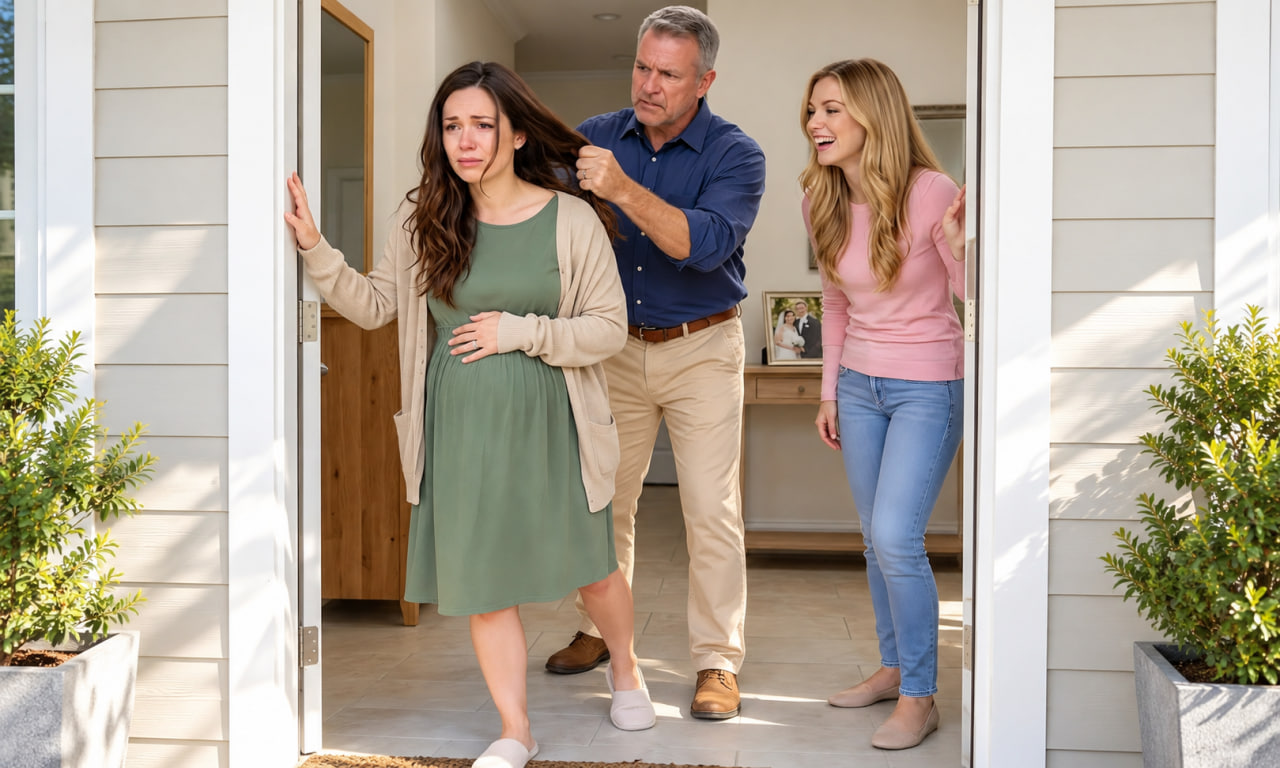
The porch had finally shown me what that peace cost: my safety, my dignity, and almost my chance to bring June into the world without terror.
I was allowed to grieve a father who was still alive. I was also allowed to keep him away.
When June was old enough to track my face with her eyes, I began showing her photographs of Daniel.
I told her how he danced terribly while cooking, how he always stole the corner piece of brownies, and how he painted stars above her crib even though he was afraid of heights on a ladder.
I told her he had made sure our home belonged to us both, not because he expected a fight, but because we were a team.
One Sunday morning, I finally moved his coffee mug from beside the sink. Not into a box.
I set it on the kitchen shelf beside a framed picture of him holding the tiny shoes we’d bought for June. Sunlight came through the window, and June made a sleepy sound against my shoulder.
My father had believed that losing Daniel meant losing my protection.
What he never understood was that Daniel had left me something stronger than a house: proof that love could make room for my voice instead of silencing it.
Richard and Kelsey had lost the money, the sale, and the future they tried to build on a lie.
My father had also lost the right to know his granddaughter. That was the consequence he kept begging me to reverse.
I never did.
I looked down at June, safe in the home her father had loved, and whispered, “We’re staying.”