Richard had never been appointed as that representative.
He had no authority to negotiate on my behalf.
The last page contained a letter from my grandmother.
Gideon,
I cannot predict what will happen to the land after I am gone. Perhaps you will live there forever. Perhaps you will sell it one day and build a different life somewhere else.
Either choice is yours.
But if anyone tells you that you must surrender your home to prove your love, remember this: love does not require you to become the sacrifice every time someone else makes a mistake.
Your father may tell you that family means sharing everything. But true family does not demand the right to take what it has not earned.
If the land ever becomes valuable, do not allow that value to decide who you are.
And if it never becomes valuable, do not believe that your life has been wasted.
The greatest thing I can leave you is not the land itself.
It is the freedom to decide what happens to it.
I put the letter down.
For several seconds, I couldn’t speak.
My grandmother had understood something that had taken me twenty-nine years to learn.
My father didn’t merely want the house.
He wanted the right to decide what I was allowed to keep.
And I had spent my entire life confusing obedience with love.
Victoria reached across the table and placed her hand beside mine.
“You don’t have to decide anything today,” she said.
I nodded.
For the first time in days, I felt that I could breathe.
Then Daniel made one final observation.
“There is another matter. The development company recently requested updated information about the property’s ownership. We have not yet determined whether that inquiry came from Richard, Tristan, or another party.”
I looked up.
“Does the company know what happened at the wedding?”
“Not from us. But given the number of witnesses, I suspect news of the incident will spread quickly.”
Victoria looked toward the window.
“Then they may contact Gideon directly.”
Daniel nodded.
“They may. If they do, I recommend that he obtain independent legal advice before discussing any sale, easement modification, or financial arrangement.”
I closed the folder.
For the first time, I understood that I had no obligation to rush.
No deadline invented by my father.
No emergency created by Tristan.
No family gathering at which I would be pressured into signing something I didn’t understand.
The house was mine.
And the decision would be mine, too.
But as I stood to leave, Daniel handed me a final sheet of paper.
It was a copy of an email sent to my grandmother six weeks before she died.
The sender was Richard.
The subject line read:
We need to settle this before Gideon finds out.
I looked at the date.
Then I read the opening sentence.
Mother, if you refuse to cooperate, you leave me no choice but to explain to Gideon what really happened to his father’s business.
I stared at the page.
My father had never told me much about my grandfather.
I knew he had died when Richard was young, and that the family had struggled financially for a time.
But I had never heard anyone explain exactly what had happened to the business he supposedly left behind.
I looked at Daniel.
“What is this about?”
His expression changed.
“Your grandmother asked me not to disclose the details unless you specifically requested them. She believed the information could cause serious conflict within the family.”
“I’m requesting them.”
Daniel took a slow breath.
“Then we need to discuss what happened before you were born.”
And for the first time since the wedding, I realized that the secret behind my house might be only one part of the truth.
My father had been trying to control my future.
But the reasons he feared losing control might reach much further back than I had ever imagined.
PART 5: The Man My Father Never Wanted Me to Become
I returned to my house that evening with the documents secured in a folder on the passenger seat.
The sun was sinking behind the ridge, turning the windows gold.
I parked in the driveway and sat there for several minutes.
The house looked exactly as it had the morning before the wedding.
The stone chimney rose above the roofline. The oak door stood beneath the small covered porch. Through the front windows, I could see the fireplace I had built with Harrison’s help.
Nothing about the building had changed.
But I had.
For the first time, I no longer saw the house as something I needed to defend against my family.
I saw it as proof that I could build a life without their permission.
Inside, I placed my grandmother’s letter on the kitchen island.
Then I called Harrison.
“I need to know what happened to my grandfather’s business.”
There was a long silence.
“Daniel told you about the email?”
“Yes.”
Harrison sighed.
“I was hoping you’d have more time before this came up.”
“Why?”
“Because the truth is complicated, and I don’t want you to make the same mistake your father made.”
I sat down.
“What mistake?”
“Believing that being right gives you permission to destroy everyone who disagrees with you.”
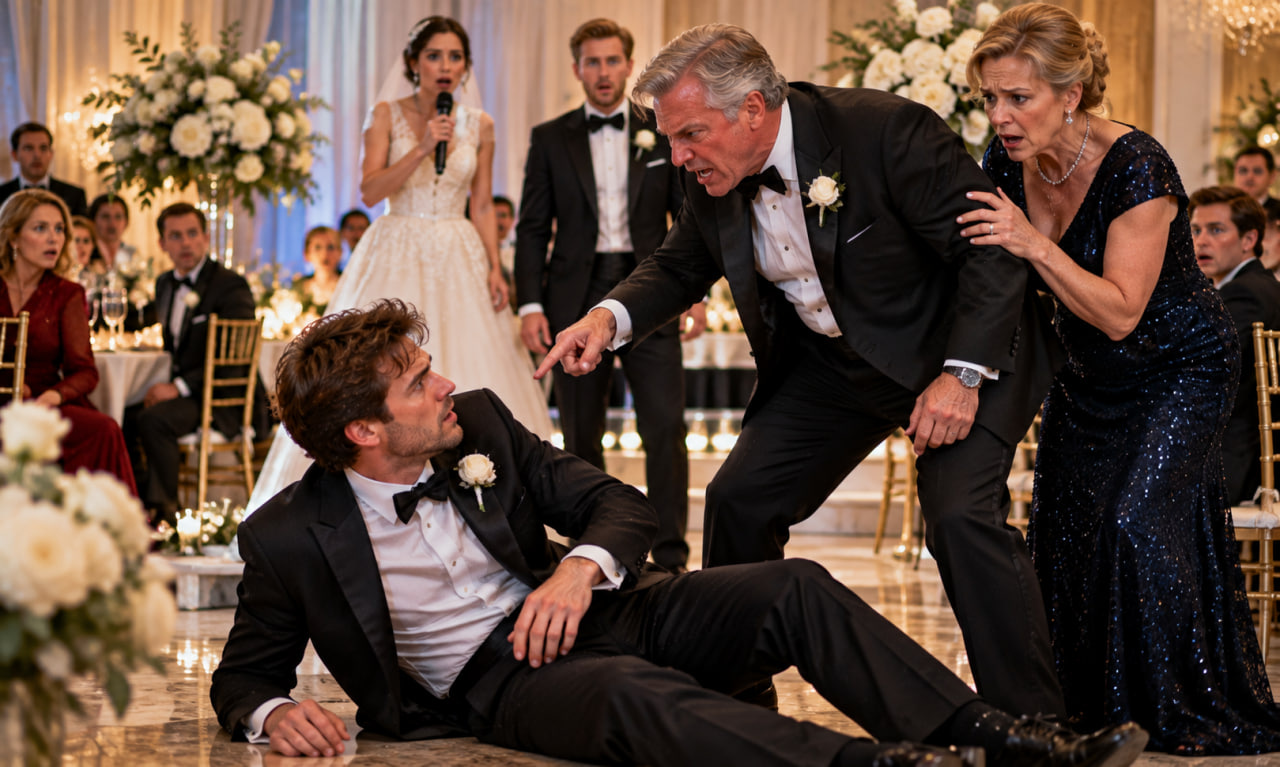
I thought about my father lying on the floor of the ballroom only in the sense that I had been the one on the floor, bleeding while he stood over me.
“I don’t want to destroy him,” I said. “I want to understand him.”
Harrison was quiet for a moment.
Then he told me what he knew.
My grandfather, Edward, had owned a small construction supply business. It wasn’t a massive corporation, but it had been profitable for years.
Richard joined the company in his early twenties.
He was ambitious, charming, and exceptionally good at convincing people that success was always one big opportunity away.
At first, he did well.
Then he began taking risks.
He borrowed money to expand into new markets. He purchased equipment before contracts were finalized. He promised delivery schedules that the company could not always meet.
When one major project collapsed, the business lost a substantial amount of money.
My grandfather wanted Richard to slow down.
Richard wanted another loan.
They argued.
According to Harrison, the conflict grew so bitter that Edward eventually removed Richard from control of several company accounts.
Richard never forgave him.
“He told people his father had betrayed him,” Harrison said. “He said Edward had ruined his future because he couldn’t tolerate seeing his son succeed.”
“What really happened?”
“Your grandfather tried to stop the company from going bankrupt. He was willing to help Richard recover, but only if Richard agreed to an independent financial review.”
“And Richard refused?”
“Yes.”
I looked toward the fireplace.
The pattern was painfully familiar.
My father wanted trust without accountability.
He wanted support without conditions.
He wanted everyone to believe in him while refusing to show them the truth.
“What happened to the business?”
“Your grandfather sold part of it to pay the creditors. The rest was reorganized under new management. Richard received some assets, but not the control he wanted.”
“And he blamed my grandfather?”
“Until the day Edward died.”
I closed my eyes.
For years, my father had told stories about how his own father had failed him. He used those stories to explain why he demanded loyalty from his children.
He said he had been forced to build everything himself.
He said he would never allow his family to abandon one another.
But he had left out the part where his father had tried to save the business by insisting on accountability.
He had turned a financial dispute into a lifelong grievance.
And somewhere along the way, he had decided that his children must repay him for a suffering they had never caused.
I asked Harrison one more question.
“Did my grandfather leave anything to me?”
“Not directly that I know of. But Betty kept some of Edward’s papers. She believed they might help you understand why Richard behaved the way he did.”
“Do you have them?”
“No. Daniel may have copies.”
I thanked him and ended the call.
Then I sat alone in the house until the room grew dark.
I thought about Tristan.
He had been born into the same family, heard the same stories, and watched the same arguments.
Yet he had made different choices.
My father had given him money, protection, and endless excuses. Perhaps that had taught him to avoid responsibility.
But he was still an adult.
He had signed the documents.
He had agreed to use my property.
He had stood in the ballroom while our father struck me.
Understanding why someone behaved badly did not erase the harm they caused.
That was another lesson I needed to learn.
The following morning, I contacted an independent attorney recommended by Daniel. She reviewed the property records, advised me to preserve every message and document, and explained the steps available to protect my ownership.
I changed the locks on the house, secured the original deed, and made digital copies of the relevant records.
I also contacted the authorities about the assault.
I didn’t do it to embarrass my father.
I did it because he had attacked me, and I wasn’t going to pretend it hadn’t happened simply because we shared a surname.
For years, my family had treated silence as a form of loyalty.
I was done confusing the two.
Three days later, Victoria called.
“Gideon, I need to tell you something about Tristan.”
I leaned back in my chair.
“What happened?”
“He came to my father’s office yesterday. He wanted me to withdraw my statement about the wedding and tell everyone that the documents were misunderstood.”
“What did you say?”
“I told him that I would correct anything that turned out to be inaccurate, but I wouldn’t lie to protect him.”
I nodded, even though she couldn’t see me.
“Good.”
“He also said something else.”
“What?”
“He claimed Richard had promised him the house years ago.”
I frowned.
“Years ago?”
“He said your father told him that the property would eventually belong to him because he was the one who would carry on the family business.”
I stared at the wall.
That was absurd.
My grandmother had left the land to me. My father had no authority to promise it to Tristan.
But I could imagine him doing exactly that.
He had probably spent years telling Tristan that whatever I built would eventually be shared.
That my independence was temporary.
That my success was simply another family asset waiting to be redistributed.
“Did Tristan believe him?” I asked.
“I think he wanted to believe him.”
“That doesn’t excuse what he did.”
“No,” Victoria said. “It doesn’t.”
We were silent for a moment.
Then she asked, “Can I visit the house sometime?”
I hesitated.
“Why?”
“Because I want to see the place you built. Not the version Tristan described. The real one.”
I thought about it.
Then I said yes.
She arrived the following Saturday afternoon.
Harrison came over with a pot of coffee, and the three of us sat on the porch while the wind moved through the trees.
Victoria walked through the rooms slowly.
She touched the oak banister, examined the stone fireplace, and stopped beside a framed photograph of my grandmother.
“This is beautiful,” she said.
“Thank you.”
“No, I mean it. It’s not just expensive materials or fancy design. You can tell someone cared about every part of it.”
I looked at the fireplace.
“Harrison taught me most of what I know.”
“Your father never helped?”
“No.”
She seemed surprised.
“Not even once?”
“He came to inspect the property when it was nearly finished. He spent twenty minutes explaining what he would have done differently.”
Harrison laughed.
“Richard wouldn’t know a level from a shovel.”
For the first time in days, I laughed, too.
The sound felt unfamiliar.
Victoria sat beside me.
“I used to think Tristan wanted to build a company because he had something important to prove,” she said. “Now I think he wanted to build something that would make people admire him without having to do the work.”
I considered that.
“Maybe.”
“Do you think he can change?”
I watched a hawk circle above the ridge.
“I don’t know. But I know I can’t change him for him.”
Victoria nodded.
“My father says the same thing about business partners who repeatedly make the same mistake.”
“Your father sounds sensible.”
“He is. Sometimes annoyingly so.”
She smiled faintly.
Then she became serious again.
“I also wanted to tell you that my father has no intention of using what happened to pressure you into a deal. He wants to keep his company’s business separate from your family’s situation.”
“That’s fair.”
“If the development company contacts you, he’ll make sure you have independent representation. But he won’t ask you to sell.”
“Thank him for that.”
“I will.”
She looked toward the ridge.
“There’s something else. The developers are reviewing their access plans. They may approach you eventually, but no one knows whether they’ll make an offer or what it would involve.”
I nodded.
“Then I’ll decide if and when that happens.”
Victoria smiled.
“That sounds like the Gideon I met at the wedding.”
I looked at her.
“You met me for about five minutes.”
“Sometimes five minutes is enough to recognize someone who knows what matters.”
I didn’t know what to say to that.
But for the first time, I felt that the story of my family might not end with anger.
It might end with something better.
Not reconciliation at any cost.
Not forgiveness demanded by people who had never apologized.
Something quieter.
The freedom to choose who deserved a place in my life.
And the courage to build a future that didn’t depend on anyone else’s approval.
PART 6: The House My Father Could Never Take
Three weeks later, my father stood on my doorstep for the first time since the wedding.
He looked older. His expensive suit was wrinkled, and the confidence he once wore like armor had disappeared.
“Gideon,” he said quietly, “can we talk?”
I let him stand outside for a moment before answering.
“What do you want?”
He lowered his eyes.
“The company is in trouble. Tristan has left town, Victoria has ended the engagement, and the bank is demanding answers. I thought you might reconsider helping us.”
I stared at him.
“Are you here because you regret hitting me, or because you still want my house?”
His silence told me everything.
“I made a mistake,” he finally muttered.
“No, Dad. You made a choice. You chose to hurt me because I wouldn’t give you something that was never yours.”
His eyes filled with tears.
For a moment, I wanted to believe that he finally understood.
Then he whispered, “But we’re still family.”
I nodded slowly.
“Yes. And that’s why it took me so long to realize how badly you were treating me.”
I closed the door gently.
Not because I hated him, but because I had finally learned that forgiveness didn’t require me to surrender my boundaries.
Months passed.
The investigation into the assault and the questionable financial transactions continued. My father had to face the consequences of his decisions, while Tristan eventually contacted me to apologize. I told him that if he truly wanted to change, he would have to prove it through his actions, not his promises.
Meanwhile, the development company approached me through my attorney to discuss the property’s access arrangements. After months of independent reviews and careful negotiations, we reached an agreement that protected my ownership and fairly compensated me for the rights involved.
For the first time, my family couldn’t decide what my future would look like.
I could.
I kept my house.
I used part of the proceeds from the agreement to establish a small construction business, hiring people who wanted to learn the trade the way Harrison had taught me.
On the day we completed our first project, Harrison stood beside me, smiling proudly.
“You built more than a house, kid,” he said. “You built a life nobody can take away from you.”
I looked at the oak doorway of my home and remembered my grandmother’s words.
Love does not require you to become the sacrifice every time someone else makes a mistake.
Victoria eventually started a charitable foundation with her family, helping young people develop professional skills and build independent futures. We stayed friends, and she often visited the house. Neither of us rushed into anything more. We had both learned that a good future must be built on honesty.
As for my father, I didn’t know whether he would ever become the man I had spent my childhood hoping he would be.
But I no longer needed him to.
One evening, standing beside my fireplace, I received a message from him.
I’m sorry, Gideon. I hope someday you can forgive me.
I read it twice before putting my phone away.
Maybe someday I would forgive him completely.
But I wouldn’t give him my house.
I wouldn’t give him my peace.
And I would never again confuse being a good son with allowing someone to destroy me.
I had spent three years building that home with my own hands.
It turned out the most important thing I built wasn’t the roof, the walls, or the stone fireplace.
It was the courage to say no when everyone expected me to surrender.
And that was the one thing my father could never take away.