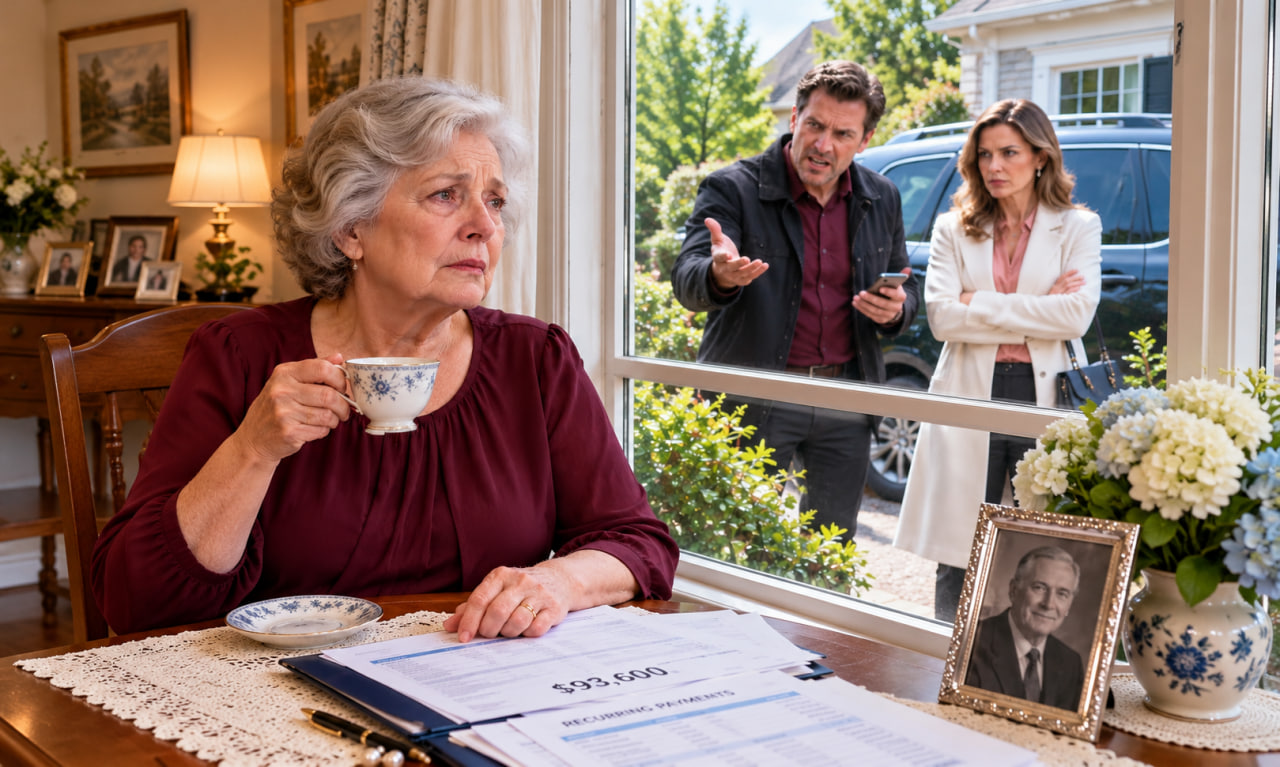
The unauthorized financial activity was treated separately from the assistance I’d genuinely agreed to provide. I wasn’t entitled to reclaim every gift I’d ever given simply because I regretted my generosity.
But the disputed transactions were another matter.
Authorities reviewed the evidence, and formal proceedings followed. Benjamin and Genevieve eventually accepted responsibility for offenses supported by the records through negotiated resolutions.
The consequences included restitution, financial obligations, and supervision requirements. I attended the proceedings that required my participation, but I didn’t go simply to watch my son suffer.
When I was invited to speak, I explained that I’d offered financial help because I loved my family. That love had never been permission to use my identity, make unauthorized payments, or plan the sale of my home.
I also explained how painful it was to have my age used as an argument against my ability to make decisions. Being seventy-seven didn’t mean my wishes were less important than those of my children.
Benjamin cried during the proceedings, while Genevieve remained composed. I didn’t measure their responsibility by their expressions because the documents and admitted actions already established what mattered.
Afterward, I returned home with Wesley and Serena. We ate a quiet lunch, talked about ordinary things, and avoided pretending that one legal decision had repaired every damaged relationship.
The restitution arrived in installments, which Miriam helped document. I placed the money into a separate account and continued managing my retirement independently.
Benjamin’s financial circumstances changed dramatically. He and Genevieve eventually sold their townhouse, canceled their expensive memberships, and moved into a smaller rental home.
His consulting business closed, and he accepted a job with a regional supplier. The work was less glamorous than the career he’d once described, but it provided a reliable income.
I didn’t offer to finance another venture. For the first time, Benjamin had to build a life based on what he could actually afford.
Genevieve sent a long email claiming that everyone had misunderstood her intentions. She described the business payments as reimbursements and suggested that I’d overreacted.
I forwarded the message to Miriam without replying. I was beginning to understand that I didn’t have to defend every boundary to someone determined to resent it.
During the following summer, Benjamin and Genevieve separated. Their arrangements concerning Alice took time, and they received professional support to help her adjust without feeling responsible.
I remained committed to protecting my relationship with my granddaughter. Whatever Genevieve had done to me, Alice still loved her mother, and I wouldn’t make that love another source of conflict.
When Alice visited, we talked about school, books, and the birds in my garden. We baked biscuits, played games, and enjoyed ordinary afternoons that had nothing to do with bank statements.
Occasionally, she asked difficult questions about her parents. I answered gently, explaining that adults sometimes made mistakes and needed to take responsibility for them.
I never asked her to choose sides.
Meanwhile, Serena and I began rebuilding our relationship. She admitted she’d trusted Benjamin’s descriptions because he lived closer to me and seemed more involved in my daily life.
I acknowledged that I’d also contributed to the misunderstanding by hiding my unhappiness. For years, I’d told my children everything was fine because I didn’t want them to worry.
We agreed to communicate more honestly. Serena began asking whether I wanted help rather than assuming I needed it, and I learned to accept kindness without surrendering control.
Wesley continued visiting regularly, sometimes bringing groceries or helping with small repairs. He never treated those gestures as a reason to tell me how to spend my money.
One afternoon, he admitted he’d worried about Benjamin’s borrowing for years. He’d tried to discuss it with me, but I’d always defended his younger brother.
I remembered those conversations and apologized for dismissing his concerns. Wesley accepted my apology and said he simply wanted me to enjoy the retirement Thomas and I had worked so hard to create.
That conversation stayed with me.
For years, I’d confused protecting Benjamin from consequences with being loyal to him. I finally understood that sometimes allowing someone to face the results of their choices was a more honest expression of love.
I began volunteering at the library twice a week and joined a small card-playing group. One of the women, Dorothy, was eighty-one and had a wonderful sense of humor.
We became friends, and she encouraged me to travel again. At first, I hesitated because I’d grown accustomed to making plans around Benjamin’s financial emergencies.
Then I realized those emergencies were no longer mine to manage.
That spring, I spent a long weekend near the coast with Wesley and Ruth. We walked along the water, drank tea in a little cottage, and enjoyed the quiet pleasure of having no urgent responsibilities.
I thought about Thomas often during that trip. He’d loved the ocean, especially early mornings when the beach was almost empty.
When I returned home, I finally opened a drawer in his old desk that I’d avoided since his death. Inside were photographs, receipts, and several letters tied together with string.
One unfinished letter was written in Thomas’s handwriting. It described our garden, our marriage, and the ordinary moments he’d treasured during our years together.
Near the bottom, he mentioned Benjamin’s financial problems. He admitted he’d noticed how anxious I became whenever our son called, and he regretted allowing me to handle so many difficult conversations alone.
The final paragraph made me cry.
“If I go first, please keep living. Not just looking after everyone. Living.”
I read those words several times before placing the letter beside his photograph. Thomas had known me better than anyone, and even he had worried that I’d spend my remaining years taking care of other people.
I framed a copy of the paragraph and placed it near my favorite chair. It became a quiet reminder that my own happiness deserved attention too.
Several months later, Benjamin asked to meet me at a café near the library. I agreed to forty-five minutes because I wanted to hear what he had to say without returning to our old patterns.
He arrived early and ordered tea for me. We talked about Alice, his new job, and ordinary family matters before he finally became serious.
“Mom, I need to apologize without asking you for anything afterward.”
I waited.
“I used you. I made your love solve problems I didn’t want to face.”
He admitted that he’d allowed himself to believe my financial support would continue indefinitely. Whenever he felt ashamed of needing help, he became defensive and treated my questions as criticism.
He also acknowledged that he’d helped create the false impression that I couldn’t manage my affairs. He’d hoped that if everyone accepted that story, controlling the situation would become easier.
I listened carefully because his words were different from his earlier excuses. He wasn’t blaming Genevieve or claiming that he’d only been trying to protect me.
“I’m sorry, Mom.”
I looked toward the window, thinking about how many times I’d imagined hearing those words.
“I wanted you at that dinner, Benjamin. I would have helped you make an honest plan when your business failed.”
His eyes filled with tears.
“But you chose to make me the embarrassing part of your life.”
He lowered his head, and I let the silence remain between us. For once, I didn’t feel responsible for making him comfortable.
When he asked whether I could forgive him, I explained that forgiveness and trust weren’t the same thing. I wanted to move forward, but I needed time and consistent behavior before feeling safe again.
I told him that I wouldn’t pay his bills, restore account access, or accept pressure involving Alice. He agreed without arguing.
Before leaving, he asked whether he could hug me. I considered the request, then stood and opened my arms.
The hug was brief, but it felt honest. Benjamin didn’t ask me to promise that everything would return to the way it had been.
Over the following months, he continued attending counseling and maintaining his financial responsibilities. He began asking permission before visiting and accepted my answers without complaint.
Sometimes we met for lunch, and occasionally he brought Alice to my house. I appreciated the gradual improvement, but I never confused one good afternoon with complete restoration of trust.
By my seventy-eighth birthday, our family had found a quieter rhythm. Wesley and Ruth organized a small celebration in my garden, while Serena brought flowers and Alice made a paper crown.
Benjamin attended for an hour after asking in advance. He brought a book about garden birds, remembering how much I enjoyed watching them through the kitchen window.
Inside, he’d written a short apology and thanked me for allowing him to visit. There were no financial requests or attempts to reopen old arguments.
I placed the book beside Thomas’s photograph because I wanted to remember the effort without pretending the past had disappeared.
The following Thanksgiving, I invited everyone for dinner at my house. Genevieve and Benjamin were still living separately, and the adults respected the arrangements they’d made concerning Alice.
Wesley brought potatoes, Serena bought rolls from a bakery, and Benjamin arrived with roasted carrots he’d cooked himself. Alice immediately began making place cards for the table.
This time, she placed a purple card beside my plate. It had a small bird drawn above my name, and the letters were carefully written.
I smiled when I saw it because I remembered the blue card she’d hidden in her pocket the previous year.
At dinner, Wesley raised his glass and offered a short toast. He thanked me for bringing everyone together, and I laughed when he promised not to turn it into a long speech.
Benjamin sat quietly beside Alice, helping her pass the vegetables. He wasn’t trying to impress anyone or pretend his life was more successful than it was.
After dinner, we played dominoes with Thomas’s old set. The familiar clicking sounds brought back memories of evenings when the children were young and our biggest arguments concerned whose turn it was.
There was still sadness in our family, and some relationships remained complicated. But we no longer needed to pretend that everything was perfect to enjoy being together.
Before Benjamin left, he stopped beside the kitchen counter.
“Thank you for inviting me, Mom.”
I looked at him and smiled.
“You were invited, Benjamin.”
He nodded slowly, understanding exactly what I meant.
After everyone had gone, I walked through the house switching off the lights. The rooms were quiet, but they no longer felt empty or lonely.
I stopped beside Thomas’s photograph, where the old blue place card and the new purple one stood together. One reminded me of the night I’d been excluded, while the other reminded me that love could survive difficult truths.
My home was still mine. My savings were protected, my financial decisions belonged to me, and nobody could assume that my age gave them permission to control my future.
I still loved my children, including Benjamin. But loving them no longer meant financing every problem or accepting every demand.
I made tea in my finest cup, settled into my favorite chair, and opened my calendar. There was a library shift on Tuesday, cards with Dorothy on Thursday, and Alice’s school performance the following week.
In spring, I planned to return to the coast. I wanted to see the ocean again, walk along the water, and remember Thomas without feeling that enjoying my life somehow meant leaving him behind.
I thought about that rainy November evening when Benjamin told me I wasn’t welcome at dinner. At the time, I’d believed the message meant my place in the family had disappeared.
Now I understood something different.
I had spent fifteen years trying to make my son comfortable, but I couldn’t purchase respect, gratitude, or love. Those things had to exist freely, or they meant very little.
The 174 payment arrangements were gone, and I no longer needed them to prove that I cared. My family could ask for my company, my advice, or my love without expecting access to my bank accounts.
I looked toward Thomas’s photograph and smiled.
“We’re still learning, sweetheart.”
Then I lifted my teacup and listened to the rain outside.
At seventy-eight, I was still a mother, still a grandmother, and still someone who wanted the people she loved to be happy.
But I was also a woman with her own home, her own plans, and a future that belonged to her.
And for the first time in fifteen years, I had nothing left to pay in exchange for being loved.