PART 2 — THE WOMAN THE BRIDE REMEMBERED
The last argument I had with my father as a teenager began at a dinner table.
Easton Bell had just left our house.
He was thirty-eight, recently divorced, and connected to a business arrangement my father wanted more than he wanted my happiness.
For months, dinners had become invitations. Invitations had become expectations.
Then Dad announced that Easton intended to propose.
“I’m not marrying him,” I said.
Griffin looked up from his plate.
My mother stopped cutting her food.
Dad set down his fork.
“You don’t understand what this could mean for the family.”
“I understand what it would mean for me.”
He called me selfish.
Then ungrateful.
By the end of the evening, he had decided that if I refused the future he arranged, I could leave the home he paid for.
I went to a college friend’s apartment with two bags and enough money for a few days.
The following years were difficult in ordinary, exhausting ways.
I worked. I found a less expensive school. I finished my degree with financial aid, loans, and people who helped without asking me to surrender my choices.
After graduation, I earned my commission in the Navy.
There were years of training, demanding assignments, mistakes I learned from, and officers who expected more of me than I knew I could give.
Eventually, I became a rear admiral.
My father had never been required to approve any of it.
At first, I sent letters.
A new address.
A graduation date.
A photograph in uniform.
Sometimes I received a short reply reminding me that I knew what I needed to do to repair the family.
Eventually, I stopped writing.
My mother and I spoke occasionally before her death, cautiously and often briefly. Those conversations never became the relationship I wanted.
By then, distance had become a habit everyone knew how to maintain.
Calder was the first person who asked whether it had to stay that way.
Three weeks after we reconnected, he invited me to a video call with his fiancée.
“She’s Navy too,” he told me. “You’ll have something to talk about besides my terrible childhood haircut.”
When Liora Vance appeared on the screen, we both went still.
Then she smiled.
“Admiral Rowe?”
Calder looked between our faces.
“You know each other?”
Liora laughed once, in disbelief.
“Your aunt is the officer I told you about.”
I remembered her immediately.
Two years earlier, she had been held responsible for a failure during an assignment. The initial account made the matter look straightforward.
Her written response raised questions the supporting documents did not answer.
When the issue came through the command where I served, I asked for those questions to be addressed before a final conclusion was reached.
Other officers and reviewers did substantial work. Records were checked. Responsibilities were examined.
The eventual findings were different from the first account.
Liora kept her career.
What she remembered was a conversation outside my office.
“You told me you couldn’t promise the result,” she said during the video call. “But you could promise that someone would read what I had submitted.”
I remembered her gripping a folder so tightly that one corner had bent.
“You deserved a fair review.”
“I know that now.”
Calder leaned back in his chair.
“I cannot believe neither of you mentioned this.”
“You didn’t tell me your aunt was an admiral,” Liora said.
“She didn’t lead with it. She asked if I still hated peas.”
We laughed.
Later, Liora asked whether she could thank me briefly at the reception.
I told her the wedding should be about them.
“It is,” she replied. “You’re part of how we got here.”
We agreed she could speak about her own experience without naming people or discussing details of the case.
I did not ask her to defend me.
I had not expected to need defending.
Now, in the ballroom, Liora approached in an ivory gown with small buttons down the sleeves.
She embraced me carefully around the bouquet.
“I’m so glad you came.”
“You look happy.”
“I am.”
She glanced toward Alden and Griffin, who had moved away.
“Calder told me what happened.”
“It’s handled.”
She studied my face.
“You don’t have to make it smaller for us.”
Before I could answer, the coordinator came to gather them for the speeches.
I returned to my seat.
My father spoke first.
He talked about family loyalty, tradition, and the responsibilities that came with the Rowe name.
Then he looked toward my table.
“Some people mistake doing whatever they want for independence. Real character means putting family first.”
The woman beside me shifted in her chair.
I kept my eyes on the candle in the center of the table.
At the front, Calder leaned toward the coordinator.
A moment later, she approached my father and thanked him, smoothly directing the evening onward.
He appeared irritated, but surrendered the microphone.
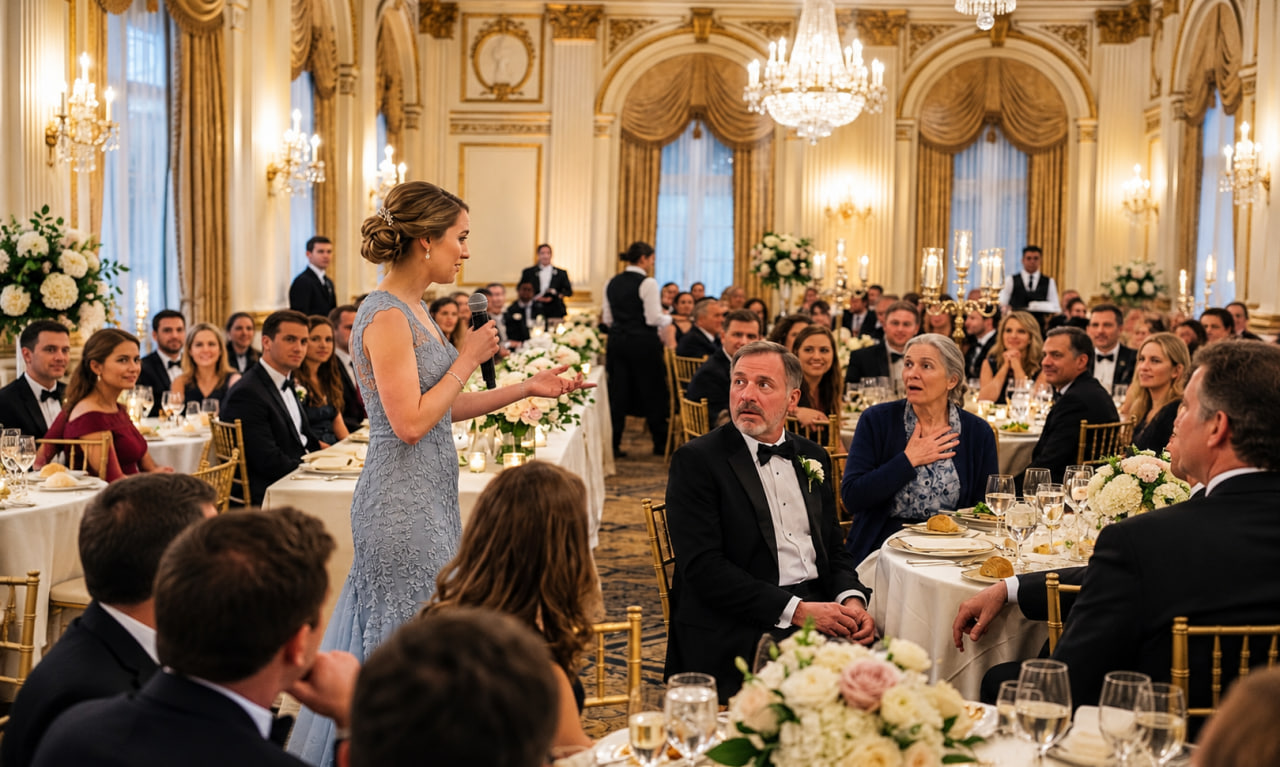
Liora stood.
She waited until the room settled.
“Before we dance,” she said, “there’s someone I want to thank.”
PART 3 — THE TOAST THAT WAS ALREADY TRUE
Liora held the microphone in both hands.
Calder stood beside her.
“A couple of years ago, I went through a professional experience that made me wonder whether there was room for me in the career I loved.”
The room quieted.
“I was frightened. I was angry. And I kept being told that explaining myself would only make things worse.”
I looked at my glass.
I knew what she was about to say, but hearing it in this room felt different.
“One senior officer asked a very simple question,” Liora continued. “Had anyone actually considered the records I was pointing to?”
A few guests nodded.
“She didn’t promise to make me right. She didn’t promise to make the problem disappear. She made sure the process included the facts—and that I had a chance to be heard.”
Her eyes found mine.
“I’ve thanked Rear Admiral Maren Rowe professionally. Tonight, I get to thank Aunt Maren.”
The room changed in small ways.
A chair turned.
A conversation stopped near the back.
My brother’s hand paused halfway to his glass.
Liora smiled at me.
“You told me I deserved to be heard before anyone decided who I was. I’ve carried that into my work, my friendships, and this marriage.”