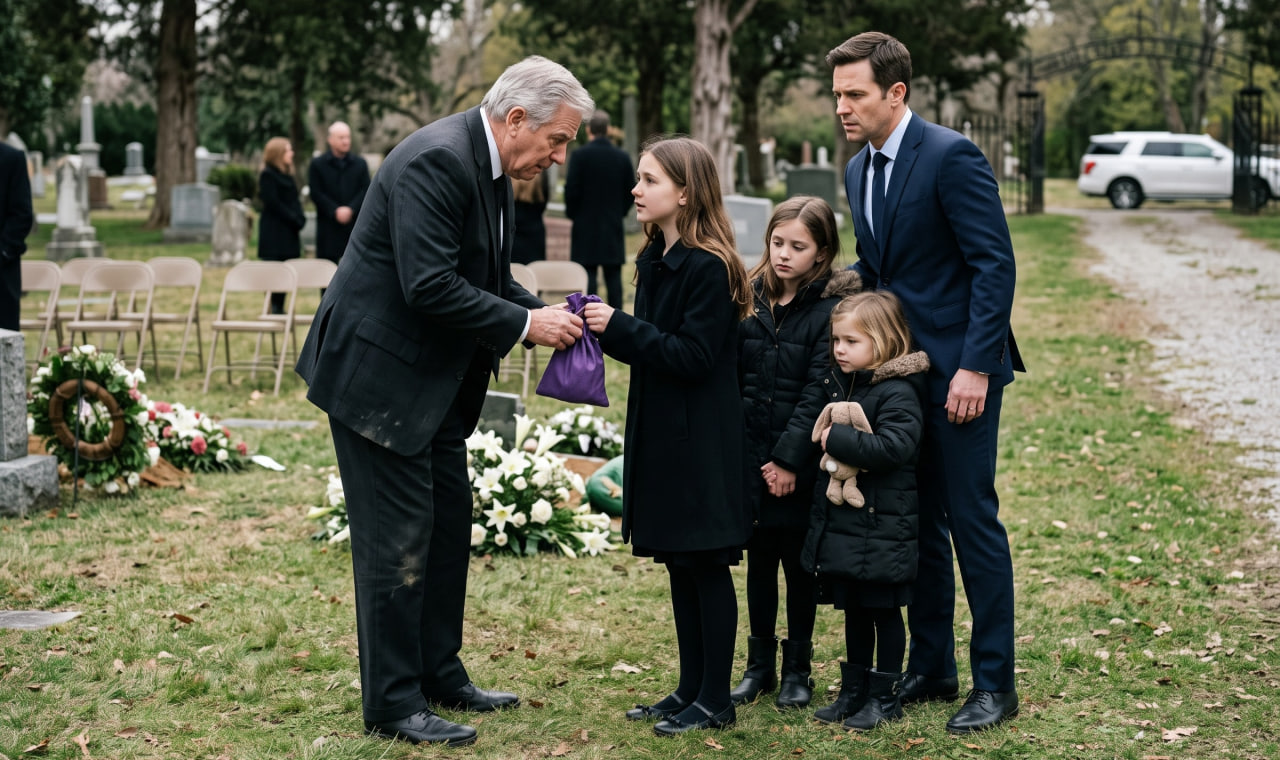
Eleanor glanced at me.
Emily continued.
“I have given copies of the relevant records to my lawyer. The original documents are stored in a secure location. If Mason challenges the trust or claims that I was confused when I made my decisions, Eleanor knows what to do.”
Her eyes filled with tears.
“I don’t know how much time I have left. The doctors are trying, but I can feel how tired my body has become.”
She stopped speaking for several seconds.
When she continued, her voice was quieter.
“I’m afraid of dying, Dad. I wish I could tell you that I’m not. I’m afraid of missing Ava’s graduation. I’m afraid of never seeing Sophie perform on a stage again. I’m afraid Grace will forget the sound of my voice.”
I could no longer see the screen clearly.
I wiped my face, but the tears kept coming.
“Most of all, I’m afraid that when I’m gone, the girls will think they have to earn the love of the people who remain.”
Emily smiled faintly.
“They don’t. They never did.”
She reached toward the camera, then hesitated.
“Dad, if you have to fight for them, fight with the truth. Don’t become cruel just because someone else has been cruel. Don’t let anger turn you into someone your grandchildren are afraid of.”
Her eyes moved toward something outside the frame.
Then she looked back at us.
“I love you. I love the girls. And whatever happens, please remember that I did everything I could to leave them a safe place to land.”
The screen went dark.
For a long time, neither Eleanor nor I spoke.
Then I asked the question that had been burning inside me since the video began.
“Did she know she was going to die?”
Eleanor folded her hands.
“She knew her condition was serious. She hoped the treatment would give her more time, but she understood the risks.”
“And she was preparing all of this while she was sick.”
“Yes.”
I looked at the frozen image of my daughter.
She had been frightened, exhausted, and uncertain about the future.
Yet she had still found the strength to think about what would happen to her children after she was gone.
I had thought I was the one who needed to save them.
Now I understood that Emily had already begun saving them before I even realized they were in danger.
Eleanor closed the video.
“We have work to do, Thomas. But we need to be careful. The evidence raises serious questions, and the children’s immediate welfare comes first.”
“What happens if Mason refuses to let me care for them?”
“Then we ask the appropriate authorities and the family court to consider the circumstances. Your relationship with the girls, Emily’s documented wishes, and the children’s needs will all be relevant. Nothing is automatic, but you have grounds to seek a formal arrangement.”
I stood.
“Then that’s what we’ll do.”
Eleanor handed me a copy of the emergency instructions.
“One more thing. Don’t underestimate Mason. If he discovers that you’ve accessed these records, he may try to get ahead of us.”
I thought of the white SUV at the cemetery.
The woman behind the wheel.
The way Mason’s face had changed when Ava handed me the purple bag.
“I think he already suspects something.”
“Then we need to move quickly.”
As I left her office, I called a family friend who had worked in social services for many years. She advised me to document everything Mason had said, keep the girls’ daily routines as stable as possible, and seek immediate guidance from the relevant child-welfare authorities.
I also arranged an appointment with a family-law specialist.
For the first time since Emily’s funeral, I felt something other than grief.
I felt purpose.
Mason had announced that he wanted a fresh start.
What he hadn’t understood was that his daughters were not possessions he could put aside when they became inconvenient.
They were children.
And they were my family.
When I returned home, I found all three girls sitting on the living-room floor.
Grace was drawing a picture of our family. She had drawn herself, her sisters, me, and Emily standing in the sky above us.
Sophie was helping her color the flowers.
Ava was sitting quietly beside the window.
“How was the lawyer?” she asked.
I placed my coat on the chair.
“She helped me understand some things your mother wanted me to know.”
“Are we staying here?”
I looked at all three of them.
“I want you to stay here. And I’m taking the proper steps to make sure you have a safe, stable home while the adults work out the legal arrangements.”
Ava studied my face.
“Does that mean Dad can’t take us away?”
“It means that no one gets to decide your future without the appropriate people looking at what’s best for you.”
She lowered her eyes.
“I don’t want to hate him.”
The words surprised me.
“Then don’t force yourself to hate him, sweetheart. You can love someone and still be hurt by what they do. You can miss the father you remember and still be honest about the father you’re dealing with now.”
She nodded slowly.
Then she asked the question I had been afraid to hear.
“What if he doesn’t want us anymore?”
I sat down beside her.
“His choices are not a measure of your worth. Never forget that.”
For the first time since the funeral, Ava leaned against me without trying to hide her tears.
I wrapped my arms around her.
Across the room, Sophie put down her colored pencil and joined us. Grace followed, carrying her rabbit.
The four of us sat together on the floor, surrounded by crayons, family photographs, and the unfinished drawing.
It wasn’t a perfect family.
It was a grieving one.
But it was a family that still had room for all of its members.
And as I held my granddaughters, I made a promise to Emily that I intended to keep.
Whatever happened next, her girls would never have to wonder whether someone wanted them.
They would know.
They would know every morning when I made breakfast, every evening when I helped with homework, and every night when I reminded them that they were loved.
Mason might have believed that sending them away would make his life easier.
He might have believed that Emily’s death had ended her ability to protect them.
But he was wrong about one thing.
My daughter was gone.
Her love was not.
And the purple bag was only the beginning.
PART 4
Three days after I opened the purple bag, Mason arrived at my house with a lawyer.
He didn’t call first.
He didn’t ask how the girls were sleeping or whether Grace had stopped crying at night. He didn’t ask if Sophie was eating or whether Ava had returned to school.
He stood on my front porch in an expensive navy suit, holding a leather folder, while a woman in a gray coat waited beside him.
When I opened the door, Mason gave me the same polite smile he had worn the first time he came to my house for dinner.
Only now, I could see what that smile was hiding.
“Thomas. We need to talk.”
I stepped outside and closed the door behind me.
“The girls are resting.”
“This concerns them.”
“Then speak quietly.”
His smile disappeared.
“I’ve been advised that I need to make arrangements for the children’s care. I can’t continue like this indefinitely.”
“Like what?”
“Like this.” He gestured toward the house. “You taking them in without any formal agreement. It’s not sustainable.”
“They’re your daughters, Mason. You announced at their mother’s funeral that you wanted them placed in foster care. What did you expect me to do? Leave them standing beside their mother’s grave?”
His lawyer shifted uncomfortably.
Mason’s jaw tightened.
“I was overwhelmed. I made a suggestion based on what I believed was best at the time.”
“You called your children an obstacle to your fresh start.”
“I never said that.”
“I heard you.”
He looked away for a moment.
Then he opened his folder.
“I’ve spoken with the relevant people. I understand that you’ve been consulting lawyers about Emily’s estate. I need you to understand that I’m their surviving parent. I have rights here.”
“You do,” I answered. “And the girls have rights, too.”
His eyes narrowed.
“What exactly did Emily tell you?”
There it was.
Not a question about his children.
Not a question about their grief.
A question about what his dead wife had left behind.
“I’ve spoken to her lawyer.”
Mason went completely still.
For the first time since the funeral, he looked genuinely frightened.
“Which lawyer?”
“Eleanor Whitmore.”
The woman beside him glanced at her notes.
Mason closed his folder.
“Emily was sick, Thomas. You need to remember that. She was taking medication. She wasn’t always thinking clearly.”
I felt my anger rise, but I remembered my daughter’s words.
Fight with the truth. Don’t become cruel just because someone else has been cruel.
“Her lawyer has records,” I said. “If you believe Emily’s decisions were invalid, you can address that through the proper legal process.”
He stared at me.
Then he said something that changed the way I understood the entire situation.
“She promised me that money would remain in the family.”
I looked directly at him.
“It is remaining in the family. It’s being protected for your daughters.”
He said nothing.
His lawyer finally stepped forward.
“Mr. Reed, perhaps we should discuss the immediate arrangements separately.”
But Mason wasn’t listening to her.
He was watching me with an expression that mixed anger and disbelief.
“You don’t understand what she did.”
“Then explain it.”
He opened his mouth.
For several seconds, no words came out.
Finally, he turned toward the lawyer.
“We’re leaving.”
He walked down the steps without saying goodbye.
Before getting into his car, he looked back at the house.
I had the uncomfortable feeling that this was not the last time I would see him.
I was right.
That afternoon, Eleanor called.
“Mason’s attorney has contacted me,” she said. “He is questioning aspects of the trust and suggesting that Emily may not have been mentally competent when she established certain provisions.”
“Can he do that?”
“He can raise the question. Whether he can prove it is another matter. Emily’s medical records, the documents she signed, and the independent legal advice she received will all be important.”
“What about the girls?”
“We are preparing the necessary applications concerning their care. In the meantime, keep records of every communication and do not prevent lawful contact unless there is a safety concern or an appropriate authority advises otherwise.”
I thanked her.
Then I went upstairs to check on Ava.
She was sitting at Emily’s old desk, looking through a stack of school photographs.
“Was Dad here?”
“Yes.”
“What did he want?”
I sat beside her.
“He wanted to discuss what happens next.”
Ava looked at me.
“Did he ask about us?”
The question was so quiet that I almost missed it.
“He knows you’re here.”
“That’s not what I asked.”
I had no good answer.
So I gave her the truth.
“He didn’t ask how you were feeling.”
She looked back at the photographs.
For a moment, she seemed much younger than thirteen.
“Mom always asked.”
“I know.”
“Even when she was in the hospital, she’d ask whether Grace had eaten and whether Sophie had finished her homework. She would call me before sleeping and ask about school.”
Her voice cracked.
“She was the sick one, Grandpa. She was the one who was supposed to need everyone else.”
I put my arm around her.
“Your mother loved you in a way that never depended on how much energy she had left.”
Ava leaned against me.
“Why couldn’t Dad be like that?”
I looked at the photograph in her hands.
It showed Emily standing between her daughters at the beach. Sophie was laughing, Grace was covered in sand, and Ava had one arm around her mother’s waist.
Mason had taken that photograph.
Once, he had been part of those happy moments.
I didn’t know whether he could become that man again.
But I knew that my granddaughters could not spend their childhood waiting for him to change.
“We can’t control the choices other people make,” I told her. “But we can make sure those choices don’t define who you become.”
She nodded.
Then she placed the photograph on the desk.
“Mom said you were good at fixing things.”
I smiled sadly.
“Your mother had a generous opinion of my abilities.”
“She said you fixed the back gate when you were angry, because you didn’t know what else to do with your hands.”
I laughed despite myself.
“That sounds like something she’d say.”
Ava smiled for the first time in days.
It was a small smile, but it mattered.
Because grief did not disappear in one great moment of healing.
Sometimes, it loosened its grip because someone remembered a funny story.
Sometimes, it eased because a child felt safe enough to laugh.
And sometimes, it simply sat quietly beside you while you learned to keep living.
I was beginning to understand that my job was not to make the girls forget their mother.
It was to help them carry her love into a future she would never get to see.
The Woman in the White SUV
A week later, Eleanor called with an update.
The financial records were being reviewed, and she had arranged for an independent accountant to examine the unexplained transfers.
More importantly, the messages Emily had preserved had helped identify the woman named Vanessa Cole.
Vanessa had been working as a financial consultant for a small company Mason had recently become involved with.
But she was not merely a business acquaintance.
According to records obtained through the appropriate legal process, Mason and Vanessa had been discussing a property purchase together for several months.
They had also exchanged messages about his marriage, his financial arrangements, and his plans after Emily’s death.
I sat silently while Eleanor explained.
“Does that mean he was planning to leave Emily?” I asked.
“The records suggest he was preparing for a future separate from her. We cannot determine every aspect of their relationship from these documents alone.”
“And the girls?”
“Some messages refer to the children as a practical problem he needed to resolve. That language is concerning, particularly given what happened at the funeral.”
I looked toward the kitchen.
Sophie was helping Grace make sandwiches. Ava was doing homework at the table.
They had begun to settle into a routine.
School in the morning.
Lunch at home.
Homework in the afternoon.
Dinner together.
Bedtime stories when Grace couldn’t sleep.
It wasn’t the life they had known before.
But they were beginning to feel safe.
“What happens now?” I asked.
“We continue with the legal proceedings. The accountant will prepare a report, and we will respond to Mason’s claims about the trust. The children’s living arrangements will be considered separately, with their welfare as the priority.”
After the call, I sat for a long time.
I had spent decades believing that the greatest danger to a family was something obvious: a serious illness, a lost job, a terrible accident.
I had never understood how much damage could be done by the quiet decisions people made while everyone else was busy trying to keep life together.
Emily had been fighting for her health.
Mason had been planning his next life.
And the girls had been watching their mother disappear without understanding why their father was becoming a stranger.
I couldn’t change what had happened.
But I could make sure the truth was not buried with her.
Two weeks later, Mason’s attorney requested a meeting.
Eleanor advised me not to attend alone, so we met at her office.
Mason arrived without Vanessa.
He looked tired. His suit was wrinkled, and there were dark circles beneath his eyes.
For the first time, he looked less like a man determined to win and more like someone who had discovered that his decisions had consequences.
His attorney spoke first.
“Our client would like to reach an agreement regarding the children and avoid unnecessary conflict.”
Eleanor nodded.
“We also want an arrangement that protects the children’s welfare and respects the relevant legal requirements.”
Mason looked at me.
“I want my daughters back.”
I studied him carefully.
“Back from what, Mason? Their grandfather’s house? The home where their mother grew up? The place where they’ve been sleeping safely since you told them you wanted to send them away?”
He lowered his eyes.
“I was under pressure.”
“So were they.”
“I know.”
“Do you?”
He looked toward Eleanor.
She remained silent.
I leaned forward.
“You stood beside Emily’s grave and told me you wanted a fresh start. Did you think the girls wouldn’t remember that? Did you think they wouldn’t understand what you meant?”
He rubbed his forehead.
“I didn’t know what else to do.”
“Then you should have asked for help.”
His eyes filled with tears, but I couldn’t tell whether they came from regret, fear, or frustration.
Perhaps even he didn’t know.
“I thought I could start over and still be a father,” he whispered.
“Being a father isn’t something you can put on a shelf until it’s convenient.”
He looked at me.
For a moment, I saw the young man who had once fixed my back gate without being asked.
Then I remembered the children standing beside their mother’s grave.
Both memories were true.
And neither erased the other.
Eleanor brought the meeting back to the practical questions.
The lawyers discussed temporary care arrangements, the girls’ schooling, and the process for determining what contact with Mason would be appropriate.
Mason agreed that the girls should remain with me while the matter was reviewed.
He also agreed to participate in a structured process to rebuild contact, subject to the children’s needs and professional guidance.
It was not a complete resolution.
But it was the first time he had acknowledged that the girls’ feelings mattered.
Before leaving, he turned to me.
“Can I see them?”
I took a moment before answering.
“That isn’t a decision I’ll make alone. We’ll follow the advice of the people responsible for their welfare, and we’ll listen to the girls.”
He nodded.
Then he walked out.
Eleanor waited until the door closed.
“That was a productive meeting,” she said. “But don’t mistake cooperation for proof that everything has changed.”
“I won’t.”
Because I had learned something important.
An apology could open a door.
It could not erase the damage that had happened behind it.
The Documents Emily Hid
The accountant’s report arrived several weeks later.
It confirmed that a number of transfers required further explanation. Some were linked to expenses Mason had described as family costs, while others appeared to have gone toward business and property arrangements that Emily had not been aware of.
The report did not establish that every transfer was improper, but it gave Eleanor grounds to challenge several of Mason’s claims concerning the family’s financial position.
Then another discovery changed everything.
Emily had retained copies of a document Mason had asked her to sign shortly before her final hospitalization.
The document would have given him broader authority over certain assets and financial arrangements.
She had never signed it.
Instead, she had written a note across the top of her copy:
Independent review required. Do not sign under pressure.
There was nothing dramatic about the words.
No accusation.
No angry paragraph.
Just a clear refusal to make a decision she did not fully understand.
That was Emily.
She had been frightened, but she had not surrendered her judgment.
When Eleanor explained the significance of the document, I felt both pride and sorrow.
“She knew he might try to use it,” I said.
“She was concerned about the possibility,” Eleanor replied. “Her decision to preserve the records was prudent.”
“And the trust?”
“The trust remains subject to the legal process, but the documents supporting its creation are strong. Emily received independent advice, and there is evidence that she understood the arrangements she made.”
Over the following months, the legal dispute continued.
Mason’s lawyers challenged certain aspects of the trust. Eleanor responded with records, correspondence, and professional assessments.
The court considered the available evidence rather than relying on either person’s accusations.
Meanwhile, the children began meeting with a counselor who specialized in grief and family transitions.
Ava struggled with anger.
Sophie became anxious whenever the phone rang.
Grace continued asking when her mother was coming home.
There were good days and terrible days.
Some evenings, Ava would sit at the kitchen table and talk about school as if nothing had changed. On others, she would retreat to her room and refuse to speak.
Sophie began keeping a journal.
Grace insisted on leaving one place setting empty at dinner because she said her mother might be hungry.
I never told her she was wrong to remember Emily.
Instead, we found a way to honor her.
We placed a photograph beside the kitchen table. We shared one favorite memory of Emily at dinner whenever the girls wanted to. We celebrated her birthday with her favorite cake.
And slowly, the house began to feel less like a place where something terrible had happened and more like a place where the people who remained were learning to live again.
One evening, Sophie brought her journal downstairs.
“Grandpa, can I read you something?”
“Of course.”
She opened to a page near the middle.
“I used to think families were people who lived in the same house. Now I think a family is made of people who keep choosing you, even when things get difficult.”
She looked up.
“Is that true?”
I felt my throat tighten.
“Yes, sweetheart. I think that’s one of the truest things anyone can learn.”
She closed the journal.
“Then I think Mom chose us every day.”
I reached across the table and held her hand.
“She did.”
That night, after the girls went to bed, I opened the purple bag again.
I reread Emily’s letter.
Then I watched her video.
I no longer watched it because I was searching for evidence against Mason.