“Yes, you did.”
“I really should have listened to you.”
“Yes.”
“I should have read every single word of those papers.”
“Absolutely.”
He swallowed hard.
“I just let Chloe take the wheel because being lazy was so much easier than paying attention.”
I turned my head to face him directly.
“That is the honest truth.”
Tears pooled in his eyes.
“Can you ever forgive me?”
“I love you, David.”
He waited for the rest.
“But forgiveness and blind trust are two very different things.”
He nodded slowly.
“I know they are.”
“Trust has to be rebuilt through consistent behavior.”
“Then I’ll spend the rest of my life working on that.”
And to his credit, he did exactly that.
He always called before dropping by.
He stopped speaking over me when I talked to my doctors.
He stopped weaponizing normal disagreements as proof of cognitive decline.
If I ever needed help reading a tiny font, he simply bought me a magnifying glass or blew up the text on a copy machine instead of making the decision for me.
When I said no, my word was final.
Sarah also helped me establish ironclad legal protections around my entire estate and financial portfolio.
David will undoubtedly inherit this property one day.
But as long as I am breathing and mentally competent, absolutely no one can legally sell it, transfer the deed, or leverage it for a loan without my explicit, notarized consent.
My mother’s antique silver flatware chest was safely returned to the dining-room hutch that Arthur had built with his own two hands.
Tucked securely inside are faded family polaroids, handwritten letters, my mother’s vintage pearl brooch, Arthur’s pocket watch, and a lopsided macaroni art card David made for me in the second grade.
Exactly one year to the day after I changed the locks, David pulled into the driveway carrying two large coffees.
We sat together in the shade of the massive oak tree Arthur and I had planted decades ago.
After a comfortable silence, David turned to me and asked, “Mom, are you happy?”
I just looked at him.
Nobody had asked me a question like that in years.
People constantly asked if I was feeling safe.
If I remembered to take my blood pressure pills.
If navigating the staircase was getting too hard.
If I needed a hand balancing my checkbook.
If a nursing facility might be a more convenient option.
Everyone was entirely focused on whether my body could still function.
Hardly anyone cared to ask if my soul was actually living.
I looked over at the blooming hydrangeas lining the front porch.
At Arthur’s weathered wooden bird feeder swaying in the breeze.
At the bright morning sunlight glinting off my brand-new brass deadbolt.
“Yes,” I said with a soft smile.
“I truly am.”
On that chaotic Sunday morning, I genuinely believed I was just changing the locks to protect a piece of real estate.
But this physical house was never the most important asset at stake.
What truly mattered was protecting my fundamental right to decide exactly what happened within its walls.
Chloe took one look at my gray hair, my aluminum walker, and my deteriorating eyesight and falsely assumed those things made me easy to erase.
She grossly miscalculated.
I might require a larger font size.
I might walk with a slower, more deliberate gait.
I might need a teenager to carry my heavy grocery bags up the driveway.
But none of those physical limitations gives another human being ownership over my voice.
I fought tooth and nail for the right to dictate where I sleep.
Who gets to cross my threshold.
Who touches my bank accounts.
Who gets to speak on my behalf.
And exactly when I am finally ready to pack up and leave.
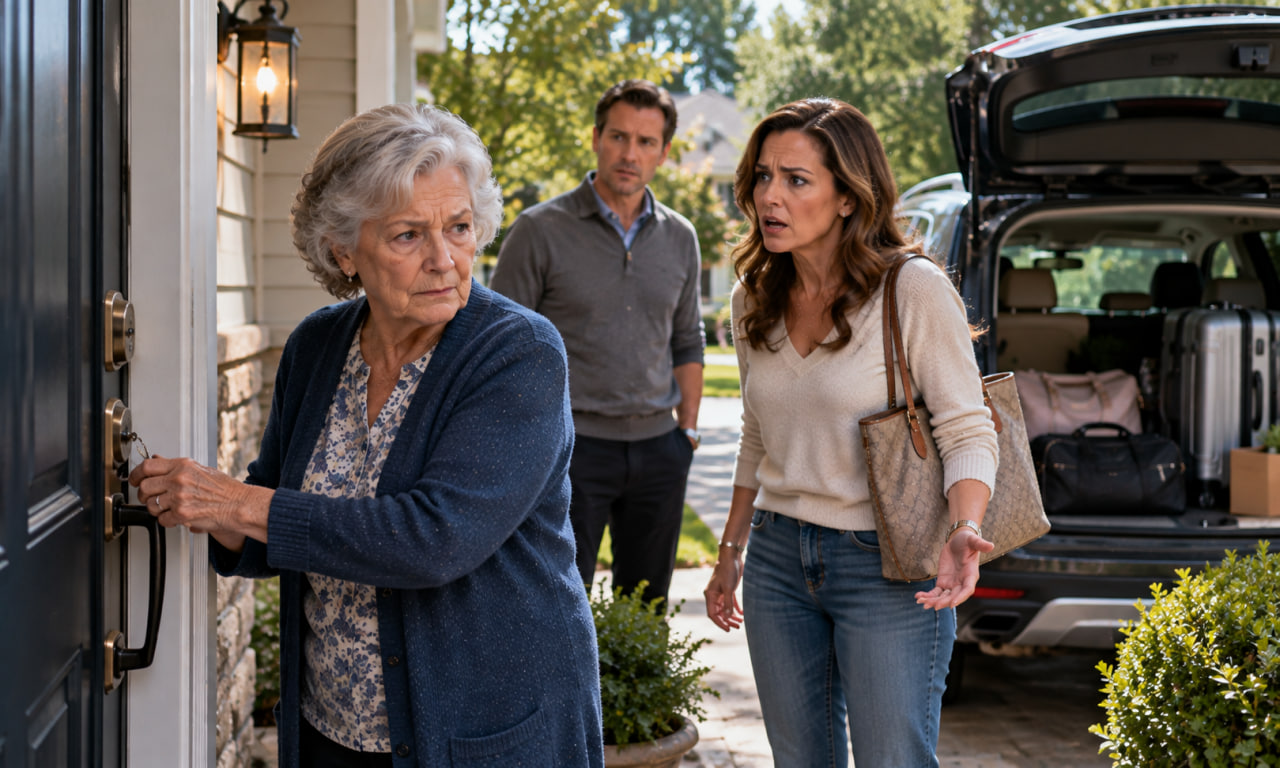
Every now and then, I still smile thinking about the pathetic sound of Chloe’s key grinding uselessly inside that fresh lock cylinder.
For four long years, she had trampled over one personal boundary after another so incrementally that we barely even noticed the invasion.
But on that specific morning, the final boundary became completely impossible to misinterpret.
The property was mine.
The ultimate decision was mine.
The key was mine.