“I believed him.”
“Because believing him gave you what you wanted.”
Her jaw tightened visibly.
“Yes.”
Her admission earned a measure of respect for honesty, not forgiveness. She pushed several printed conversations across the table, but I left them untouched at first.
“What are these?”
“Approvals.”
“For the expenses?”
“Yes.”
“Why keep them?”
Vivian held my gaze.
“Because I’m not stupid either.”
Of course I almost laughed. Callum thought he had chosen two controllable women, yet both had saved evidence. Vivian’s messages confirmed his approval of personal flights booked as development, her penthouse charged to executive housing, and a necklace disguised as a gift to a nonexistent hospitality partner.
One nonfinancial exchange struck deeper. Vivian wrote: Sloane looked upset tonight. Does she know? Callum answered: She suspects. Doesn’t matter. Everyone already thinks she’s unstable. If she makes noise, it proves the point. I reread those words as my vision blurred. Julian spoke; I raised a hand, needing a moment alone with the truth. Whether I cried, accused, raged, or stayed quiet, Callum could recast my reaction as instability, paranoia, volatility, or weakness. He controlled the story—until now. I set the page down. Vivian looked ill.
“I didn’t respond.”
“You didn’t object either.”
“No.”
“Why?”
She looked at me directly.
“Because at the time, I wanted him to choose me.”
Her honesty was unpleasant, yet genuine. The inquiry lasted twelve days; journalists called it the Ashford Crisis, a glamorous label for sleepless nights, strangers debating whether I knew of the affair, and wedding photographs illustrating financial reports. I lived at Everett’s townhouse. On the seventh night, I found him making tea.
“You’re doing it wrong,” I remarked. He appeared personally offended.
“I have made tea longer than you’ve been alive.”
“You’re boiling it to death.”
“It is water.”
“That’s not a defense.”
He gave me the kettle. For a little while we were simply a grandfather and his granddaughter, sharing a kitchen without discussing the board, the divorce, or the scandal. Then he mentioned, “He asked to see you.”
My hand went still.
“Callum?”
“Yes.”
“What did you say?”
“That it was not my decision.”
I leaned back against the counter.
“Do you think I should?”
“No.”
I glanced at him, and he smiled faintly.
“You asked what I think. Not what you should do.”
I couldn’t help laughing.
“Fine.”
I watched the surface of my tea before answering.
“I need to see him.”
Callum visited the following afternoon, thinner and stripped of his habitual authority. The board had suspended him pending its findings; Margaret no longer spoke to the press, Vivian had resigned, and Nathaniel remained company counsel but ceased representing Callum individually.
He sat opposite me in Everett’s library. Technically we remained married, although papers were signed and our lawyers were finishing matters. He surveyed the room.
“I remember this room.”
“We had dinner here before you proposed.”
“You wore blue.”
The fact that he recalled it stung.
“Yes.”
He rubbed his palms together.
“I did love you.”
I kept my eyes on him.
“I think you believe that.”
His expression grew strained.
“You don’t?”
“I think you loved the way I made you feel.”
“That’s unfair.”
“You liked that I wasn’t impressed by your name. Then after we married, you spent three years trying to make me impressed by it.”
He stared toward his lap.
“I screwed up.”
“That phrase is too small.”
“What do you want me to say?”
“The truth.”
“I cheated.”
“More.”
“I lied.”
“More.”
His jaw locked.
“I used company money.”
“More.”
He went quiet. I waited until he finally looked up.
“I made people doubt you.”
The admission made my eyes fill. Seeing my tears, Callum leaned forward almost instinctively.
“Sloane.”
I gave a broken laugh through the tears.
“Is this what you wanted?”
He stopped moving.
“At the gala.”
I brushed a tear from my cheek.
“You wanted me to cry.”
His expression crumpled.
“I was angry.”
“No. You were confident.”
“Sloane—”
“You knew exactly what you were doing.”
He looked away while I rose.
“I spent months wondering what I had done to make you hate me.”
“I don’t hate you.”
“That’s what made it worse.”
Callum lifted his eyes, and I shook my head.
“If you’d hated me, maybe I could understand it. But you didn’t. You just decided my dignity was less important than your convenience.”
He stood to face me.
“What happens to Ashford Luxe?”
Even at that moment he returned to the business, the Ashford name, the empire. I managed a sorrowful smile.
“The board decides what happens to the company.”
“And your grandfather?”
“He’ll enforce the rights he has.”
“You could stop him.”
“No.”
“You mean you won’t.”
“I mean I won’t interfere to protect you from consequences you created.”
His gaze hardened.
“So this is revenge.”
“No.”
I moved one step nearer.
“Revenge would be destroying Ashford Luxe because it carries your name.”
He seemed unable to believe what he’d heard.
“I don’t want it destroyed.”
The answer visibly startled him.
“Thousands of people work there. They didn’t cheat on me. They didn’t lie about me. They didn’t approve Vivian’s necklace.”
He recoiled.
“I want the company protected from you.”
He fell silent because the distinction had finally reached him. Ashford Luxe was a company employing thousands, not Callum himself. He understood losing authority over what he considered his identity.
“You planned all of this,” he said almost inaudibly.
“No.”
I faced the man I had once trusted with my heart.
“I planned to survive you.”
Callum departed without speaking further. Julian phoned later that evening.
“The board vote is tomorrow.”
I moved toward the library window.
“What are they recommending?”
“Callum’s removal as CEO.”
I shut my eyes for a moment.
“And the financing rights?”
“Whitmore’s position will increase substantially under the existing agreements.”
“What about the morality clause?”
“His divorce protections are materially affected. Your settlement position is significantly stronger.”
I remembered the apartment he’d presented as a generous concession, despite its having belonged to me all along.
“What does he keep?”
Julian hesitated.
“Sloane.”
“I’m asking.”
“He isn’t destitute. This is not a fairy tale. Rich men do not become poor because they behave badly.”
I managed a faint smile.
“I know.”
“But he is losing control.”
This was a loss of power, not sudden destitution or imprisonment or any implausible ruin. He would remain rich; what he would lose was the control he valued above everything. After thanking Julian, I ended the call. An unknown number flashed on my phone, and I decided to answer.
“Sloane?”
Margaret’s voice greeted me. Away from her grand social settings, she sounded almost unfamiliar. I let her speak.
“The vote is tomorrow.”
“I know.”
“You can stop this.”
“No.”
“You have influence with Everett.”
“So do you, apparently. You knew about his financing.”
A silence followed before she said, “I was protecting my family.”
I closed my eyes.
“So was I.”
“You are not an Ashford anymore.”
I studied the pale line where my wedding ring had rested.
“No.”
For once, acknowledging that I was no longer an Ashford did not wound me. Margaret’s tone grew sharp again.
“If Callum loses the company, what do you think all this was for?”
I understood her question only after remembering the wardrobe rules, obligatory dinners, corrections, planted gossip, and Vivian’s acceptance into the family circle. Protecting Callum’s image had justified every indignity. Now the company Margaret had sacrificed so much to preserve was slipping beyond her son’s control. I spoke quietly.
“That’s the question you should have asked him before the gala.”
I hung up.
PART 5: THE CLAUSE
The board dismissed Callum at 11:42 the next morning. I waited elsewhere in the building. At 11:46 Julian emerged and nodded. There was no applause, merely the quiet finality of consequences: an elevator opening, a lawyer exhaling, a news alert, and a marriage without a farewell.
The board established that corporate funds paid inadequately justified expenses, necessary approvals and disclosures had been breached, and Callum had created governance and reputational risks. The independent directors removed him; Whitmore-linked entities exercised long-standing contractual rights. Ashford Luxe survived. Employees retained their jobs; the hotels kept the Ashford name. Callum lost his control.
Our divorce remained private. Section 14’s consequences for documented adultery and reputational misconduct undermined his expected settlement protections; the financial records bolstered my position. I neither wanted nor took everything. I kept my property, rejected the fiction that he had gifted me my own apartment, and demanded a public correction of unfounded claims about my mental health. He fought that harder than some financial terms. Money could be replaced; surrendering the story cost him his cover. Eventually, he signed.
Three weeks later I returned to my East Seventy-Second Street apartment. Most of Callum’s belongings were gone, except one box of photographs: our wedding, Italy, Christmas with Everett, Callum asleep with his head in my lap, and me laughing off-camera. Sitting on the bedroom floor, I finally cried without witnesses.
Some memories were real, which hurt most. So were his coffee deliveries, our late-night talks, and the comfort he gave me after my mother’s memorial. Perhaps his love had been real too. But affection does not excuse deliberate cruelty. He had exploited vulnerabilities he knew intimately. One truth never canceled the other. In an old T-shirt, face swollen and nose running, I wept until nothing about it was graceful. Nobody watched.
Six months later, Ashford Luxe hired a permanent CEO from outside the family. Everett offered me a board seat over breakfast, and I refused. He looked surprised.
“No?”
“No.”
“You spent a year learning that company.”
“I spent a year learning my husband.”
“There is overlap.”
I let out a laugh.
“I’m serious.”
“So am I.”
I filled my coffee cup.
“I don’t want my next decision to be about Callum.”
Everett thought it over and gave a nod.
“Good.”
Eventually I took a more active role overseeing the Whitmore interests held for me, not out of hunger for an empire but because I now understood the danger of treating ownership as mere ornament. I examined agreements, challenged vague explanations, and never apologized for asking questions.
Vivian vanished from the society columns for a while, then reportedly resumed consulting elsewhere. Friendship was neither possible nor necessary. After her final meeting to assist the inquiry, I ran into her outside Julian’s office. She stopped to speak.
“I am sorry.”
I met her gaze and believed the apology was sincere, although sincerity could not undo the past.
“I know.”
Vivian left society pages for a time and reportedly rebuilt her consulting work elsewhere. We never developed a friendship; none was required. After her final meeting with investigators, she stopped me outside Julian’s office.
“You all right?”
I surveyed the familiar marble and hanging crystals. This time I was living a different life.
“Yes.”
And I meant it. Later, Nathaniel Pierce approached me. He still handled company business but had stopped representing Callum personally.
“Ms. Whitmore.”
I greeted him with a smile.
“You can call me Sloane.”
Embarrassment crossed his features.
“I owe you an apology.”
“For which part?”
His laugh came out in surprise.
“Fair.”
He glanced back toward the ballroom.
“I should have stopped what happened that night.”
“Could you?”
He took the question seriously.
“I could have refused to participate.”
I appreciated his honesty and nodded.
“Then yes. You should have.”
He accepted my words without offering excuses. Before leaving, he asked, “May I ask you something?”
“What?”
“When you asked me to confirm Section Fourteen… how certain were you that it would hold?”
I smiled quietly.
“Certain enough.”
“That’s not an answer.”
“It is the only one you’re getting.”
He laughed as he walked away. I had never been certain Section 14 would hold. Contracts could be disputed, boards could shield powerful men, and public opinion might turn. The clause, the evidence, and Everett’s investments were leverage, not magic. Their value depended on my willingness to act.
I once mistook strength for never crying. Now I recognized it in reading the invoices, challenging lies, refusing their judgment, facing Vivian’s truth, protecting company employees rather than punishing them, and finally allowing myself to grieve alone.
Near midnight, I walked onto the terrace above Manhattan. Everett stepped out behind me.
“Cold?”
“A little.”
He began taking off his coat.
“I don’t need it.”
“I wasn’t offering it. This is Italian.”
His joke drew a laugh from me and a smile from him. We watched the city before he asked, “Do you regret it?”
“Which part?”
“Any of it.”
I remembered Callum’s first kiss, our wedding, his betrayals, Vivian’s diamonds, Margaret’s pearls, the divorce papers, and Callum’s expression when Everett appeared. The woman I had been trusted the man she loved. She hadn’t been stupid or weak, and I refused to blame her.
“I regret what he chose to do,” I answered. Grandfather waited for the rest.
“But I don’t regret loving him before I knew.”
Everett dipped his head thoughtfully.
“That sounds expensive.”
“It was.”
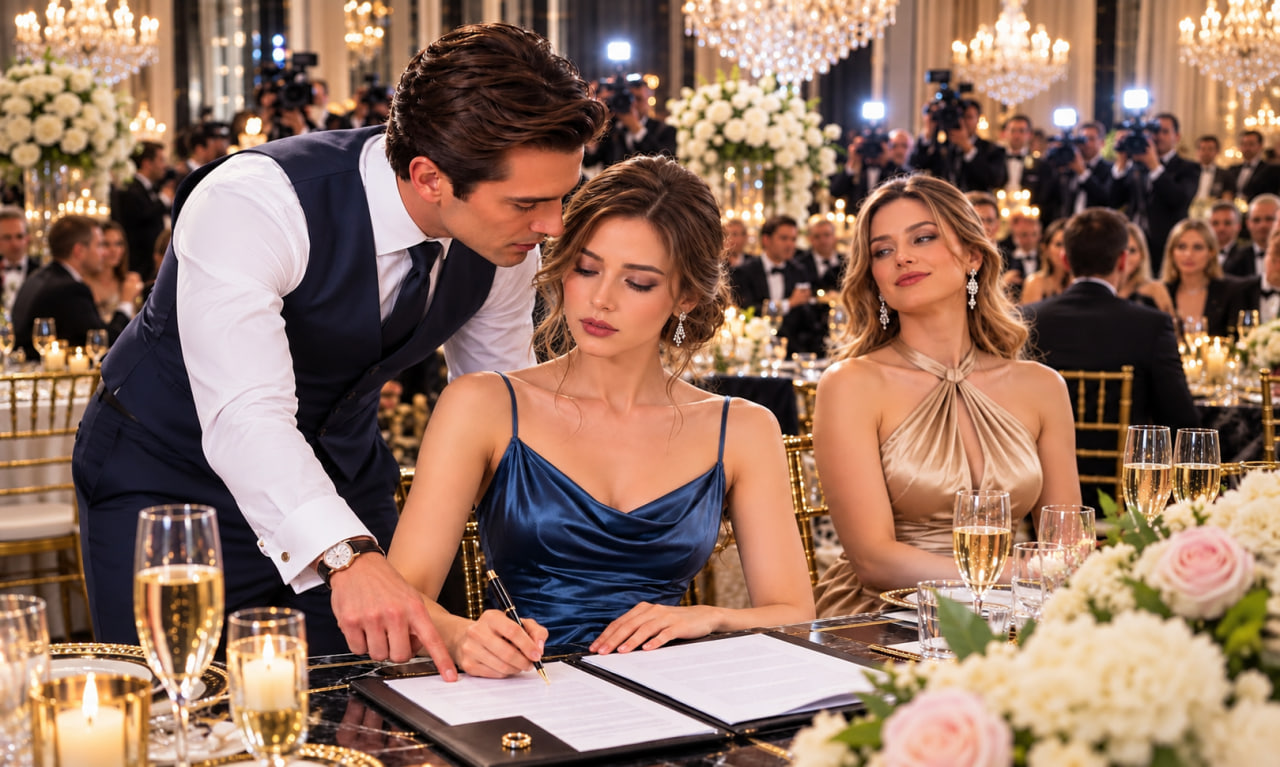
Everett laughed. Someone inside called guests to dessert. Looking through the doors, I remembered how Callum had controlled the gala’s guest list, attorneys, cameras, and timing, even preparing the image of a fragile, unstable, grateful wife he wanted others to see. He forgot I had been listening.
His mistake wasn’t simply his affair, Vivian, Grandfather, or Section 14. He believed quiet affection meant an absence of judgment. He mistook restraint for helplessness and gave me a stage when he placed those papers before me. Ashford Luxe survived; employees retained their livelihoods. What ended was Callum’s unquestioned control and the false story he constructed about me.
I had cried, though not for his audience, and suffered without surrendering my identity. Losing the marriage hadn’t meant losing myself. Everett touched my arm.
“Ready?”
I studied the skyline and caught my reflection in the glass. My ring was gone, along with Margaret’s approved wardrobe and a husband who corrected my smile. I stood there entirely myself.
“Yes,” I replied. We went back through the doors into the light. Callum had demanded tears as his last spectacle. Instead I had signed the papers, raised one question, and relied on a clause he should have examined before dismissing me as helpless. He got his final performance, but he never got the one he planned.