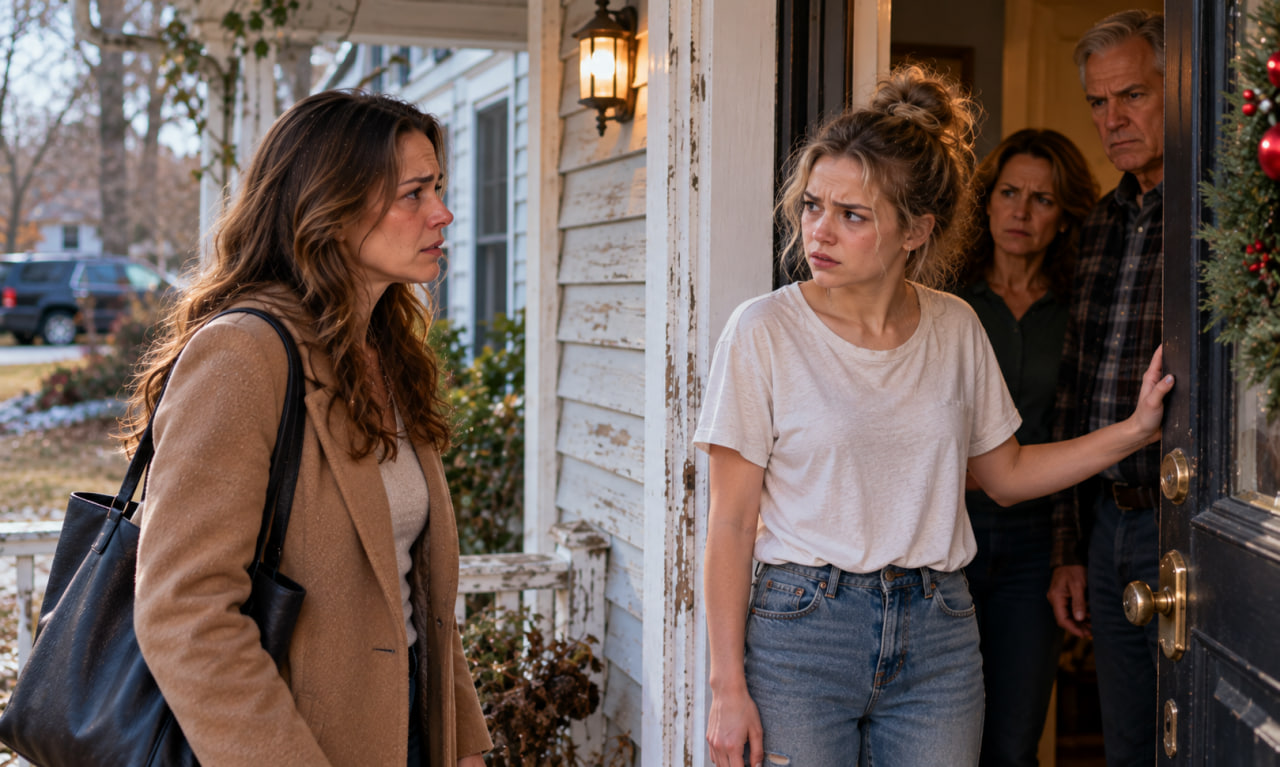
Instead, they had asked around three times.
Then they had stopped.
My father finally spoke.
“We heard you had moved away.”
“Yes.”
“We heard you were working.”
“Yes.”
“And we assumed you were doing all right.”
I stared at him.
“You assumed.”
He lowered his head.
I wanted to scream.
I wanted to tell him about the nights I had gone to sleep hungry, about the landlord who threatened to throw my belongings onto the street, about the time I nearly lost my job because I couldn’t afford a babysitter.
I wanted to tell him about the fever Lily had when she was three months old, when I sat beside her crib all night, terrified that if I closed my eyes, something terrible would happen.
But the words caught in my throat.
Because I suddenly understood that I could tell them every detail, every painful memory, every terrible thing that had happened to me, and none of it would change the fact that they had chosen not to be there.
I took a slow breath.
“Why did you adopt Emily?”
My mother looked toward the hallway.
“Because we were lonely.”
I felt the answer settle over me like cold rain.
Lonely.
They had been lonely.
So they had brought another child into their home.
My father spoke quietly.
“We thought we could do things differently the second time.”
I looked at him.
“And did you?”
He didn’t answer.
I glanced at the photograph on the wall.
Emily in her graduation gown.
Emily standing between my parents at what appeared to be a family celebration.
Emily smiling in a house where I had once believed I belonged.
“Did you ever tell her about me?”
My mother shook her head.
“No.”
“Why?”
“We didn’t know how.”
I let out a long breath.
“You didn’t know how to tell your daughter that you had another daughter?”
My father leaned forward.
“We wanted to protect her.”
“From what? The truth?”
He looked away.
And that was when I noticed something else.
On the coffee table, beneath a stack of old magazines, lay a thick manila envelope.
My name was written across the front.
Not my married name.
Not my business name.
My childhood name.
The name I had used before I left Alabama.
I stepped closer.
My mother’s eyes followed me.
“What’s that?”
She immediately reached for the envelope.
“Nothing.”
I stopped.
Twenty years ago, I might have accepted that answer.
I might have assumed she knew best, that questioning her would only make things worse.
But I was no longer the girl who had stood in the rain waiting for her parents to change their minds.
I held out my hand.
“Give it to me.”
My mother hesitated.
My father closed his eyes.
And Emily, who had quietly returned to the living room, whispered the words that made the room go completely silent.
“Mom, that’s the envelope you told me never to open.”
I turned toward her.
Emily looked frightened now.
She glanced at the envelope and then at me.
“You told me it was something private about the family. You said it had to stay hidden until I was old enough to understand.”
My mother stood abruptly.
“Emily, go to your room.”
“No.”
It was the first time the girl had spoken with any real force.
She looked at my mother with tears in her eyes.
“First, you tell me I have a sister I’ve never heard about. Now you’re telling me there’s a secret envelope with her name on it?”
She shook her head.
“I’m not a little kid anymore.”
My father rubbed his face with both hands.
“Margaret, I think it’s time.”
My mother stared at him.
“Thomas, don’t.”
He looked at me.
For the first time that afternoon, I saw something in his expression that wasn’t anger, pride, or shame.
Fear.
Real fear.
And suddenly, I knew the envelope wasn’t simply a collection of old photographs or letters.
It contained something they had spent twenty years trying to keep buried.
My father rose slowly from the sofa.
“There is something you need to know,” he said.
I picked up the envelope.
It felt heavier than paper should have felt.
I turned it over.
The seal had already been broken once, then carefully pressed shut again.
Inside, I could see the corner of a document with an official-looking stamp.
And beneath it, something handwritten.
My name appeared again.
Along with a date.
The date was six months after I had left home.
I looked at my father.
“What is this?”
He swallowed.
“Something we should have told you a long time ago.”
My fingers trembled as I opened the envelope.
The first document was a letter.
The handwriting belonged to my grandmother, Eleanor Carter.
My grandmother had died when I was fourteen. She had been the only person in our family who ever made me feel that being different wasn’t something I needed to apologize for.
She used to slip me cookies before dinner and wink whenever my mother complained that I talked too much.
When I was younger, she had promised to take me to Nashville when I turned eighteen.
She had never gotten the chance.
I unfolded the letter.
The first line read:
My dearest granddaughter,
I stopped breathing.
My grandmother had written to me after I was thrown out.
I began reading.
If you are reading this, then I fear the worst has happened. I have spoken to your father, and I know he intends to make you leave the house. I have begged him to reconsider, but he refuses to listen.
My vision blurred.
I read the next sentence.
You must understand that none of this is your fault. You are still the girl who used to sit beside me on the porch and tell me about her dreams. Nothing that has happened can take away your worth.
I pressed the letter against my chest.
For twenty years, I had believed that no one in my family had tried to help me.
But my grandmother had known.
She had tried.
And there was more.
I have made arrangements to ensure that you and your baby will have a chance at a safe future. Your parents do not agree with my decision, but I have made it nonetheless.
I looked up.
“What arrangements?”
My father stood by the fireplace, his face pale.
My mother was crying silently.
Emily had moved closer to me.
I looked down at the letter again.
The details are enclosed. Please do not allow anyone to convince you that you are undeserving of what I have left for you. I only wish I could be there to see you become the woman I know you will be.
The letter ended with a sentence that broke something open inside me.
You have always been loved, even when the people around you forget how to show it.
I covered my mouth.
My grandmother had died before I could return to her.
I had spent years believing I was alone.
But she had tried to leave me something.
Something my parents had hidden.
I looked at the remaining papers inside the envelope.
The second document was a letter from an attorney.
The third was a copy of a trust agreement.
And the fourth was a bank statement.
I scanned the pages, struggling to understand the legal language.
Then I saw the amount.
My hands went numb.
$487,000.
I read it again.
Then I looked at the date.
The money had been placed in a trust for me and my unborn child.
The trust had been established by my grandmother before her death, and the documents indicated that the funds were to be preserved for our benefit.
But a handwritten note in the margin caught my attention.
Beneficiaries not contacted. Distribution suspended pending confirmation of whereabouts.
I looked at my father.
“What happened to this money?”
He didn’t answer.
My mother began sobbing.
Emily stared at the papers.
“Mom?”
I turned to my father again.
“What happened to my grandmother’s money?”
He finally spoke.
“We didn’t steal anything.”
I looked at him in disbelief.
“I haven’t accused you of stealing yet.”
His mouth snapped shut.
I lifted the bank statement.
“Then explain this.”
He took a long breath.
“Your grandmother left instructions. We were supposed to help manage the trust until you were old enough to receive it.”
“I was eighteen eight years ago.”
“We couldn’t locate you.”
“You never tried.”
“We didn’t know where you were.”
“You had my name. You had my grandmother’s attorney. You had every reason to find me.”
He looked at the floor.
My mother wiped her cheeks.
“Your grandmother was very stubborn. She insisted that you should have money of your own, that no one should be able to control your future.”
I stared at her.
“She sounds like the only person in this family who understood me.”
My mother flinched.
I continued reading.
The trust agreement was more complicated than I had first realized. It included a provision requiring the appointed trustee to make reasonable efforts to locate me and notify me of my rights.
There were copies of letters addressed to my parents.
Several were marked as received.
One was dated eight months after I had left.
Another was dated when I turned eighteen.
A third was dated five years later.
All had my name written at the top.
All had been sent to my childhood home.
I held them up.
“You received these?”
My father stared at the letters.
“Yes.”
“And you never forwarded them?”
He said nothing.
I felt sick.
My grandmother hadn’t forgotten me.
Her attorney hadn’t forgotten me.
The money hadn’t simply disappeared into the past.
There had been opportunities to contact me.
Again and again.
And my parents had done nothing.
“Why?” I whispered.
My father finally sat down.
“Because we were afraid.”
“Of what?”
He looked at me, and his answer came so quietly I almost didn’t hear it.
“Of losing the money.”
The room went silent.
My mother covered her face.
Emily took a step backward.
I stared at the man who had raised me, the man whose approval I had spent half my life chasing, and felt something inside me break free.
“That money was meant for me and my baby.”
He nodded miserably.
“We know.”
“You let me struggle while you sat here with letters telling you I was entitled to help.”
“We thought—”
“You thought what?”
My voice rose.
“That if you ignored the letters long enough, I would disappear? That I would stay poor? That I would never come back to ask questions?”
My father stood.
“We made a terrible mistake.”
I shook my head.
“No. You made a decision. And then you made it again every time another letter arrived.”
I looked toward Emily.
She was crying now, her arms wrapped tightly around herself.
I softened my voice.
“None of this is your fault.”
She nodded, but she looked devastated.
I understood why.
She had spent her entire life believing she was part of an ordinary family. Now she was learning that her parents had hidden a daughter, concealed a substantial inheritance, and built a second chance for themselves on top of an old betrayal.
I gathered the documents carefully and placed them back in the envelope.
“I need copies of everything.”
My father nodded.
“I’ll give you whatever you need.”
“You’ll give me the originals too, so my attorney can review them.”
My mother looked up.
“Your attorney?”
“Yes.”
I held her gaze.
“I built a company. I employ hundreds of people. I have a legal team that handles contracts, property disputes, and complicated financial matters. I didn’t come here looking for money, but I’m not going to ignore what my grandmother left for me.”
My father looked as though he wanted to argue.
Then he seemed to remember that the little girl he once ordered out of his house had grown into a woman who no longer needed his permission.
He nodded.
“Of course.”
I slipped the envelope into my handbag.
Then I looked at the clock.
I had been inside the house for less than an hour.
Yet it felt as though I had walked through twenty years of pain in a single afternoon.
“I should go.”
My mother stood quickly.
“Please don’t.”
I turned toward her.
She took a step closer, her hands trembling.
“Please. We’ve lost so much time already.”
I looked at her for a long moment.
“You lost that time when you threw me out.”
She began to cry again.
“I know.”
“No, Mom. You don’t know.”
I opened the front door.
Behind me, Emily spoke.
“Will you come back?”
I stopped.
I turned to look at her.
She stood in the hallway with tears shining in her eyes. In another life, she might have been me at eighteen, trying to understand why the adults who were supposed to protect her had made such a terrible mess of things.
I didn’t blame her for any of it.
And despite everything, I didn’t want her to feel that she had to choose between the truth and the people who had raised her.
“I don’t know yet,” I answered honestly.
She nodded.
Then she asked the question that made me pause.
“Can I meet Lily someday?”
For the first time that afternoon, I smiled.
“That’s something I’ll have to ask her.”
Emily’s face brightened slightly.