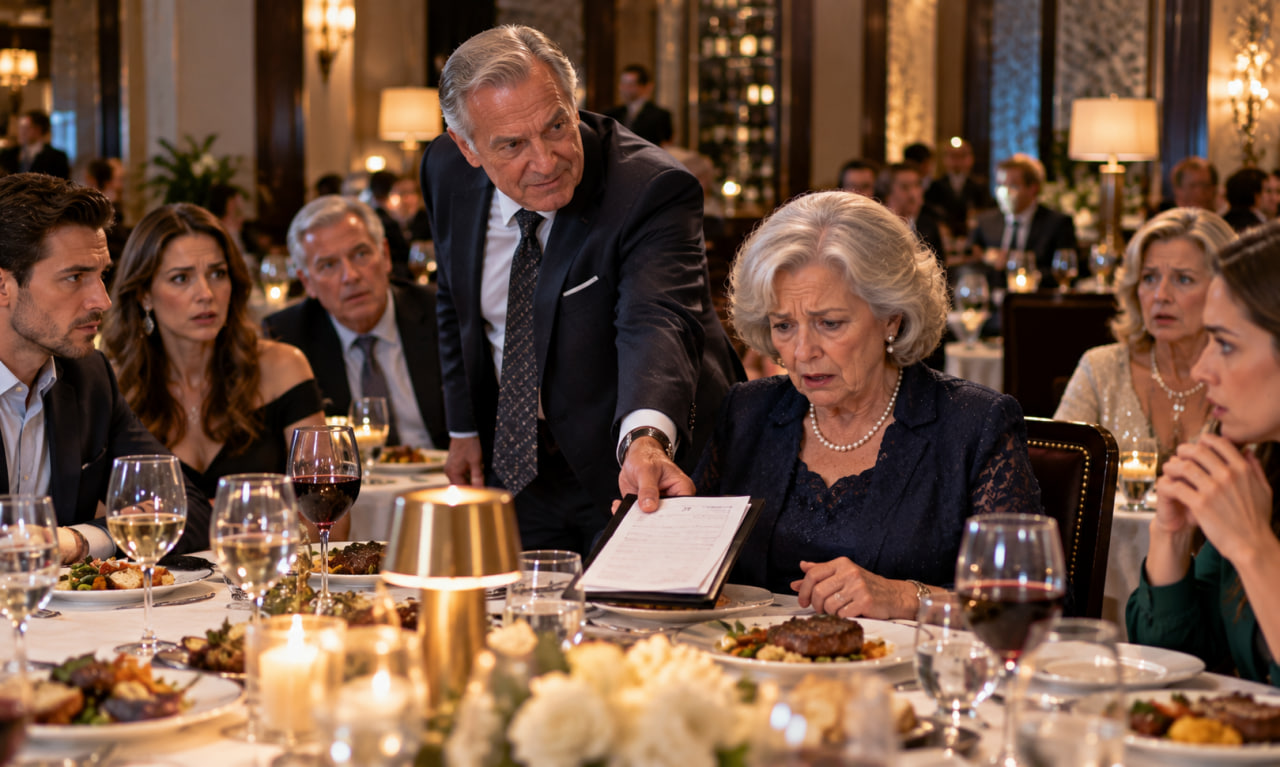
Walter rejected the idea twice.
Then he looked around and realized nobody was going to rescue him simply to protect his pride.
He finally nodded.
“Fine. Separate checks.”
The words came out like a punishment.
But the consequences were immediate.
The adults began sorting out their own meals. Robert covered his and his wife’s portion. Michael paid for his family’s food. Dennis paid for the wine he had requested.
Rachel and Susan divided their own families’ meals between them.
The total that remained on Walter’s portion was still substantial, but it was nowhere near the original $3,926.18.
When the server returned with Walter’s new total, he handed him the receipt.
Walter read it.
Then he looked at me.
“You could have prevented all of this.”
I took a slow breath.
“No, Walter. I could have paid for it. Those are two different things.”
He looked away.
And for the first time in forty-two years, I didn’t rush to soften my words.
Dinner ended in fragments.
Some guests left early, offering awkward birthday wishes as they collected their coats. Others lingered near the entrance, talking quietly while they waited for their rides.
The grandchildren had become restless and confused.
My oldest granddaughter, Lily, approached me while her mother was helping her little brother into his jacket.
“Grandma, are you and Grandpa mad at each other?”
I knelt to straighten her scarf.
“Sometimes grown-ups disagree, sweetheart.”
“Did you do something wrong?”
The question hurt more than I expected.
Children often assume that the person who refuses to give in must be the person who caused the trouble.
I looked at her carefully.
“No, sweetheart. I didn’t do anything wrong by saying no to something I didn’t agree to.”
She considered that for a moment.
Then she wrapped her arms around me.
“I love you.”
I held her a little longer than usual.
“I love you, too.”
When I stood up, I saw Walter watching us from across the room.
He looked irritated, but there was something else in his expression.
Uncertainty.
He had expected the evening to end with me apologizing. Perhaps he had imagined that once we were alone, he could explain that I had humiliated him and that I needed to make things right.
But as I gathered my coat, I realized I didn’t want to have that conversation tonight.
I wanted to go home.
I wanted to sleep.
And I wanted, for once, to decide what happened next without first asking Walter’s permission.
Outside, the October air was cold enough to sting my cheeks.
Rachel caught up with me beside the car.
“Mom?”
I turned.
She glanced toward the restaurant entrance, where Walter was still talking to Robert.
“Are you okay?”
I almost answered automatically.
Of course. I’m fine.
It was the response I had given for decades whenever someone asked whether I was tired, hurt, disappointed, or lonely.
Instead, I told the truth.
“I don’t know.”
Rachel’s face softened.
She took my hand.
“I’ve wanted to say something to you for years, but I never knew how.”
“What is it?”
She swallowed.
“Dad has always treated you like you need his permission to do anything. Even when I was little, I noticed it. I thought maybe that was just how marriages worked.”
I stared at her.
“You noticed?”
She nodded.
“I remember when you wanted to take that pottery class at the community center. You saved the money yourself, and Dad said it was a waste of time. You never went.”
I had forgotten about the pottery class.
Or perhaps I had simply pushed it so far into the back of my mind that I no longer allowed myself to remember.
Rachel continued.
“And when Grandma got sick, you were the one driving her to appointments, cooking her meals, and staying overnight. Dad told everyone he was supporting his mother, but you were the one doing most of the work.”
My throat tightened.
“He worked hard, Rachel.”
“I know he did. But so did you.”
She squeezed my hand.
“Mom, you don’t have to keep proving you’re a good wife by making yourself smaller.”
For several seconds, I couldn’t speak.
I had spent so long trying to convince myself that my contributions mattered that hearing my daughter say it felt like being seen for the first time.
I hugged her.
Then I got into my car.
Walter arrived a few minutes later, slammed the passenger door, and pulled his seat belt across his chest.
He didn’t speak until we were halfway home.
“You made me look like a fool.”
I kept my eyes on the road.
“You ordered nearly four thousand dollars of food and expected me to pay without asking.”
“I thought we were a family.”
“We are.”
“Then why couldn’t you help me?”
I turned onto our street.
“Because being a family doesn’t mean one person gets to make every decision and another person has to pay for them.”
Walter laughed bitterly.
“Forty-two years, Elaine. Forty-two years, and now you’re acting like a stranger.”
I parked in the driveway.
Then I turned off the engine.
For a moment, the only sound was the ticking of the cooling engine and the wind moving through the trees.
I looked at him.
“Perhaps you’ve never really known me, Walter.”
He stared at me.
I opened my door and stepped out.
Behind me, he muttered something I couldn’t hear.
For once, I didn’t ask him to repeat it.
I barely slept that night.
Walter went to bed without speaking to me. I heard him moving around in the bathroom, opening drawers more loudly than necessary, and turning the television on in the bedroom.
It was his way of making sure I knew he was angry.
I lay awake beside him, staring into the darkness.
At 2:13 a.m., I got up.
I went downstairs, made a cup of tea, and sat at the kitchen table.
The house was quiet.
For the first time in years, I allowed myself to examine my life without immediately defending Walter.
I thought about the holidays when I had cooked for everyone while he sat in the living room with his brother.
I thought about the years I spent helping his mother, bathing her when she could no longer manage alone, changing her sheets, and comforting her when she woke frightened in the middle of the night.
I remembered the evenings I worked at the medical supply company and came home to make dinner because Walter believed a meal prepared by one’s wife was part of what made a house a home.
I remembered the time I asked him whether we could take a weekend trip for our anniversary.
He told me we couldn’t afford it.
The following month, he spent nearly three thousand dollars on a new golf club membership.
I remembered the sofa.
The pottery class.
The books I stopped buying because he asked why I needed more when the library was free.
The clothes I wore until the fabric thinned.
The vacations I postponed.
The opportunities I quietly abandoned because Walter had a reason each one wasn’t practical.
None of those memories, individually, seemed large enough to explain the feeling in my chest.
Together, they formed a pattern I could no longer ignore.
Walter hadn’t simply been careful with money.
He had been careful with my independence.
And I had mistaken his control for responsibility because that was easier than admitting how lonely it had made me.
At 3:05 a.m., I went upstairs and opened the small desk drawer where I kept my personal paperwork.
My retirement letter was there.
So was the statement showing the money deposited into my individual account.
I took both documents downstairs.
I studied the balance.
A little over twenty-one thousand dollars.
It wasn’t a fortune.
It wouldn’t buy a house or allow me to retire in luxury.
But it was enough for a plane ticket to Oregon, a few weeks with Marianne, and the beginning of a life in which I could make some decisions for myself.
I picked up my phone.
For a moment, I hesitated.
Then I opened Marianne’s contact and typed a message.
Are you awake? I think I’m finally ready to come visit you.
I watched the screen.
The message showed as delivered almost immediately.
A minute later, the phone rang.
I answered quietly.
“Hello?”
“Elaine?”
My sister’s voice was thick with sleep, but the moment she heard mine, she became alert.
“What happened?”
I pressed my fingers against my forehead.
“Nothing terrible. I just need to talk to someone.”
“Then talk.”
I told her about the dinner.
I told her about the bill, Walter’s words, the declined cards, and the way I had felt when I pushed the folder back across the table.
Marianne listened without interrupting.
When I finished, she was silent for a moment.
Then she asked a question I hadn’t expected.
“Elaine, do you remember what you told me when we were seventeen?”
I smiled faintly.
“We were seventeen for about five minutes before you started telling me what to do.”
She laughed softly.
“You told me that when we got older, you wanted a little house with a garden. You said you wanted roses by the front steps, a kitchen window that looked out onto the yard, and a room where you could read without anyone telling you that you were wasting time.”
I closed my eyes.
I remembered.
We had been sitting on the back porch of our childhood home, talking about the lives we imagined for ourselves.
Marianne had wanted to travel.
I had wanted a garden and a quiet room.
Neither of us had known how complicated adulthood could become.
“I remember,” I whispered.
“Do you still want that?”
I looked around my kitchen.
The clock on the wall had stopped five minutes fast, just as Walter liked it. The calendar on the refrigerator was filled with appointments and family events. A list of household repairs was held to the door by a magnet.
Every inch of the room carried the evidence of a life spent making sure everyone else had what they needed.
“Yes,” I said.
The word came out so softly that I almost didn’t recognize it.
Marianne exhaled.
“Then come here. Stay as long as you want. We’ll go to the coast, we’ll buy ridiculous amounts of flowers, and we’ll sit in the garden until we get cold.”
I laughed, and to my embarrassment, tears began rolling down my face.
“I don’t know if I can.”
“You can visit your sister, Elaine. You don’t need permission to see me.”
I pressed my hand over my mouth.
For a long time, neither of us spoke.
Then Marianne said, “I’m going to ask you something, and I want you to think carefully before you answer.”