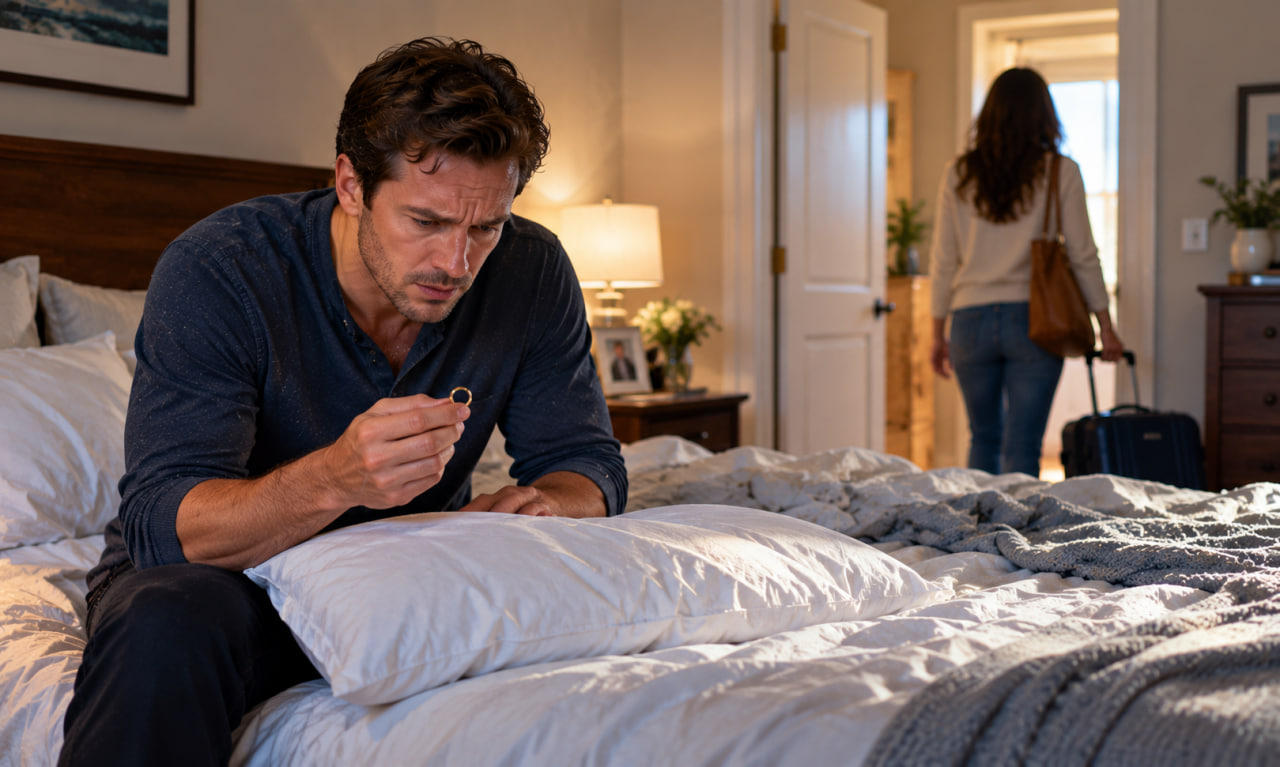
I stared at the envelope on top.
My name was written in Vivian’s familiar handwriting.
I took it with me when I left that afternoon.
But I didn’t open it until I reached home.
My house felt different that evening.
The porch swing creaked in the wind.
The rosebush beside the garage was still alive, just as Vivian had once asked.
Inside, the kitchen smelled faintly of the coffee grounds I had left in the machine that morning.
For years, I had tried to make the house feel less empty.
I had bought a new television. I had repainted the living room. I had replaced the old curtains Vivian had complained about for a decade.
None of it had helped.
Now, standing in the same kitchen where she had once asked me for a divorce, I realized that the emptiness had never been about the furniture.
It had been about the person who was missing.
I sat at the dining table and opened the envelope.
Dear Lucas,
If you’re reading this, Melanie has probably decided that I can no longer keep everything to myself.
I’m sorry. I know those words have become meaningless between us, but I don’t know where else to begin.
The day I learned about the cancer, I sat in my car outside the hospital for almost an hour. I watched people come and go. A woman carried a sleeping baby. An old man struggled to fold his umbrella. A young couple argued over where they had parked.
Everyone was living an ordinary day.
I remember thinking that I would give anything to have an ordinary day with you again.
I wanted to come home. I wanted to tell you everything. I wanted to let you hold me while I cried.
But then I pictured your face when I told you.
I knew you would try to save me.
You would find the best doctors. You would read every article. You would spend your nights searching for answers and your mornings telling me not to worry.
You would turn your entire life into a promise that I would survive.
And I was terrified that one day, when I couldn’t survive, you would believe you had failed.
I stopped reading.
My eyes were burning.
I walked to the sink, splashed water on my face, and returned to the table.
The letter continued.
I told myself that leaving you was an act of love.
I told myself that if I gave you enough time, you would meet someone who could grow old beside you without asking you to spend your final years in hospitals.
But there was another truth I was too ashamed to admit.
I was afraid.
I was afraid of becoming dependent on you. I was afraid you would see me sick and remember me that way. I was afraid that every beautiful memory we had made would eventually be replaced by the sound of hospital machines.
Most of all, I was afraid that I would need you so much that I would forget how to be myself.
I know now that I was wrong about what love required.
I thought love meant protecting you from my pain.
I didn’t understand that love also meant trusting you enough to let you choose whether you wanted to share it.
I lowered the letter.
For three years, I had believed Vivian left because she no longer wanted me.
But the truth was more complicated.
She had loved me so much that she had convinced herself she needed to disappear.
And in trying to protect me from losing her, she had made me lose her while she was still alive.
I continued reading.
There is one more thing I need you to know.
I have never stopped wearing my wedding ring in my heart.
The night I came to your house, I wanted to ask you to let me stay.
I wanted to wake up beside you again.
I wanted to make coffee in our terrible machine and complain that you had forgotten to buy milk.
I wanted to spend the rest of my life with you, however long that life might be.
But when I woke up, I remembered the promise I had made to myself: that I would not pull you back into a life you had already been forced to leave.
So I took off my ring.
I placed it on your pillow because I thought it was the only way I could leave you something honest.
I see now that it was another dishonest thing I did in the name of love.
I am sorry.
If I recover, I hope I can find a way to become brave enough to tell you everything.
If I don’t, I hope you will remember that the years we shared were the happiest years of my life.
You were never the burden I needed to escape.
You were the home I was too frightened to return to.
Love always,
Vivian.
I folded the letter carefully.
Then I sat at the table and cried.
Not because I had discovered that Vivian loved me.
I had always suspected that some part of her did.
I cried because I finally understood how fear had taken three years from us.
And because I knew we could never get those years back.
But we still had today.
For the first time in a long time, I knew what I wanted to do with it.
The following morning, I opened the woodworking shop at my usual time.
For twenty-eight years, the shop had been my refuge.
I had built dining tables, cabinets, rocking chairs, and custom bookshelves for families who wanted something that would last.
I liked wood because it taught patience.
You couldn’t force a crooked board to become straight simply by wishing it were different. You had to understand the grain, work with what was there, and accept that some marks would remain no matter how carefully you sanded.
I had spent years trying to repair furniture.
Now I wondered whether I had been equally determined to repair everything except my marriage.
My longtime employee, Tom, arrived at eight.
He took one look at me and put down his toolbox.
“You look terrible.”
“Good morning to you too.”
“Did you sleep?”
“Not much.”
He studied me.
“Is everything okay?”
I hesitated.
Then I told him the truth.
“Vivian’s sick.”
Tom’s expression softened.
“How sick?”
“Very.”
He didn’t ask me to explain.
He had known Vivian for almost as long as he had known me. He had attended our wedding and helped me build the kitchen cabinets in our first house.
After a moment, he said, “What do you need?”
I looked around the shop.
For years, I had believed that keeping the business running was one of the things that made me a responsible man.
But the machines could run without me.
Orders could be delayed.
Wood could wait.
“I’m going to need you to manage things for a while,” I said. “I’ll still handle the important decisions, but I may not be here every day.”
Tom nodded.
“Then that’s what we’ll do.”
Just like that, a burden I had spent years imagining became something simple.
I called Vivian after lunch.
She answered on the second ring.
“Lucas?”
“Have you eaten?”
There was a pause.
“Hello to you too.”
“Hello. Have you eaten?”
“Melanie made soup.”
“Did you eat it?”
“Some of it.”
“That’s not an answer.”
She laughed softly.
“You sound exactly like you did when I was pregnant with Emma’s godmother’s baby shower cake.”
“That was a completely different situation.”
“You insisted I needed three meals and two snacks.”
“You were trying to live on crackers.”
“They were very good crackers.”
I smiled.
For several minutes, we talked about ordinary things.
The weather.
The rosebush.
The ridiculous price of groceries.
Then I asked, “Would you like me to come over tonight?”
She became quiet.
“Are you sure?”
“No, Vivian. I’m not sure about anything anymore. But I know I want to see you.”
Her breath caught.
“Then yes.”
I went to Melanie’s house that evening with groceries, a small toolbox, and a bag of coffee beans from the shop near my house.
Vivian looked at the coffee.
“You brought your own?”
“I know how particular you are.”
She smiled.
“I thought you were the one who liked it strong enough to stand a spoon in.”
“I learned from the best.”
We sat at the kitchen table while Melanie went upstairs to make a phone call.
For a while, neither of us mentioned the future.
We talked about Emma’s wedding.
We talked about our old neighbors.
We argued about whether the blue paint in our first house had been a mistake.
Then Vivian reached across the table.
“Thank you for coming back.”
I took her hand.
“I didn’t come back, Vivian. I never really knew how to leave.”
Her eyes filled with tears.
And this time, she didn’t try to hide them.
The weeks that followed were not easy.
There were appointments, blood tests, scans, and long conversations with doctors. There were days when Vivian felt strong enough to walk around the garden and days when getting out of bed required more energy than she had.
Some mornings, she was optimistic.
On others, she was frightened and angry.
I learned that loving someone through illness did not mean knowing what to say.
Sometimes, it meant sitting quietly beside her while she cried.
Sometimes, it meant arguing with her when she refused to eat.
Sometimes, it meant leaving the room for five minutes because we were both exhausted and neither of us wanted to admit it.
We also had difficult conversations about our marriage.
One afternoon, while we sat in the garden, Vivian said, “I don’t expect you to forgive me.”
I looked at her.
“Why not?”
“Because I hurt you.”
“Yes, you did.”
She nodded.
“I know.”
“I don’t think forgiveness works the way you imagine it does,” I continued. “You don’t apologize once and then everything becomes fine.”
She looked down at her hands.
“I understand.”
“But I also don’t want to spend whatever time we have left punishing you for something we can no longer change.”
She lifted her eyes.
“So what happens now?”
I thought about the question.
“We tell the truth. We stop making decisions for each other. And when we’re afraid, we say we’re afraid instead of pretending we’re fine.”
She let out a shaky breath.
“That sounds difficult.”
“It will be.”
She smiled sadly.
“You always did prefer difficult projects.”
I laughed.
Then I reached for her hand.
“There is one thing I need you to promise me.”
“Anything.”
“Don’t tell me to leave because you think it will hurt less.”
She looked at me for a long time.
Finally, she nodded.
“I promise.”
I believed her.
Not because I was certain she would never become afraid again, but because this time we were making the promise together.
Three months after the hospital called, Vivian began another course of treatment.
The doctors had explained the possibilities carefully. They could not promise a cure, but they believed the treatment might control the disease and improve her quality of life.
Vivian decided to proceed.
I accompanied her to the hospital whenever she wanted me there.
On the days she preferred to go with Melanie, I respected that too.
We were learning how to love each other without turning love into control.
One afternoon, after a particularly exhausting appointment, Vivian sat in the passenger seat of my truck and stared out the window.
“I have a question.”
“Go ahead.”
“If I get better, what happens to us?”
I glanced at her.
“What do you mean?”
She twisted the strap of her bag between her fingers.
“I mean, we were divorced. We can’t pretend that everything is the same just because we still love each other.”
I nodded slowly.
“You’re right.”
She looked disappointed, though she tried to hide it.
I reached for her hand.
“I don’t want to go back to the marriage we had before. I want to build something better.”
“What if we make the same mistakes?”
“Then we talk about them before they become three years of silence.”
She laughed faintly.
“And if we discover we’re too different now?”
“Then we face that honestly too.”
She studied my face.
“You would really be willing to start over?”
“Vivian, I built a dining table for a customer last year who changed his mind about the finish four times. I can handle starting over.”
She burst out laughing.
It was the kind of laugh I hadn’t heard in years, full and unguarded, and it made me smile even as my eyes filled with tears.
Then she grew serious.
“I don’t want you to choose me because you’re afraid I’ll die alone.”
I turned toward her.
“I’m choosing to be here because I love you. Your illness didn’t create that love. It just forced us to stop pretending we didn’t have it.”
She held my hand against her cheek.
“Then I want to try again.”
I kissed her forehead.
“So do I.”
We didn’t rush into remarrying.
We didn’t need a ceremony to prove what we were trying to rebuild.
Instead, we began dating again.
At first, it felt ridiculous.
We had shared a bed for twenty-two years, and now I was picking Vivian up for dinner and asking what time she wanted me to arrive.
She insisted that I knock on Melanie’s front door instead of walking in with groceries.
I brought her flowers.
She made fun of me for choosing the same roses every time.
I took her to the little Italian restaurant where we had celebrated our fifth anniversary. The owner recognized us and asked whether we were celebrating another milestone.
Vivian looked at me.
“What should we tell him?”
I smiled.
“That we’re trying to get our first date right.”
The owner laughed and brought us a complimentary dessert.
For the first time in years, Vivian ate an entire meal without looking at the clock or apologizing for needing to rest.
It was a small evening.
But it became one of my favorite memories.
Around the fourth month, Vivian’s test results showed encouraging signs.
The treatment was helping.
Her doctors were careful not to promise too much, but the latest scans suggested the disease had responded.
When the oncologist explained the results, Vivian covered her face with both hands.
I reached for her.
“Is it good news?” I asked.
The doctor smiled.
“It’s encouraging news. We’ll need to continue monitoring her closely, but we’re pleased with what we’re seeing.”
Vivian began to cry.
So did I.
In the parking garage afterward, she sat in the passenger seat with the results folded in her lap.
“Lucas?”
“Yes?”
“I thought I would feel different.”
“Different how?”
“I thought if I got good news, all the fear would disappear.”
I nodded.
“I think fear is stubborn.”
She smiled faintly.
“Like you.”
“I’m much more handsome than fear.”
She laughed.
Then she reached for my hand.
“I want to go home.”
The word caught me by surprise.
“Your house or mine?”
She looked at me.
“Ours.”
I didn’t answer immediately.
I couldn’t.
I started the engine, then switched it off again.
Vivian turned toward me.
“What is it?”
I looked at her.
“For three years, I thought I was the only person who still considered that place home.”
Her eyes filled.
“I never stopped.”
We sat there holding hands until the parking garage began to empty.
That evening, I drove her to my house.
She walked slowly through the front door and stopped in the kitchen.
The same cabinets.
The same dining table.
The same ugly coffee maker.
She ran her fingers over the counter.
“You really haven’t changed anything.”
“I changed the curtains.”
She looked toward the living room.
“Oh, those curtains.”
“You hated them.”
“I still do.”
I laughed.
Then she turned toward me, and her expression became serious.
“Can I stay tonight?”
I looked at the woman I had once watched disappear before sunrise.
“Yes.”
She took a breath.
“But this time, I won’t leave without talking to you.”
I held out my hand.
“Then this time, we’ll make coffee in the morning.”
She placed her hand in mine.
And for the first time in three years, Vivian slept in our house without leaving a ring behind.
The next morning, I woke to the sound of a cupboard closing.
For one disorienting second, I thought I was dreaming.
Then I smelled coffee.
I walked into the kitchen.
Vivian stood beside the counter wearing one of my old sweatshirts, her hair untidy and her face still sleepy.
She looked over her shoulder.
“You bought the wrong coffee.”
I stopped in the doorway.
“What?”
“This isn’t the one we usually buy.”
“We haven’t bought coffee together in three years.”
“Exactly. You should have remembered.”
I stared at her.
Then I started laughing.
Not because it was funny.
Because it was ordinary.
Because she was there.
Because for the first time in years, I was standing in my kitchen with the woman I loved, arguing about coffee as though the world had briefly forgotten to be cruel.
She turned toward me.
“What?”
I crossed the room and wrapped my arms around her.
She rested her head against my chest.
“I missed this,” I whispered.
“Me too.”
We stayed like that for a long time.
Then the coffee machine made a terrible grinding noise.
Vivian pulled away.
“Honestly, Lucas. That thing sounds like it’s dying.”
“It’s been making that noise for fifteen years.”
“Then perhaps it’s time to let it go.”
I looked at her.
She looked at me.
And suddenly we were laughing so hard that I had to sit down.
It was the happiest morning I could remember.
Not because everything was fixed.
But because nothing had to be perfect for us to be happy.
Six months after Vivian came home, we sat together on the porch swing.
The rosebush beside the garage had bloomed.
It was late afternoon, and the sunlight had turned the garden gold.
Vivian leaned against my shoulder.
“Do you remember the first time we sat here?”
“Of course.”
“You had just bought the house.”
“And you told me the porch was too small.”
“It was too small.”
“You also said the kitchen needed renovating.”
“It did.”
“You said the garden was a disaster.”
“It was.”
I smiled.
“You were very difficult to please.”
She tilted her head toward me.
“And yet you married me.”
“Terrible judgment.”
She laughed, then grew quiet.
“Lucas?”
“Hmm?”
“There’s something I’ve been wanting to ask you.”
I turned toward her.
“Ask.”
She took a deep breath.
“Would you marry me again?”
I didn’t answer immediately.
She hurried on.
“I know it sounds foolish. We’ve already been married. We don’t need a wedding, and I don’t want you to feel obligated. I just keep thinking about the way we ended things. I don’t want the last official decision we made about our marriage to be the divorce.”
Her eyes glistened.
“I want us to choose each other again. Not because we’re afraid of losing time. Not because I’m sick. Just because we want to.”
I looked at her for a long moment.