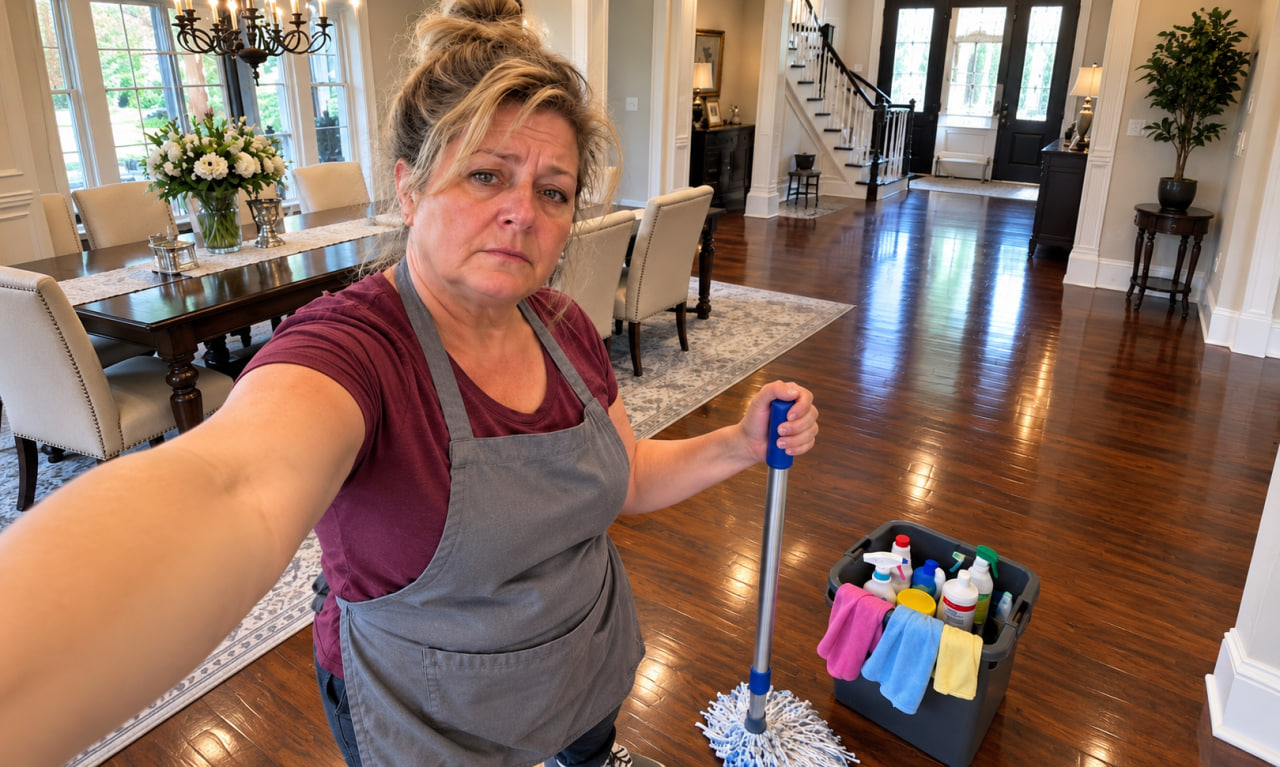
I didn’t know what to say.
Mrs. Whitaker reached for the envelope.
She removed another document.
This one was different.
It was a letter.
The paper was old.
Yellowed slightly at the edges.
There was handwriting on it.
Not Mrs. Whitaker’s.
I recognized the name at the bottom before I even finished reading.
Thomas Whitaker.
Her husband.
My eyes moved across the page.
The letter was dated twelve years earlier.
Before I had ever met her.
Before I had ever cleaned her house.
Before Willa was even a teenager.
I looked up.
“Why are you showing me this?”
Mrs. Whitaker’s eyes filled with tears.
“Because Thomas knew you.”
I laughed nervously.
“No. He didn’t.”
“He did.”
“How?”
She looked down at the letter.
“Because the reason I hired you wasn’t an accident.”
The room suddenly felt colder.
“What are you talking about?”
She folded her hands.
“My husband died six months before you answered my advertisement.”
I waited.
“He left instructions.”
My pulse quickened.
“Instructions about what?”
“About you.”
I stared at her.
“That’s impossible.”
“I thought so too.”
She opened the letter.
“Until I found this.”
I watched her eyes move over the page.
Then she read aloud.
“‘If the young woman named Carly Bennett ever comes through your door, don’t turn her away. You’ll know her because she’ll insist she doesn’t need help.’”
My mouth went dry.
I took a step backward.
“Who was he?”
Mrs. Whitaker looked at me.
“My husband?”
“Yes.”
She nodded.
“He was a social worker.”
I shook my head.
“That doesn’t explain how he knew my name.”
“No.”
She turned the letter over.
“That’s the part I’ve been afraid to tell you.”
On the back was an address.
My old address.
The tiny apartment where Willa and I had lived when she was nine.
I stared at it.
I couldn’t breathe.
“I never gave that address to anyone.”
Mrs. Whitaker nodded.
“I know.”
“Then how did your husband know?”
She hesitated.
Then she said:
“Because he was the person who helped you get Willa into that school.”
My mind went blank.
I remembered the school.
I remembered the paperwork.
I remembered someone helping me when I couldn’t afford the enrollment fees.
But I’d always believed it had been a community program.
A nameless charity.
A form I’d signed.
A check that had appeared at exactly the right moment.
I had never known who paid it.
I sat down.
Mrs. Whitaker opened another folder.
Inside was a photograph.
It showed a younger Thomas Whitaker standing beside a woman and a little girl.
The little girl was me.
I stared at the picture.
My entire body went cold.
“I don’t remember this.”
“You wouldn’t.”
“Where was it taken?”
“Outside the community center.”
I looked closer.
And then I remembered.
Not the photograph.
The day.
I had been crying because I thought Willa would have to leave her school.
A man had crouched beside me and said, “Sometimes people help because they remember what it felt like when nobody helped them.”