I pressed play.
Florence’s voice filled the room.
It was weak.
She must have recorded it during the final months of her illness.
“Daniel.”
I stopped breathing.
“If you’re listening to this, then I’m gone.”
There was a long pause.
“I wish I could have told you everything while I was alive.”
Her voice trembled.
“But I was afraid that if I did, you would change your behavior only because you knew I was watching.”
I closed my eyes.
“So I watched.”
A soft laugh came through the speaker.
“I watched you when you thought I wasn’t paying attention.”
She described things I had forgotten.
The night I stayed awake beside her when she was sick.
The morning I repaired the broken kitchen cabinet.
The time I secretly paid one of her medical bills.
The afternoon I sat with her for four hours while she talked about Douglas.
I had forgotten those things.
She hadn’t.
“But I also watched you count the paintings,” she continued.
“I watched you ask Paul how much the house might be worth.”
My face burned.
“I watched you search through my desk when you thought I was asleep.”
I covered my face.
“I watched you become frightened when I talked about changing my will.”
My eyes filled with tears.
“But Daniel…”
Her voice became softer.
“You were never completely the man you thought you were.”
I looked up.
“You were greedy.”
A pause.
“You were dishonest.”
Another pause.
“And sometimes, you were ashamed.”
I couldn’t breathe.
“But you were also kind.”
The recording crackled.
“And I believe people should be judged by what they choose when nobody is forcing them to choose.”
I wiped my eyes.
Florence continued.
“So I made you a bargain without telling you.”
My heart began pounding.
“I left you the house.”
I stared at the recorder.
“What?”
“But not because you married me.”
I looked around the basement.
“The house is yours only if you agree to one condition.”
My hands trembled.
“You must sell it.”
I stared at the walls.
“All of it.”
The house.
The furniture.
The paintings.
Everything.
Then Florence said the words I would remember for the rest of my life.
“And you must give the money away.”
I almost laughed.
After everything.
After all those years.
After believing I had finally secured the future I wanted.
She had left me a fortune with a condition that meant I couldn’t keep it.
But then she continued.
“Not all of it.”
I stopped.
“You may keep enough to pay your father’s medical bills.”
I froze.
“You may keep enough to make sure your mother never has to worry about money again.”
My eyes filled with tears.
“And you may keep enough to start over.”
There was a long silence.
“But you must never again build your life around money that belongs to someone else.”
The recording ended.
I sat in that basement for a long time.
Eventually, I found one final envelope.
Inside was the deed to the house.
And beneath it was a handwritten note.
Daniel,
If you’ve made it this far, then you finally know the truth.
I didn’t marry you because I needed a husband.
I married you because I wanted to give you one last chance to decide who you were.
You thought you were trapping a lonely old woman.
The truth is, I was giving you the opportunity to trap yourself.
You walked straight into my trap.
But it was never designed to punish you.
It was designed to show you yourself.
I cried harder than I had cried at her funeral.
Because suddenly I understood something terrible.
Florence had loved me.
Not blindly.
Not foolishly.
She had seen the worst parts of me and still believed there might be something better underneath them.
And that was harder to live with than hatred would have been.
Three months later, I sold the house.
Every piece of furniture.
Every painting.
Every investment Florence had left under the terms of her will.
I kept only what she had allowed me to keep.
I paid for my father’s care.
I paid off my mother’s debts.
And I established a small foundation in Florence’s name to help elderly people who lived alone.
I never remarried.
Not because I couldn’t.
Because I didn’t want to spend the rest of my life trying to replace something I hadn’t understood until it was gone.
Years later, I still visit the grocery store where I first met Florence.
Sometimes I stand outside and remember that afternoon.
The heavy bags.
Her wheelchair.
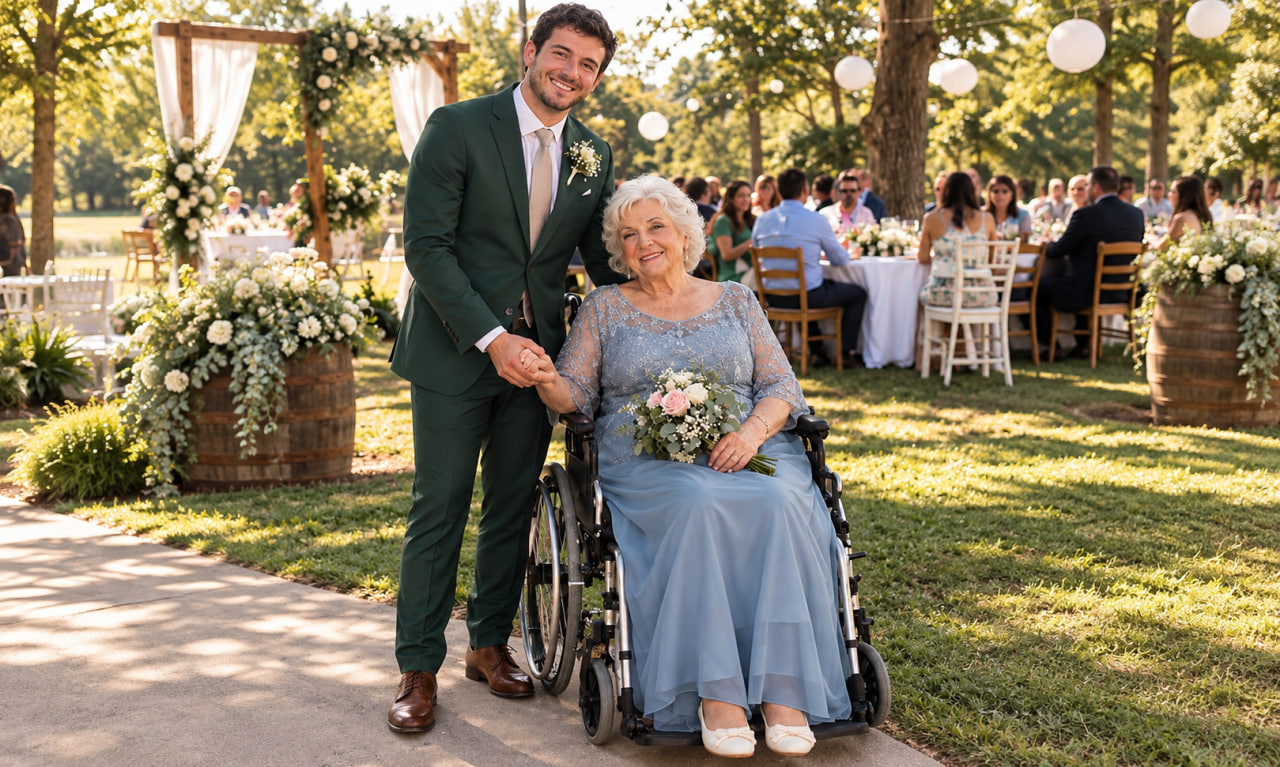
The woman who insisted she didn’t need help.
And the selfish young man who saw an old woman’s house before he ever saw the woman herself.
I used to think Florence had tricked me.
Now I understand that she did something much more difficult.
She gave me exactly what I had wanted.
Money.
A house.
A way out.
And then she forced me to decide what kind of man I would become once I had them.
The cardboard box is still with me.
I keep it in my closet.
Inside are the photographs.
The letters.
The brass key.
And the final note.
Sometimes, when I feel myself becoming selfish again, I open that box.
I read Florence’s words.
And I remember the lesson she left me.
The greatest trap isn’t losing the money you wanted.
It’s getting everything you ever wanted…
and discovering that you became someone you can no longer live with.
Florence died believing there was still good in me.
For the rest of my life, I intend to prove that she was right.