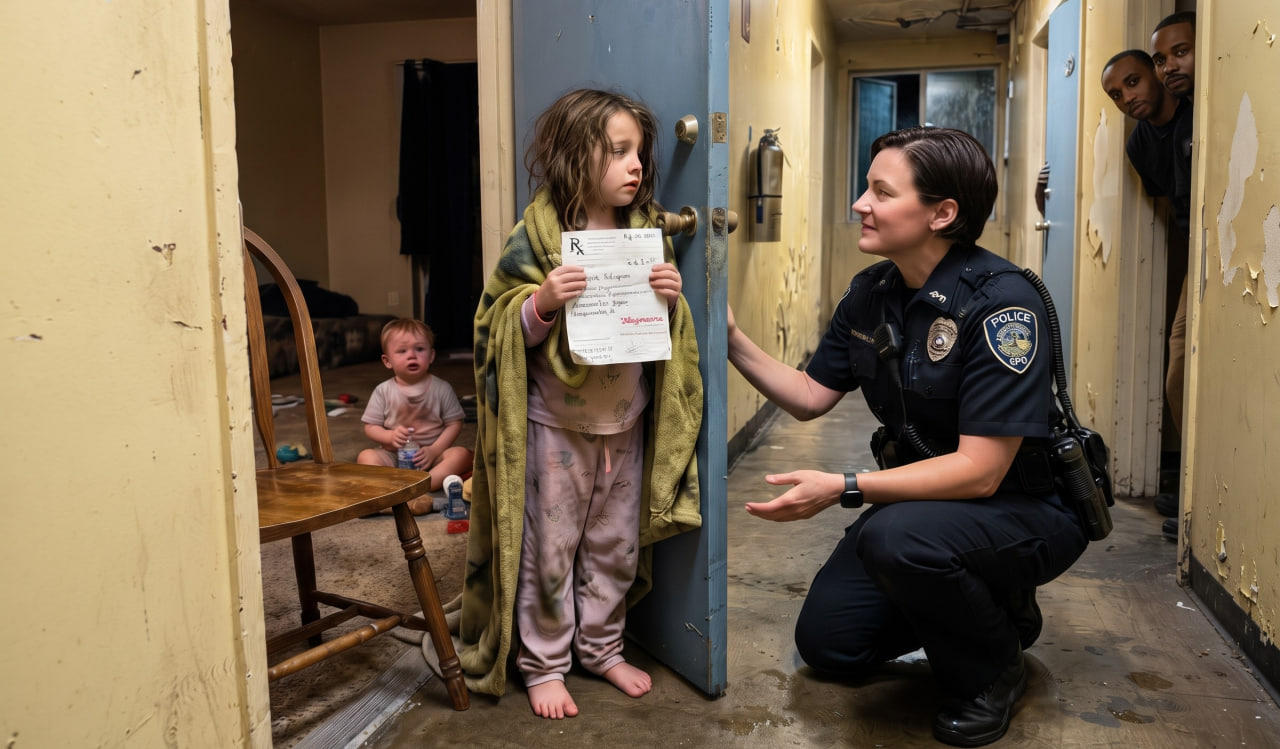
At 2:17 a.m., the emergency line opened with static, rain, and the sound of a child trying not to wake anyone who might be listening.
Marcus Thorne had been working the graveyard shift for six hours, long enough for the coffee beside his keyboard to turn cold and the half donut on his napkin to lose whatever appeal it had once possessed.
The storm pressed against the dispatch center windows in hard bursts, rattling the glass and washing a faint hiss through the headset.
Then a little girl whispered, “My mom told me not to open the door for anyone.”
Marcus moved his hand away from the coffee.
The voice was small, careful, and strained in the way children sound when they have been carrying a problem for too long and are afraid that speaking aloud might make it worse.
“But the power went out,” she continued, “we’re out of food, and my little brother won’t stop crying.”
Behind her words, Marcus heard a toddler’s uneven cry and the hollow acoustics of a nearly empty apartment.
This was not a prank call, and it was not a child testing a phone.
It was a child who had reached the end of the instructions she had been given.
Marcus softened his voice and asked her name.
Silence followed, but it was not an empty silence, because the toddler kept crying and the rain kept pushing static across the connection.
“Lily,” she finally said.
She was seven years old.
Her little brother’s name was Leo, and he had a fever so high that their mother had gone out to find medicine.
Their mother had promised to be right back.
Lily explained time the only way she could: they had gone to sleep many times, awakened many times, and their mother still had not returned.
Marcus asked where their father was.
The question changed the silence on the line.
“My dad doesn’t live here,” Lily said.
Then she lowered her voice until Marcus had to lean toward the headset.
“Mom says if he comes, don’t open the door.”
The words were simple, but the rule behind them was not.
Marcus did not press her for an explanation while Leo was crying and the apartment was dark.
He traced the call to apartment 4B in a deteriorating Detroit complex and dispatched the nearest squad car.
While the officer drove through the rain without sirens, Marcus stayed on the line.
He asked Lily whether Leo was awake.
“He’s crying,” she said. “I gave him water, but the bottle is empty now.”
He asked whether the front door was locked.
“Yes. Mom pushed a chair under the handle.”
Then Lily repeated another instruction.
“She told me not to go outside, even if somebody knocks.”
Marcus looked at the call information on his screen, then at the clock, then back at the call information as though the numbers might rearrange themselves into something less frightening.
A seven-year-old had been left with a sick toddler, no food, no power, and a door reinforced from the inside.
Yet she had waited because her mother had told her not to bother people unless it was a real emergency.
“You did exactly the right thing by calling me,” Marcus said.
Lily released one trembling breath.
It sounded less like relief than permission.
Until that moment, she had been trying to act like the adult in the apartment.
Officer Rachel Brooks approached the building with the lights low and the siren off.
The rain had darkened the concrete and turned the entrance into a slick reflection of weak exterior lamps.
Inside, the hallway smelled of damp laundry, backed-up plumbing, and wet coats that had never fully dried.
Buckets sat beneath brown stains in the ceiling.
Clothes hung from improvised lines where the power failure had left residents with few options.
Rachel climbed toward the fourth floor while Marcus relayed what Lily had said.
Apartment 4B was at the far end of the hall.
Before Rachel reached it, a nearby door opened three inches.
A woman peered through the gap and asked who the officer was looking for.
“A little girl who called 911,” Rachel said.
The neighbor’s face tightened with the satisfaction of someone who believed a rumor had finally become official.
“Apartment 4B,” she said. “That mother is always running around. God knows what she’s mixed up in.”
Rachel stopped.
“Did you knock and check on the children before you decided that?”
The woman did not answer.
Her door clicked shut.
Rachel continued down the hall, passing more closed doors and more people listening from behind them.
The faded blue door to apartment 4B bowed inward under pressure from a heavy chair wedged beneath the knob.