She had never met Ben or Yolanda.
As far as she knew, I still lived in my one-bedroom apartment and worked too much.
Most importantly, I had never given her a key.
I stared at the tiny image of her hand wrapped around the door handle.
Then I called 911.
The dispatcher asked whether anyone was in immediate danger.
“No.”
“Do you own the property?”
“Yes.”
“Did you authorize the people inside?”
“No.”
I gave her the address.
I explained that I had live security footage showing three people inside an unoccupied unit without my permission and that one of them was my sister.
The dispatcher asked whether I could prove ownership.
“Yes.”
“Do you have access to the documentation?”
“On my phone.”
She said officers would respond and asked me to remain reachable.
When the call ended, I saved the footage.
Then I got back onto the highway.
That decision confused people later.
They expected me to turn around immediately and race toward Caldwell Street.
But the police were already going there.
I had documentation.
The cameras were recording.
There was nothing useful I could accomplish by speeding back toward the property while angry.
My mother was waiting for me in Greensboro.
So I kept driving.
Her kitchen smelled like roasted chicken and onions when I arrived.
My father was already sitting at the table.
“Traffic bad?” he asked.
“Not terrible.”
Mom hugged me and complained that I was too thin, something she did every time she saw me regardless of my actual weight.
There was a birthday cake on the counter covered in white icing.
Dileia wasn’t there.
That mattered.
I sat down.
Mom asked me about work.
Dad told me about his cardiology appointment.
I listened.
That evening remains one of the strangest memories I have because almost everything in the room was completely normal.
Silverware tapping against plates.
The refrigerator humming.
My mother getting up twice because she had forgotten the rolls.
My father talking about an adjustment to his prescription.
And in my purse beside my chair, my phone held footage of my sister walking strangers through property she did not even know I owned.
I wasn’t pretending nothing had happened.
I was waiting for verified information.
There is a difference.
At 5:23, my phone rang.
Charlotte number.
I excused myself and stepped into the hallway.
“Ms. Ranata?”
“Yes.”
“This is Officer David Reyes. I’m at the Caldwell Street address.”
His tone was calm and professional.
“We have three individuals here. One identifies herself as your sister. She says she has your permission to show the property.”
“She does not.”
There was a brief pause.
“You’re confirming she has never been authorized to enter Unit B?”
“Correct.”
“She says the property is connected to your family.”
“It isn’t. I own it individually.”
“Can you provide proof of ownership?”
“Yes.”
He gave me an email address.
I opened the folder on my phone labeled Caldwell.
The deed was there.
So was the title insurance certificate.
So was my property insurance policy.
I emailed all three while he stayed on the phone.
“Got them,” he said.
“I can drive back.”
“That would be helpful.”
“I’m about forty minutes from Charlotte once I get moving.”
“We’ll be here.”
I returned to the kitchen.
My mother looked up.
“Everything okay?”
“I need to go handle something at one of my properties.”
Her fork stopped halfway toward her plate.
“One of your what?”
“Properties.”
My father looked at me.
I could already see the questions forming.
I didn’t answer them.
Not then.
I kissed my mother’s cheek and wished her happy birthday again.
“I’ll call tomorrow.”
Dileia still hadn’t arrived.
As I walked toward my car, my phone buzzed with another saved motion event from Caldwell Street.
I didn’t open it.
I drove.
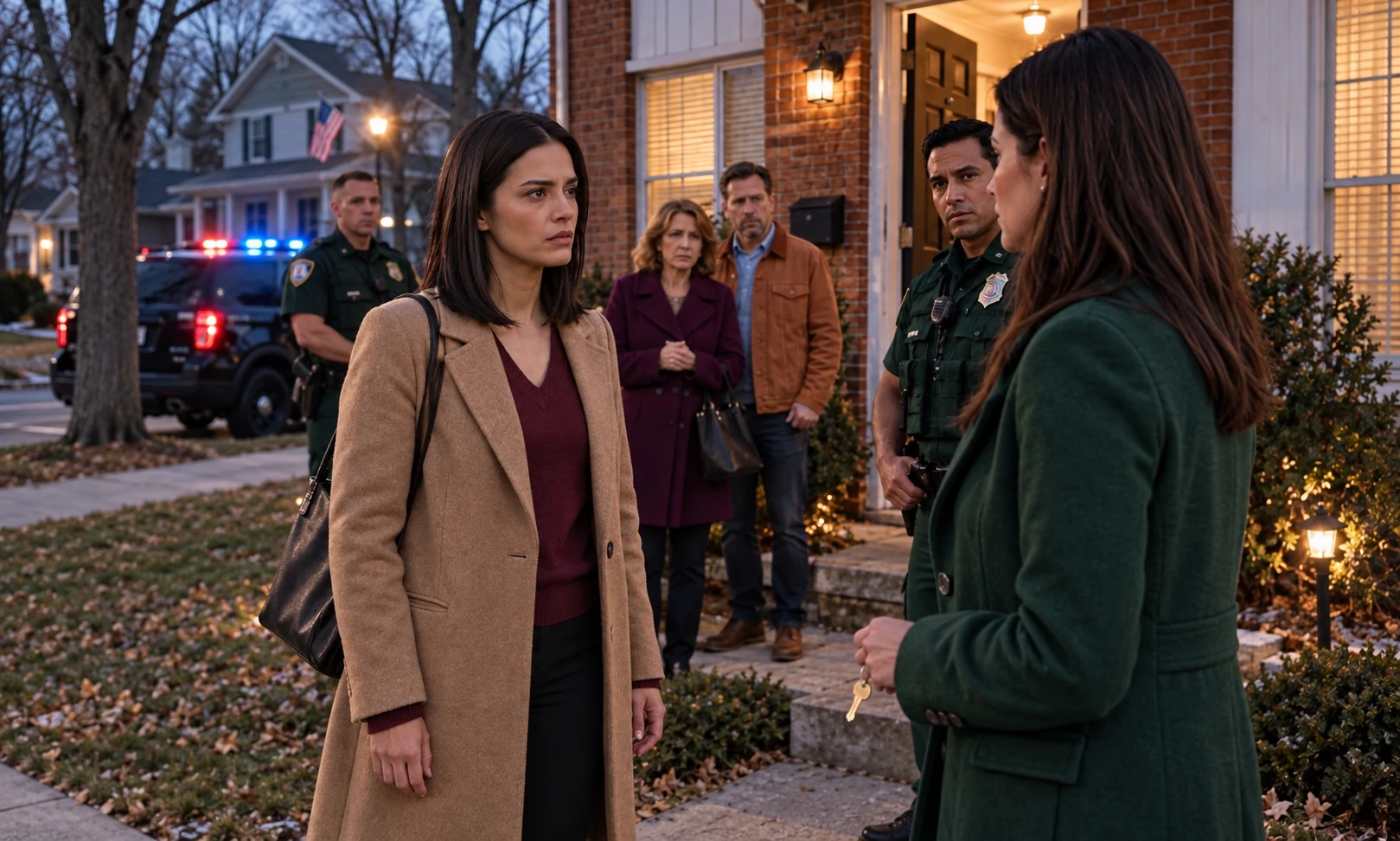
When I reached Caldwell at 6:11, the scene waiting for me became the image I would remember more clearly than any argument that followed.
Two patrol vehicles.
Officer Reyes and his partner.
Dileia standing on the sidewalk.
The unfamiliar couple.
And my front door standing open behind them.
The couple introduced themselves as Greg and Sandra Holt.
They were in their mid-forties.
They looked mortified.
Greg kept both hands buried in his jacket pockets. Sandra held her phone against her coat.
“We didn’t know,” she said immediately.
“I know.”
She glanced toward Dileia.
“We found the listing Sunday.”
“What listing?”
Officer Reyes answered.
The upper unit of my duplex had been advertised online for $310,000.
For sale.
Not rent.
Sale.
The listing used photographs taken inside Unit B.
My floors.
My kitchen.
My windows.
My property.
It had been created and managed through Dileia’s real estate access.
The Holts had contacted her because they were interested.
She arranged the showing.
I looked directly at my sister.
“You listed my unit?”
“It wasn’t like that.”
Officer Reyes had already reviewed the paperwork.
My ownership was clear.
Dileia had no deed, no agency agreement, no authorization to market the property, and no legitimate role in any sale involving Caldwell Street.
The Holts had responded to what looked like a legitimate listing posted by a licensed real estate agent.
They were not the problem.
Officer Reyes explained that they were free to leave.
Sandra looked at me one more time.
“I’m sorry.”
“You don’t need to apologize.”
She and Greg left quickly.
Neither of them looked at Dileia.
That was when my sister moved closer.
“Ranata, listen to me.”
I looked down at the key still in her hand.
“Where did you get that?”
She glanced at it as though she had forgotten she was holding it.
“It’s not important.”
“It is to me.”
“I was going to tell you.”
“About the key or the listing?”
Her mouth tightened.
“You’re acting like I tried to steal your house.”
“You advertised part of my property for sale.”
“I found interested buyers.”
“You found buyers for something you don’t own.”
She exhaled and glanced toward the officers.
That was Dileia under pressure. She didn’t immediately get louder. First she searched for an argument that would make the other person look unreasonable.
“You don’t understand what I was trying to do.”
“Then explain it.”
She hesitated.
“I knew you were doing well.”
“That’s not an explanation.”
“I knew you had money tied up in something down here. Mom mentioned you’d been busy on weekends. I figured it out.”
“You figured out the address?”
“I looked.”
That answer disturbed me almost as much as the listing itself.
Not because the property had been impossible to find.
Public records existed.
But because she had searched.
Then entered.
Then taken photographs.
Then listed it.
Every step required another decision.
None of this had happened by accident.
Dileia folded her arms.
“I was going to talk to you before anything became final.”
“After bringing buyers through?”
“They were interested.”
“In my property.”
“You’re not even using the upstairs unit.”
That sentence clarified something for me.
In Dileia’s mind, something unused had become something available.
And because I was her sister, available had become negotiable.
“I thought we could split it,” she said.
For the first time all evening, I almost laughed.
Not because any of it was funny.
Because the sentence was so completely Dileia that it could have come from twenty years earlier.
“Split what?”
“The profit.”
“There is no ‘we.’”
Her expression hardened.
“I’ve been helping Mom and Dad for years while you’re down here living your own life.”
It was an astonishing rewrite of our family history.
But arguing about family history would have pulled us away from the only fact that mattered.
I pointed toward the building.
“Your name is not on that deed.”
She looked away.
“You don’t own a percentage.”
Nothing.
“You were never authorized to enter.”
“Ranata—”
“You were never authorized to list it.”
She shook her head.
“You always do this. You act like everything is a contract.”
“No. I document things when they matter.”
Officer Reyes shifted slightly beside us.
Dileia noticed.
So did I.
I turned toward him.
“What do you need from me for the report?”
That ended the conversation.
Not emotionally.
But practically.
And practical endings had always been the kind Dileia respected least.
The locksmith arrived at 8:30.
Her name was Carla, and she worked quickly.
Gretchen had called her after I explained what had happened.
Carla replaced three exterior locks and rekeyed the mailbox while Gretchen and I sat at Ben and Yolanda’s kitchen table downstairs.
I had already spoken with them.
They had been home during part of the incident but assumed Dileia belonged there because she carried herself as though she did.
That detail stayed with me.
Confidence opens a surprising number of doors before anyone asks whether you actually own the key.
Gretchen had brought a legal pad.
“Start from the notification,” she said.
So I did.
4:47.
Motion alert.
Three people.
Unauthorized showing.
Police contact.
Listing discovered.
Ownership verified.
Locks changed.
When I finished, Gretchen put down her pen.
“Are you okay?”
I looked through the kitchen toward the ceiling, knowing my sister had been walking strangers around directly above us.
“Yes.”
Gretchen studied me.
“That sounded very fast.”
I knew what she meant.
I thought about it again.
“I’m angry.”
“That sounds more accurate.”
“I’m also not surprised enough.”
That was the part that hurt.
Not simply that Dileia had crossed a boundary.
But that she had crossed one so enormous and some small, exhausted part of me still recognized the family logic behind it.
Ranata has something.
Dileia needs something.
Therefore the distance between those two facts is negotiable.
At 9:16, while Carla finished the final lock, I sat inside Unit B and opened the real estate platform.
The listing was still live.
I took screenshots of everything.
The price.
The photographs.
The description.
Dileia’s agent information.
The date.
Then I saved copies in two separate locations.
Only after that did I report the listing.
The platform requested proof.
I uploaded the deed and the police report number.
By 11:47 that night, I received an email confirming that the listing had been removed.
I barely slept.
Not because I was afraid.
Because once the immediate tasks were finished, there was finally space for the emotional part.
I kept seeing my sister’s hand on the door.
The key.
The casual way she had walked strangers through my kitchen.
At 2:00 a.m., I got out of bed and opened my closing folder.
I looked at the deed.
My name was there.
Clear.
Undisputed.
I already knew that.
But family has a strange ability to make you feel as though you have to prove things that are objectively true.
The next morning, I called Patricia Oay.
Patricia was a real estate attorney who had reviewed my lease template before I rented Unit A.
That first meeting had cost $180.
At the time, she had told me my paperwork was cleaner than what she saw from many new landlords.
Now I explained why I was calling.
She didn’t interrupt once.
When I finished, she asked three questions.
“Do you have the security footage?”
“Yes.”
“Screenshots of the listing before removal?”
“Yes.”
“And the police report information?”
“Yes.”
“Your sister’s license is active?”
“As far as I know.”
She was quiet for a moment.
“Then the issue is not proving what happened.”
I leaned back in my office chair.
“What is the issue?”
“Deciding what result you want.”
That question took longer to answer than I expected.
There were several outcomes I did not want.
I did not want Dileia destroyed.
I did not want a permanent family war.
I did not want to spend the next year paying attorneys simply to punish someone.
But I also knew exactly what would happen if there were no meaningful boundary.
My mother would call the entire thing a misunderstanding.
My father would ask everyone to move on.
Dileia would apologize for how things “turned out.”
And six months later, the lesson would not be that my property belonged to me.
The lesson would be that nothing permanent happened when she ignored that fact.
“I want documentation,” I said.
Patricia waited.
“I want her to acknowledge in writing that she has no interest in the property and no authority to enter, list, sell, or represent anything involving it. I want my costs reimbursed.”
“Anything else?”
“I want this finished.”
“Understood.”
Fourteen days later, Dileia received Patricia’s letter by certified mail.
I read the final version before it was sent.
There was no emotional language in it.
That made it stronger.
It described the unauthorized entry.
The listing.