By eleven, he called me.
I answered.
“Lucas.”
His voice sounded different.
Not confident.
Not arrogant.
Controlled.
Barely.
“Yes?”
“We need to talk.”
“We are talking.”
“Privately.”
“No.”
He paused.
“I think there has been a misunderstanding.”
“No, Richard.”
I looked out the window.
“I think there has been a very long understanding.”
Silence.
“You’ve been investigating Merritt.”
“Yes.”
“You have no idea what you’re dealing with.”
“I have twenty years of documents.”
His breathing changed.
“Where did you get them?”
“From Ruth.”
Nothing.
For several seconds, neither of us spoke.
Then Richard whispered:
“She kept those?”
“Yes.”
“You don’t understand.”
“Then explain it.”
“I was trying to protect my family.”
I almost laughed.
“That’s what you told Ruth.”
“You knew?”
“She wrote everything down.”
His voice became angry.
“You have no right to interfere with my company.”
“I am a shareholder.”
“A minority shareholder.”
I smiled.
“You might want to check the records.”
Silence.
Then he said:
“Lucas, please.”
That word surprised me.
Please.
The same man who had once barely noticed me at his daughter’s wedding rehearsal was asking me to listen.
“What’s going to happen?” he asked.
“That depends.”
“On what?”
“Whether the truth comes out voluntarily or through an investigation.”
He didn’t answer.
I continued.
“You have until five o’clock.”
“For what?”
“To provide every financial record requested by the board.”
“And if I don’t?”
“Then the board will obtain them another way.”
He hung up.
At 4:43 p.m., the documents arrived.
At 4:51, the board suspended Richard from financial decision-making.
At 5:17, the independent auditors entered Merritt’s offices.
And at 6:02, Richard’s attorney called Harold.
By the end of the week, Richard’s carefully constructed empire was beginning to unravel.
The acquisition of his brother’s company was canceled.
Several transactions were referred for further legal review.
The board appointed an interim executive team.
And Richard resigned from his position.
But the most painful part came later.
Daniel came to my house.
He didn’t bring excuses.
He didn’t bring flowers.
He didn’t bring a gift.
He simply stood on my porch.
“Dad.”
I opened the door.
“Come in.”
He stepped inside.
We sat in the same living room where he had confessed everything.
He looked older.
Not physically.
Emotionally.
“I want to apologize.”
I said nothing.
“I know I’ve already said it.”
“Yes.”
“But I didn’t understand what I was apologizing for.”
I looked at him.
“What do you understand now?”
“That I wasn’t embarrassed by you.”
I waited.
“I was embarrassed by myself.”
That answer surprised me.
Daniel continued.
“I spent years trying to become someone Richard would respect.”
He looked at Ruth’s photograph.
“I thought money would make me important.”
His voice cracked.
“But when everything started falling apart, I realized the only person who had never asked me to prove anything was you.”
I remained silent.
“I betrayed you.”
“Yes.”
“I lied.”
“Yes.”
“I let them insult you.”
“Yes.”
“And I almost traded my father’s trust for three million dollars.”
He lowered his head.
“I know.”
The room was quiet.
Finally, I said:
“Do you know what hurt the most?”
He looked up.
“It wasn’t the money.”
His eyes filled with tears.
“It wasn’t Richard.”
“It wasn’t Victoria.”
I pointed toward the photograph.
“It was that your mother wasn’t here to see what happened.”
Daniel looked at the photograph.
“I miss her.”
“So do I.”
We sat there quietly.
Then Daniel asked:
“Can you forgive me?”
I looked at him for a long time.
“I already have.”
His face crumpled.
“But I need you to understand something.”
He nodded.
“Trust isn’t something you demand after an apology.”
“I know.”
“You rebuild it.”
“How?”
“By what you do when nobody is watching.”
Daniel nodded slowly.
“I’ll do that.”
He stood.
Before he reached the door, I called his name.
“Daniel.”
He turned.
“You don’t need Richard’s approval.”
He looked at me.
“You don’t need mine either.”
His eyes filled again.
“You need to become someone you respect when you look in the mirror.”
He nodded.
“I will.”
Then he left.
Months passed.
The Merritt investigation continued.
Richard’s name disappeared from the company’s offices.
Victoria moved out of the large house she had once treated like a symbol of superiority.
Emily and Daniel eventually separated.
Not because of the money.
Because Daniel finally understood that a marriage built around appearances couldn’t survive when the appearances disappeared.
I never celebrated Richard’s downfall.
That wasn’t what Ruth would have wanted.
Instead, I watched quietly as the truth worked its way through the system.
Some people faced consequences.
Some cooperated.
Some admitted what they had done.
And some never did.
But I didn’t need revenge.
I needed peace.
One spring morning, Daniel came to my house carrying something.
The blue casserole dish.
I stared at it.
“You kept it?”
“I found it at Emily’s parents’ house.”
I took it from him.
The ceramic was scratched.
There was a tiny chip near the handle.
But it was still the same dish Ruth had used for years.
Daniel smiled.
“I thought you should have it back.”
I ran my fingers over the edge.
“Thank you.”
He looked toward the kitchen.
“Can I make the sweet potatoes?”
I laughed.
“You don’t even know the recipe.”
He smiled.
“Then teach me.”
So I did.
We stood in the kitchen together.
Brown sugar.
Cinnamon.
Pecans.
Sweet potatoes.
For the first time in years, the kitchen didn’t feel empty.
Daniel asked questions.
I corrected him.
He complained that there was too much cinnamon.
I told him he was wrong.
He laughed.
And for a few minutes, we were simply father and son.
Nothing else.
No company.
No shares.
No inheritance.
No wealthy in-laws.
Just family.
Later that afternoon, Daniel and I sat on the porch.
He looked toward the street.
“Dad?”
“Yes?”
“Do you ever regret investing in Merritt?”
I thought about it.
Then I shook my head.
“No.”
“Even after everything?”
“Even after everything.”
“Why?”
I looked at Ruth’s photograph through the window.
“Because your mother taught me something.”
“What?”
“Money can reveal who people are.”
I paused.
“But it doesn’t create who they are.”
Daniel looked down.
I continued.
“The people who loved you before you had anything are the people you should remember when you have everything.”
He nodded.
After a moment, he asked:
“Do you think Mom would be proud of us?”
I smiled.
“She’d say we still have work to do.”
Daniel laughed.
“That sounds like her.”
“It does.”
That evening, I placed Ruth’s letter back inside the wooden box.
But before closing the lid, I added one more thing.
A photograph.
It was taken that afternoon.
Daniel and me standing in the kitchen beside the blue casserole dish.
For years, I had thought Ruth’s final gift to me was the money she had helped protect.
I was wrong.
Her greatest gift was the reminder that money should never decide who deserves a seat at your table.
That Thanksgiving, I had walked out of a house because someone told me I wasn’t invited.
I thought I had lost my family that day.
But I eventually realized something.
I hadn’t lost my family.
I had discovered which parts of it were real.
And sometimes, the hardest door to walk away from is the one that leads you back to yourself.
The following Thanksgiving, Daniel arrived at my house early.
He was carrying groceries.
He walked into the kitchen and placed them on the counter.
“Dad?”
“Yes?”
“I brought everything.”
I looked at the bags.
“Everything?”
He nodded.
“Sweet potatoes. Brown sugar. Cinnamon. Pecans.”
I smiled.
“And the turkey?”
He froze.
“I forgot the turkey.”
I burst out laughing.
He laughed too.
Then he grabbed his keys.
“I’ll go get one.”
I shook my head.
“Wait.”
I opened the refrigerator.
“There are two.”
He stared at me.
“Two?”
“One for us.”
I paused.
“And one for anyone who might show up without an invitation.”
Daniel smiled.
“That sounds like Mom.”
I looked at the empty chair at the end of the table.
“Yes,” I said softly.
“It does.”
And that year, nobody asked whether they belonged.
Nobody checked their bank account.
Nobody cared what kind of car they drove.
Nobody needed to impress anyone.
We simply opened the door.
Because Ruth had been right all along.
A family isn’t defined by who owns the biggest house.
Or who sits at the head of the table.
Or who has the most money.
A family is defined by who makes room when someone else has nowhere to sit.
And sometimes, the greatest victory isn’t making the people who rejected you regret what they did.
It’s becoming strong enough that you no longer need their invitation.
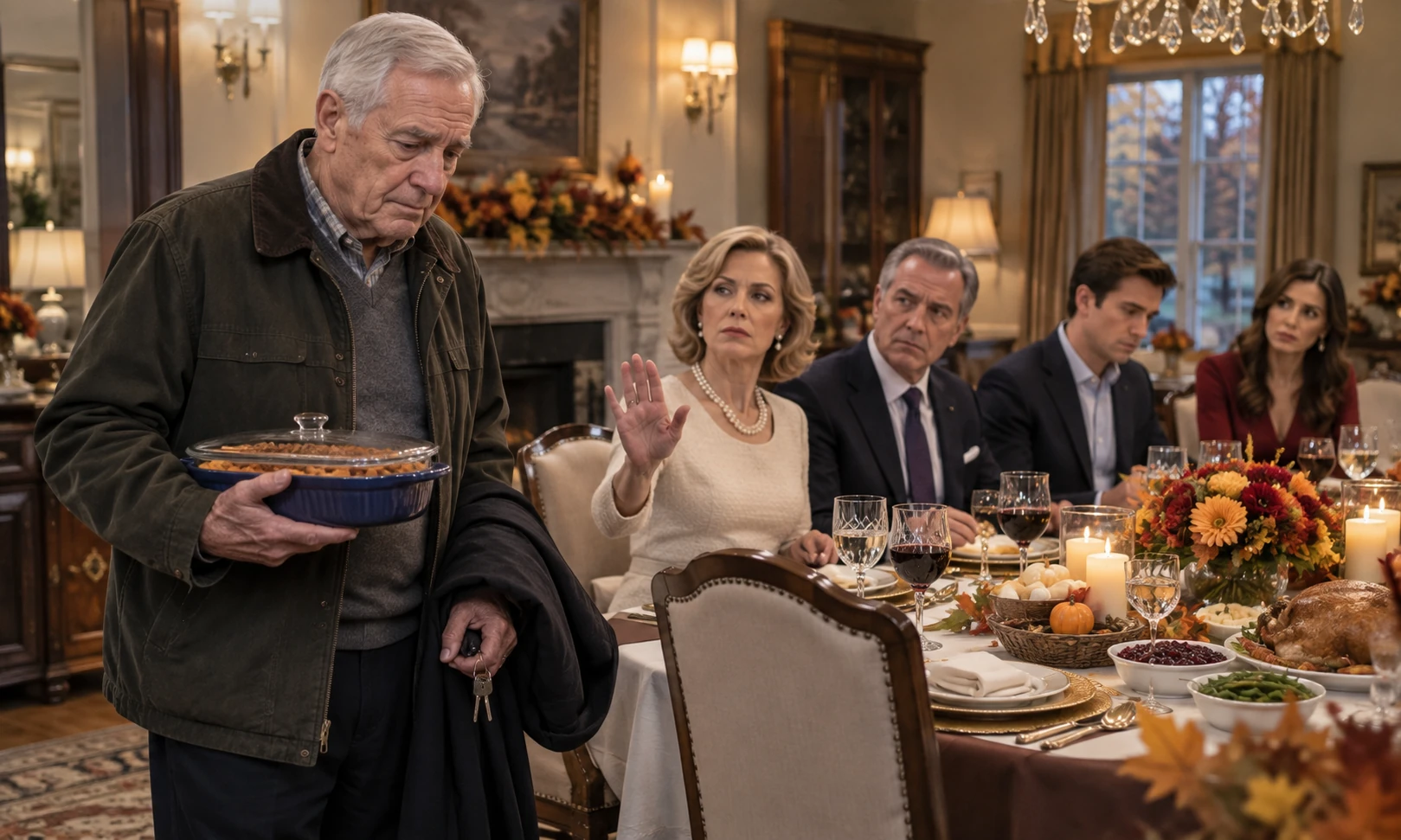
I had walked away from that Thanksgiving table with nothing but my keys and an old casserole dish.
I came home believing I had been rejected.
In the end, I discovered something much more valuable.
I had never been the one who didn’t belong.
I had simply been sitting at the wrong table.