He didn’t answer.
“Mr. Mercer?”
“We were evaluating terrain.”
“No.”
I could hear his breathing.
“You were evaluating something underground.”
Another silence.
Then he said:
“Who told you that?”
I smiled.
“Nobody.”
I hung up.
Three days later, Cardinal made a formal offer.
$2.4 million upfront.
$180,000 annual easement payment.
I stared at the number.
For a moment, I understood why someone might take it.
It was life-changing money.
More than I had ever imagined having.
Enough to pay every bill.
Enough to buy a beautiful house.
Enough to stop working.
Enough to live comfortably for the rest of my life.
But I remembered Harold’s letter.
Don’t sign the first paper they put in front of you.
I handed it to Evelyn.
She read it.
Then laughed.
“What’s funny?”
“They’re scared.”
“Of what?”
“That you’ll get another appraisal.”
“And will I?”
“We already did.”
She handed me another report.
The estimated value wasn’t $2.4 million.
It was substantially higher.
But the number wasn’t the thing that shocked me.
It was the final sentence.
The property may possess strategic subsurface value that cannot be adequately assessed without additional geological testing.
I looked at Evelyn.
“Can we test it?”
“Yes.”
“Then do it.”
And we did.
For three months, engineers came and went.
Geologists drilled test wells.
Environmental specialists examined the wetlands.
Surveyors mapped the underground formations.
And every week, Cardinal’s lawyers called.
Every week, we said no.
Then one morning, Evelyn walked into my kitchen holding a folder.
She didn’t sit.
“What?”
She placed the folder in front of me.
“You’re going to want to read this.”
I opened it.
The geological report contained one sentence highlighted in yellow.
The subsurface formation beneath Parcel 44-118 appears suitable for underground natural-gas storage, subject to regulatory approval.
I looked up.
“How much?”
Evelyn smiled.
“We don’t know yet.”
“But?”
“But Cardinal does.”
That afternoon, their CEO came himself.
Not Daniel Mercer.
Not a land agent.
The CEO.
His name was Richard Colton.
He sat across from me in the same kitchen where Harold and I had eaten meatloaf on Thursdays.
He looked at the land documents.
Then at me.
“Mrs. Vance, your husband was a very smart man.”
“Yes.”
“I wish we had dealt with him directly.”
“So do I.”
He smiled.
“I understand you’ve had geological testing performed.”
“I have.”
“You realize that could take years to monetize.”
“I understand.”
“We can make you financially secure today.”
“How much?”
He leaned forward.
“Ten million dollars.”
I said nothing.
Bernard looked at me.
Evelyn didn’t move.
Richard continued.
“Ten million upfront. Two hundred fifty thousand annually. Full restoration of the land when the project ends.”
I looked at the creek.
Then at him.
“And the subsurface rights?”
He paused.
“We’re interested in the easement.”
“That wasn’t my question.”
He smiled.
“You’re a sharp woman.”
“My husband thought so.”
He sighed.
“We can negotiate.”
I shook my head.
“No.”
His expression changed.
“You haven’t heard the entire offer.”
“I’ve heard enough.”
“Mrs. Vance, ten million dollars is more than most people see in a lifetime.”
“I know.”
“So why refuse?”
I looked at him.
“Because my husband told me not to sell until I understood what I owned.”
Richard stared at me.
Then he said quietly:
“You’re going to make this very difficult.”
I smiled.
“Harold always said I was stubborn.”
The meeting ended.
Two weeks later, the state announced that Cardinal had submitted plans for a major regional storage expansion.
The project depended on access to my parcel.
Suddenly, the land that Harold’s children had laughed at became the center of a multimillion-dollar infrastructure project.
News trucks appeared on Route 9.
Reporters called.
Neighbors stopped by.
One local paper published a story:
WIDOW’S “WORTHLESS” LAND AT CENTER OF MAJOR ENERGY PROJECT
The story mentioned Harold.
It mentioned the will.
It mentioned his children laughing about the property.
Melissa called me that night.
“Are you serious?”
“About what?”
“You’re really negotiating with Cardinal?”
“Yes.”
“You never told us.”
“You never asked.”
“We’re Dad’s children.”
“Yes.”
“We deserve something.”
I looked at the phone.
“You already received what your father left you.”
“But this is different.”
“No.”
“It is!”
“No, Melissa.”
My voice was calm.
“This is exactly what your father intended.”
Silence.
Then she said:
“Did Dad know?”
“Yes.”
“How much?”
“I don’t know.”
“You’re lying.”
“No.”
“You’ve always manipulated him.”
I closed my eyes.
For fourteen years I had swallowed those words.
But not anymore.
“Melissa, your father chose me.”
She went silent.
“He chose me as his wife.”
I continued.
“He chose me as the person he trusted with this land.”
“And?”
“And he chose not to give it to you.”
She hung up.
I expected anger.
What I didn’t expect was what happened two days later.
Todd came to my house.
Alone.
He stood on the porch.
“Can I come in?”
I hesitated.
Then opened the door.
He looked exhausted.
“Your sister sent you?”
“No.”
“Then why are you here?”
He sat down.
For a long time he stared at the floor.
Then he said:
“I stole from Dad.”
I didn’t respond.
He continued.
“Not money.”
“What did you steal?”
“Information.”
I already knew.
“Why?”
“Debt.”
“How much?”
He gave me a number.
I nearly stopped breathing.
“That much?”
He nodded.
“I owed people.”
“What people?”
“Bad ones.”
“Did Dad know?”
“Eventually.”
“And Cardinal?”
“I contacted them.”
“Why?”
“Because I thought they were going to pay me.”
“Did they?”
“No.”
He laughed bitterly.
“They used me.”
I looked at him.
“How?”
“They gave me enough money to keep me quiet.”
“And then?”
“They found out Dad had the land.”
“How?”
“I told them.”
I felt something inside me crack.
“You betrayed your father.”
“I know.”
“Why?”
“Because I thought he would sell.”
“And when he didn’t?”
“He cut me off.”
I stared at him.
“Then why did he leave you the house?”
Todd looked up.
“He didn’t.”
I froze.
“What?”
“The house went to Melissa.”
I realized something.
At the reading, I had assumed Todd received it.
He hadn’t.
The boat had gone to Todd.
The brokerage account had been divided.
The house had gone to Melissa.
And the land had gone to me.
Harold had divided everything deliberately.
Todd looked at me.
“He knew I would sell anything I could.”
I said nothing.
“That’s why he gave me the boat.”
I almost smiled.
“Your father knew you.”
Todd nodded.
Then he pulled something from his pocket.
A small envelope.
He placed it on the table.
“What is that?”
“A letter.”
“From Harold?”
Todd nodded.
“He gave it to me six months ago.”
“Why are you giving it to me now?”
“Because I finally understand it.”
I opened the envelope.
Inside was one sentence.
When the time comes, tell Doreen the truth.
Underneath was another.
You don’t have to become the man you have been.
Todd began to cry.
“I was awful to him.”
I didn’t know what to say.
He wiped his face.
“I thought he loved you more.”
I looked at him.
“He loved you differently.”
“That’s not what it felt like.”
“No.”
I sat across from him.
“Parents can love you and still refuse to protect you from the consequences of what you do.”
He nodded.
Then he asked:
“Will you forgive me?”
I didn’t answer immediately.
“I don’t know.”
He looked down.
“But I’m willing to try.”
He nodded.
“That’s fair.”
Then he stood.
Before leaving, he turned around.
“Doreen?”
“Yes?”
“He told me something else.”
“What?”
“He said if you ever wanted to know why he chose the land over everything else, you should go to the northeast corner after the first hard rain.”
I frowned.
“Why?”
Todd shook his head.
“I don’t know.”
That night, it rained.
Hard.
The next morning, Bernard, Evelyn, and I walked to the northeast corner.
The creek was swollen.
Mud covered the ground.
Evelyn stopped.
“There.”
A section of earth near the old trees had collapsed.
Beneath it was a metal door.
I stared.
“That’s the tunnel?”
Bernard nodded.
We called the authorities and had the area inspected.
Inside was a sealed concrete chamber.
And inside that chamber was an old steel box.
Harold’s name was written on it.
My hands shook as I opened it.
Inside were documents.
Old deeds.
Mineral records.
Survey reports.
And one final letter.
I unfolded it.
Doreen,
If you found this, then the ground finally gave up its secret.
I wanted you to have more than money.
I wanted you to have proof.
Proof that I knew what this land could become.
But more importantly, proof that you were never the second choice.
My children may believe you took something from them.
You didn’t.
I gave it to you.
There is a difference.
You gave me fourteen peaceful years when I thought I had already missed my chance at happiness.
Don’t let anyone make you feel guilty for keeping what I deliberately left in your hands.
If they offer millions, don’t think about what you could buy.
Think about why I refused to sell.
I wanted you to have a place no one could take from you.
Love,
Harold.
I couldn’t see the page anymore.
I pressed it against my chest.
Evelyn quietly walked away.
Bernard stayed beside me.
I whispered:
“He knew.”
“Yes.”
“He knew I would need this.”
“Yes.”
Months later, Cardinal returned with a completely different proposal.
Not an easement.
A partnership.
The final agreement included an upfront payment, annual royalties, environmental protections, restoration requirements, and a percentage tied to the future storage operation.
The total value over the initial term was projected to exceed $38 million, with additional upside depending on expansion.
I didn’t become rich overnight.
I became something better.
Secure.
Independent.
And impossible to dismiss.
I renovated the old property.
Not into a mansion.
Harold would’ve hated that.
I restored the creek.
Planted trees.
Repaired the old farmhouse.
And built a small guesthouse where Harold and I could have watched the water together if we’d had more time.
I kept the ten acres.
I kept his chair.
I kept the church bulletin where I had first written down the surveyor’s words.
And I kept the envelope with his handwriting.
Melissa eventually apologized.
It took two years.
She didn’t ask for money.
That mattered.
Todd entered treatment, paid his debts, and slowly rebuilt his life.
We never became the kind of family that pretended nothing had happened.
We became something more honest.
A family that remembered.
A family that learned.
And every spring, when the creek rose and the trees turned green, I walked to the northeast corner alone.
One year, I found a small wooden bench there.
Todd had built it.
He had carved something into the back.
Dad was right.
I sat down.
The creek moved quietly in front of me.
And for the first time since Harold’s funeral, I smiled without feeling guilty.
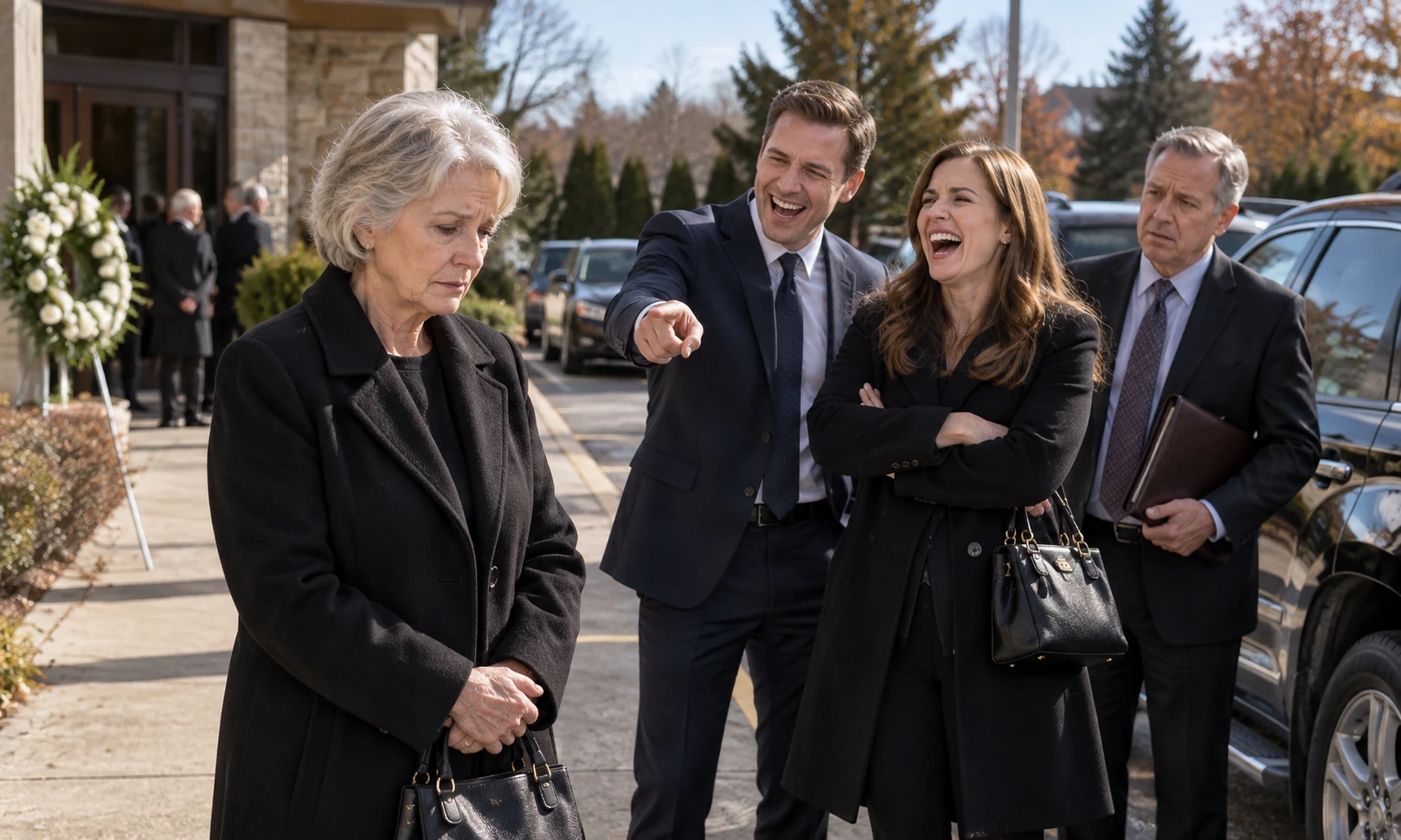
His children had laughed when they gave me the “worthless” trailer lot.
They thought they had left me with weeds.
They thought they had given me the one thing nobody wanted.
They had been wrong.
But the most important thing Harold left me wasn’t the land.
It wasn’t the money.
It wasn’t the royalties.
It wasn’t even the proof that he had planned everything.
It was the certainty that, even when I wasn’t in the room, even when his children talked over me, even when people called me the roommate instead of his wife, Harold had seen me.
He had trusted me.
And he had known exactly what I would need when he was gone.
One afternoon, I received the final payment from Cardinal.
I looked at the number on the statement.
Then I closed it.
I didn’t feel excited.
I didn’t feel victorious.
I simply walked to Harold’s old chair.
I sat down.
And I said quietly:
“You were right, honey.”
The house was silent.
But somehow, for just a moment, it didn’t feel empty.
It felt like home.
And outside, beyond the windows, the creek kept moving through the ten acres everyone had called worthless.
The same creek Harold had once pointed toward and said:
“They ain’t making more of either one.”
He had been right about that, too.