“Maybe.”
I looked at the wedding invitation on my desk.
Then I said, “But I’m not changing the wedding.”
He hung up.
I thought that was the end of it.
It wasn’t.
On the morning of my wedding, I stood in front of a mirror while Margaret fastened the final button on my dress.
My hands were shaking.
She noticed.
“Nervous?”
“A little.”
“About marrying Daniel?”
I smiled.
“No.”
“Your parents?”
I nodded.
Margaret stepped around me.
She placed both hands on my shoulders.
“Look at me.”
I did.
“You don’t owe anyone a perfect daughter today.”
My eyes filled with tears.
“You just have to be Claire.”
She kissed my forehead.
“You’ve been enough for a long time.”
The ceremony began at four.
My father was waiting at the end of the aisle.
My mother sat beside him.
Rachel was two rows behind.
I walked slowly.
When I reached my father, he smiled.
For one brief second, I saw the father I had spent years searching for.
The ceremony was beautiful.
Daniel cried.
I cried.
Everyone laughed when the officiant mentioned that I had once claimed I would never get married.
Then came the reception.
Dinner.
Toasts.
Music.
Dancing.
And finally, the wedding program was placed on every table.
My mother picked hers up.
She scanned the page.
Then stopped.
Her face changed.
My father leaned over.
“What?”
She turned the program toward him.
I watched from across the room.
At the top of the page were the names of the people who had raised me emotionally during the years my biological family had chosen not to.
Parents of the Bride: Margaret and Peter Hayes.
Underneath, in smaller letters:
With gratitude to the people who taught Claire what family means.
My father stared at the page.
My mother looked toward me.
For the first time in my life, she looked genuinely afraid of losing me.
She stood.
“Claire.”
I walked toward her.
She held the program in her hand.
“You didn’t tell us.”
“I didn’t think I needed permission.”
Her lips trembled.
“Are you replacing us?”
I looked at her.
“No.”
She seemed confused.
“You can’t replace parents.”
“I know.”
“Then why?”
I glanced across the room.
Margaret was standing beside Peter.
Peter was holding a champagne glass.
Mia was dancing with Noah.
Daniel was talking to friends.
My new family.
My chosen family.
The people who had opened a chair for me when my own family had told me there wasn’t one.
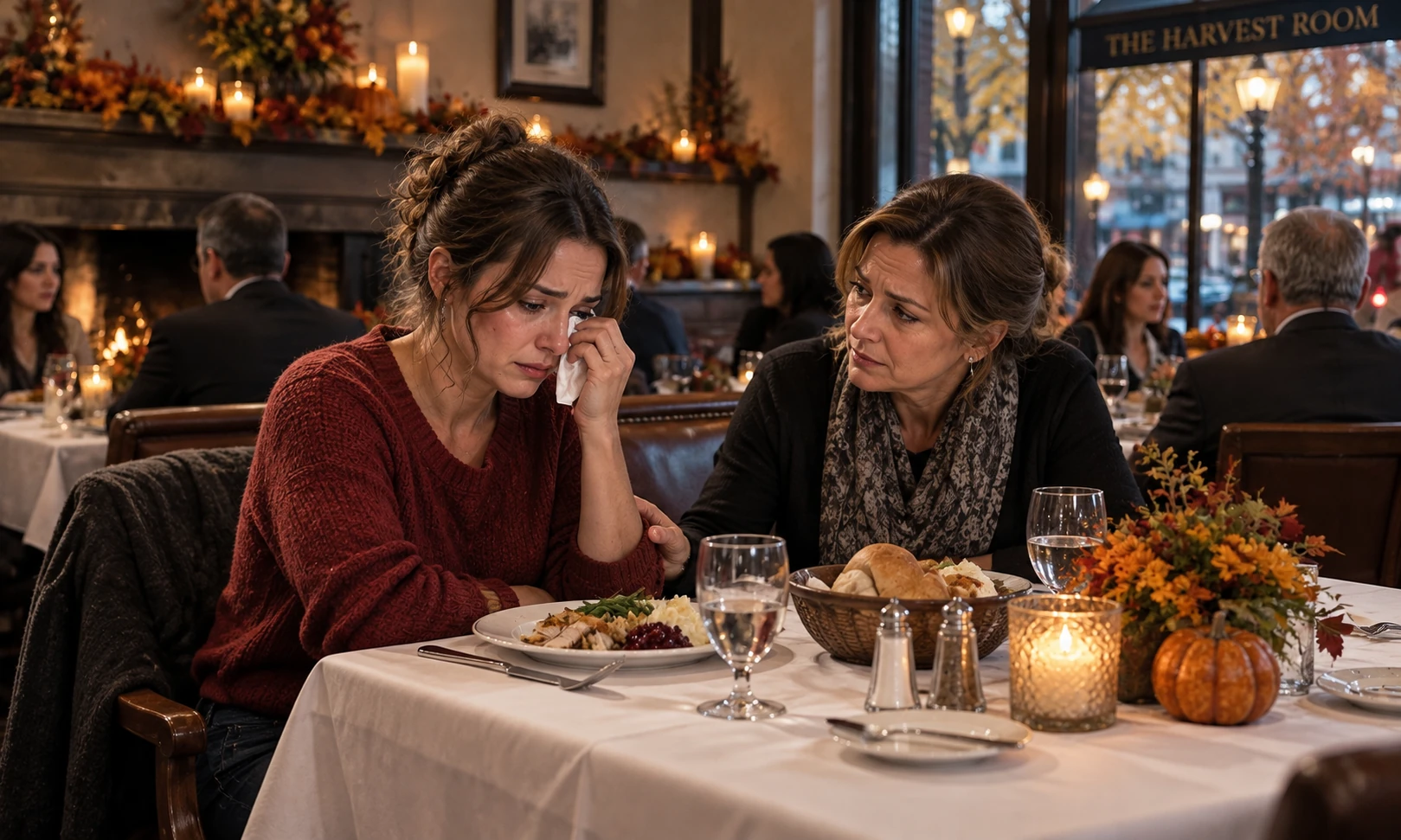
“Because five years ago,” I said softly, “I ate Thanksgiving dinner alone because my family decided my absence would make everyone happier.”
My mother’s eyes filled with tears.
“And a stranger noticed.”
She looked toward Margaret.
“She didn’t ask me what I had done wrong.”
I swallowed.
“She just gave me a chair.”
My father lowered his eyes.
I continued.
“And that chair became a home.”
No one spoke.
Then Margaret walked over.
She didn’t say anything.
She simply stood beside me.
My mother looked at her.
“I didn’t know,” she whispered.
Margaret answered gently.
“You didn’t have to know.”
My mother looked at me again.
“Can I still be your mother?”
That was the hardest question anyone had ever asked me.
Because the answer wasn’t simple.
I could forgive her.
But forgiveness didn’t mean pretending nothing happened.
So I told her the truth.
“You can be my mother if you want to know me.”
She started crying.
“What does that mean?”
“It means you can’t only love the version of me that stays quiet.”
My father looked at me.
“And me?”
I looked at him.
“You can be my father if you stop standing in the middle.”
He nodded slowly.
For the first time in my life, he didn’t defend himself.
He didn’t explain.
He simply said,
“I’m sorry.”
And somehow, that was enough for that night.
Not because it erased five years.
Not because it repaired my childhood.
But because I finally understood something.
The greatest revenge wasn’t making them regret losing me.
It was becoming someone who no longer needed them to regret it.
Later that night, when the music started again, Margaret pulled me onto the dance floor.
“You know,” she whispered, “I still think Peter’s pie was responsible for all of this.”
I laughed.
“Definitely not.”
Peter appeared behind us.
“I heard that.”
“You should have.”
He smiled.
Then he raised his glass.
“To chairs.”
I laughed.
“To chairs.”
And standing there beneath the warm lights, surrounded by people who had chosen me without obligation, I finally understood what Thanksgiving had been trying to teach me five years earlier.
Sometimes the family you are born into gives you your name.
Sometimes the family you find gives that name meaning.
And sometimes the most important moment in your life begins with an empty chair.
Because if that chair had never been empty…
I might never have discovered who was willing to make room for me.
And I would have spent the rest of my life begging people to love me…
when there were already people waiting to do it freely.
PART 4
The wedding reception had ended, but for me, the real ending had not.
The last guests were leaving when my mother found me near the entrance.
“Claire?”
I turned.
She was holding the wedding program against her chest.
For a moment, neither of us spoke.
Then she said something I never expected to hear.
“I want to know what happened after that Thanksgiving.”
I frowned.
“What do you mean?”
“I want to know everything.”
She looked toward the empty ballroom.
“Not because I want to defend myself. I think I’ve spent my whole life defending myself.”
Her voice broke.
“I want to understand how I lost my daughter.”
I didn’t answer immediately.
Then I said, “You didn’t lose me that day.”
She looked at me.
“You lost me slowly.”
Her eyes filled with tears.
“But I found myself slowly, too.”
She nodded.
And that night, for the first time, we sat together without Rachel in the room.
No competition.
No comparison.
No excuse.
Just two women trying to understand five years of silence.
I told her about Margaret.
About Sunday dinners.
About the first time someone remembered my favorite dessert.
About the promotion.
About my condo.
About Daniel.
About all the little moments when I realized I didn’t have to earn a place at someone’s table.
My mother cried through most of it.
When I finished, she whispered, “I didn’t know you were so lonely.”
“I told you.”
“I know.”
She wiped her eyes.
“But I didn’t listen.”
That sentence mattered.
Because an apology without acknowledgment is often just another way of asking someone to move on.
This one was different.
She knew what she had done.
My father joined us later.
He sat beside my mother.
For once, he didn’t let her speak for him.
“I was a coward,” he said.
I looked at him.
He continued.
“I told myself keeping peace was kindness.”
He shook his head.
“But I was only keeping peace for myself.”
I didn’t forgive him immediately.
I didn’t need to.
Forgiveness isn’t a door someone else gets to unlock.
It’s something you decide when you’re ready.
But I reached across the table and took his hand.
Not because everything was fixed.
Because maybe it could be.
Over the next year, things changed slowly.
There were no miracles.
Rachel didn’t suddenly become my best friend.
My mother didn’t become perfect.
My father didn’t magically turn into the father I had wanted as a child.